Key performance
Technical specifications
Engine
- Displacement
- 998 cc
- Power
- 200.0 ch @ 13500 tr/min (147.1 kW)
- Torque
- 112.8 Nm @ 11500 tr/min
- Engine type
- 4 cylindres en ligne, 4 temps
- Cooling
- liquide
- Compression ratio
- 13 : 1
- Bore × stroke
- 79 x 50.9 mm
- Valves/cylinder
- 4
- Camshafts
- 2 ACT
- Fuel system
- Injection
Chassis
- Frame
- périmétrique Diamond en aluminium
- Gearbox
- boîte à 6 rapports
- Final drive
- Chaîne
- Front suspension
- Fourche téléhydraulique inversée Ø 43 mm, déb : 120 mm
- Rear suspension
- Mono-amortisseur, déb : 120 mm
Brakes
- Front brakes
- Freinage 2 disques Ø 320 mm, fixation radiale, étrier 4 pistons
- Rear brakes
- Freinage 1 disque Ø 220 mm, étrier simple piston
- Front tyre
- 120/70-17
- Rear tyre
- 190/55-17
Dimensions
- Seat height
- 855.00 mm
- Fuel capacity
- 17.00 L
- Weight
- 199.00 kg
- Dry weight
- 179.00 kg
- New price
- 18 999 €
Overview
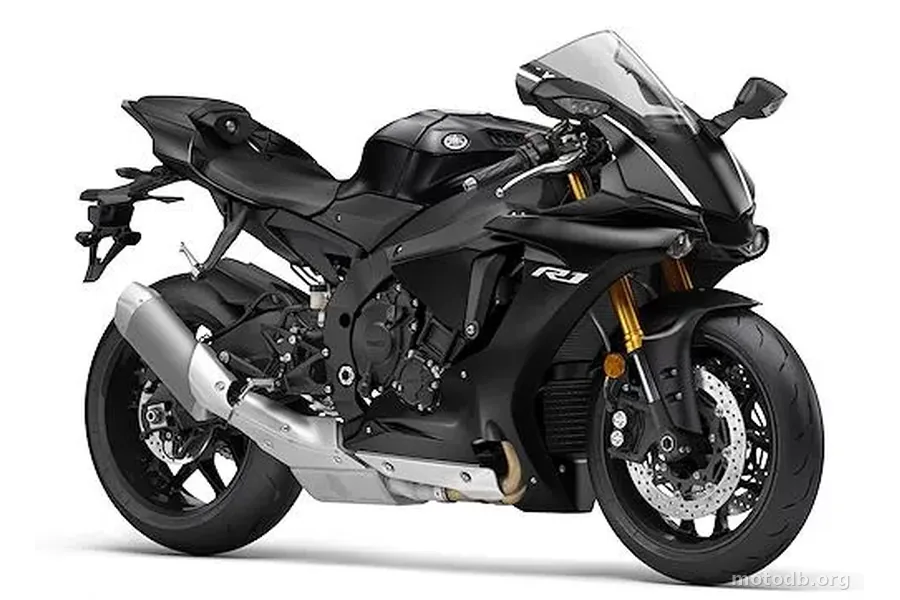
Imagine a machine that dreams only of racing, a motorcycle where every gram and every line is dedicated to track asphalt. The 2018 Yamaha YZF-R1 1000 is exactly that. It’s not meant for leisurely cruising or seduction with voluptuous curves; it’s here to dominate. With 200 horsepower delivered at 13,500 rpm, it asserts its place among the monsters of the hypersport category, facing rivals like the BMW S 1000 RR or the Kawasaki ZX-10R. This power is the result of intensive work on the celebrated Crossplane engine, a powerplant that since 2009 has revolutionized feel with its unique growl and MotoGP-derived traction. To achieve these 200 hp, Yamaha has utilized noble materials, such as titanium connecting rods, and pushed compression to 13:1. The result is an engine that breathes racing, with an intake inspired by the M1 and a sound that remains a thrill with every acceleration.
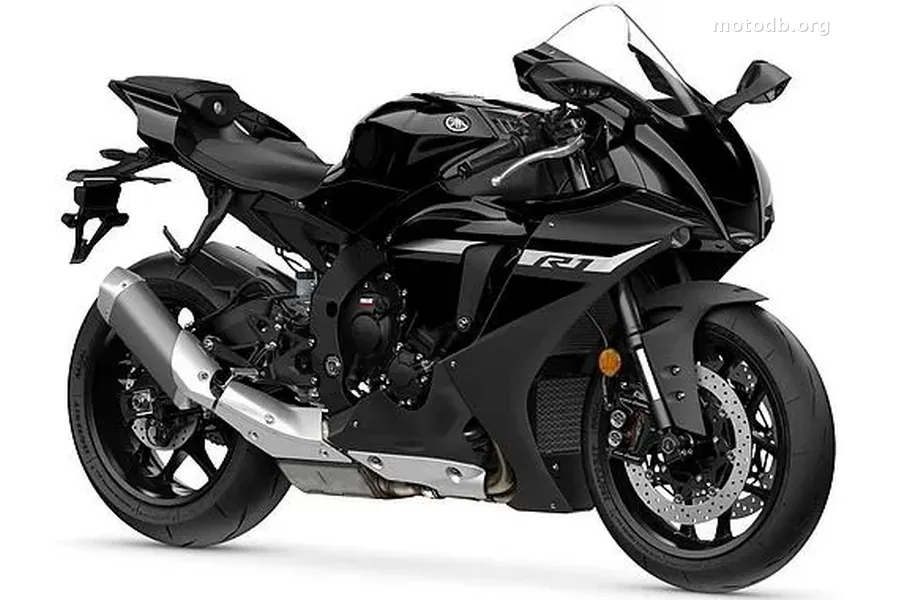
But today, raw horsepower is no longer enough. It must be mastered. And the 2018 R1 is a veritable electronic control unit. Its key asset is the IMU, a 6-axis sensor that analyzes every movement of the motorcycle in real time. This enables traction control and a wheelie control system of surgical precision, as well as a launch control system for lightning-fast starts. The rider can customize the machine via four YRC riding modes and four engine maps. The interface is a color TFT screen that alternates between a practical road mode and a track mode focused on the stopwatch. It’s an army of silicon that ensures raw power is transformed into effective and safe performance.
To support this potential, the chassis has been redesigned. The aluminum Deltabox frame uses the engine as a structural element, while the swingarm adopts a new, more rigid design. The quest for lightweight construction has been radical, with magnesium wheels and a lighter fuel tank, allowing a dry weight of 179 kg to be achieved. The geometry is shorter, the wheelbase reduced by 10 mm, for enhanced agility. KYB suspension components are fully adjustable, and braking moves to radial 4-piston calipers on 320 mm discs, with braided hoses and an integral ABS. Everything is done so that the rider feels the machine, directs it with precision, and exploits every watt.
So, who is this R1? It is the ultimate weapon of the serious track rider, one who seeks pure performance and cutting-edge technologies. It’s not gentle, nor easy. Its 855 mm seat height is high, and its 17-liter fuel tank reminds you that it’s not a road bike. At nearly 19,000 euros, it positions itself as an investment for those who live for the track. Compared to its predecessors, such as the 2009 YZF-R1 1000, which displayed approximately 180 horsepower, or even the 2010 version, this evolution is massive. It has nothing of the accessible sportbike, it is a prototype for the road. Opinions on previous models, like the 2002 or 2009 R1, often highlighted its unique character but sometimes its lack of power compared to the competition. The 2018 restores the balance.
Its current price positions it at the top of its class. To find a 2016 YZF-R1 1000 in France, the budget will naturally be lower, but the essential technology, notably the IMU, has been present since 2015. This motorcycle is not a compromise. It is abrupt, technical, and demanding. It doesn’t caress you, it challenges you. If you are looking for a sportbike that makes you feel like a track rider every time you turn the key, it might be your machine. But if you also want style, sensuality, or easy urban use, look elsewhere. The R1 has chosen its camp: absolute performance, without embellishment.
Standard equipment
- Assistance au freinage : ABS de série
Practical info
- La moto est accessible aux permis : A
Reviews & comments
No reviews yet. Be the first to share your opinion!