Key performance
Technical specifications
Engine
- Displacement
- 998 cc
- Power
- 182.0 ch @ 12500 tr/min (133.9 kW)
- Torque
- 107.9 Nm @ 10000 tr/min
- Engine type
- 4 cylindres en ligne, 4 temps
- Cooling
- liquide
- Compression ratio
- 12.7:1
- Bore × stroke
- 78 x 52.2 mm
- Valves/cylinder
- 4
- Camshafts
- 2 ACT
- Fuel system
- Injection Ø 45 mm
Chassis
- Frame
- Deltabox en aluminium
- Gearbox
- boîte à 6 rapports
- Final drive
- Chaîne
- Front suspension
- Fourche téléhydraulique inversée Ø 43 mm, déb : 120 mm
- Rear suspension
- Mono-amortisseur, déb : 120 mm
Brakes
- Front brakes
- Freinage 2 disques Ø 310 mm, fixation radiale, étrier 6 pistons
- Rear brakes
- Freinage 1 disque Ø 220 mm, étrier simple piston
- Front tyre
- 120/70-17
- Rear tyre
- 190/55-17
Dimensions
- Seat height
- 835.00 mm
- Fuel capacity
- 18.00 L
- Weight
- 206.00 kg
- New price
- 15 999 €
Overview
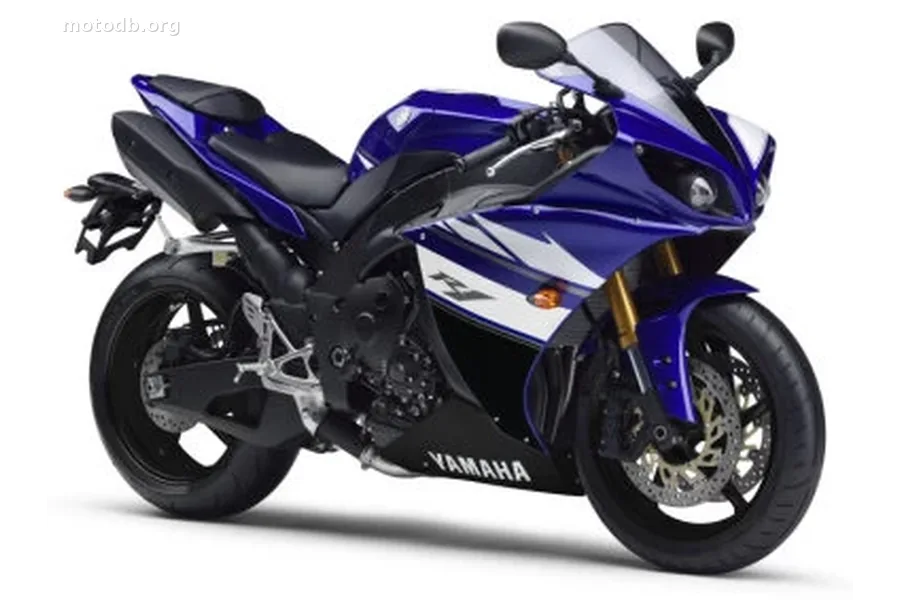
The question is worth asking: what remains to be invented on a Japanese hypersport in 2009, after a decade of horsepower chasing? Yamaha responds with a stroke of mechanical genius by setting the crankshaft of its YZF-R1 at 90 degrees. It’s no longer simply about chasing horsepower, but about an obsessive quest for sensation and traction. With 182 horsepower at 12,500 rpm, the beast hasn’t gained a plethora of power compared to its predecessors, such as the YZF-R1 1000 of 2006 or 2010, which already boasted similar figures. No, the revolution lies elsewhere, under the 18-liter fuel tank. This asymmetrical engine, with a sound that cracks like a MotoGP, delivers its power with a disconcerting linearity. The torque, 107.9 Nm, is felt at lower revs, but above all, it is predictable. The rider finally feels what the rear tire is doing, a direct connection that transforms corner exits into moments of pure grace. Faced with more conventional Suzuki GSX-R1000 or Honda CBR1000RR models, the R1 plays in a different league, the league of feel.
However, opening the wallet cools enthusiasm somewhat. At its launch, the bill was approaching 15,300 euros, a price that made even the most loyal cough. If you are looking for the price of a Yamaha YZF-R1 1000 of 2016 in France, know that this 2009-2014 generation marked a technological, but also economic, milestone. The cost of entry into the big leagues has soared. Compared to the price of a YZF-R1 1000 of 2007 in France, the difference is noticeable. Yamaha justifies this with a plethora of innovations: the revised Deltabox chassis, a separate function fork, an anti-dribble clutch, and the now-famous YCC-T. The announced weight of 206 kg fully fueled may seem high, but it includes fluids, a more honest measure than the dry weight standard. On the road, this mass is quickly forgotten thanks to a controlled center of gravity and a riding position that remains demanding, with a seat at 835 mm.
So, who is this machine for? Certainly not a beginner. It’s the ultimate weapon of the demanding road-racer, the one who seeks emotion as much as the stopwatch time. It forgives more than an Aprilia RSV4 Factory, thanks to its less savage power delivery, but demands finesse. Opinions on the Yamaha YZF-R1 1000 2009 agree on its unique character, even if some purists criticized its somewhat massive rear end and fuel consumption, which, like all hypersportives, can become voracious when using its power. Ask an owner about the average fuel consumption of a Yamaha YZF-R1 1000 Factory Superbike 2009, and he will tell you mostly about a smile on his face, not about the number of liters.
Ultimately, this R1 is not just a simple evolution. It’s a change of philosophy. It proves that the hypersport war is not won solely on the dyno, but in the way of transmitting the madness of its 998 cm3 engine to the asphalt. It has aged, certainly, but its soul, forged by this engine with an inimitable sound, remains a grail for those who believe that technology must serve sensation. A mechanical myth, to be cherished and ridden with respect.
Practical info
- La moto est accessible aux permis : A
Reviews & comments
No reviews yet. Be the first to share your opinion!