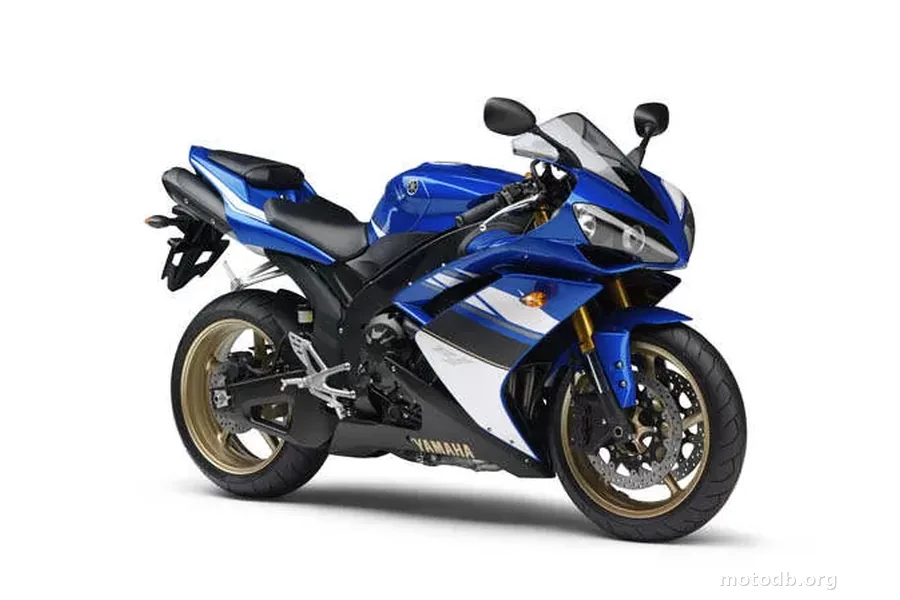
Key performance
Technical specifications
Engine
- Displacement
- 998 cc
- Power
- 180.0 ch @ 12500 tr/min (132.4 kW)
- Torque
- 107.9 Nm @ 10500 tr/min
- Engine type
- 4 cylindres en ligne, 4 temps
- Cooling
- liquide
- Compression ratio
- 12.7:1
- Valves/cylinder
- 4
- Camshafts
- 2 ACT
- Fuel system
- Injection
Chassis
- Frame
- deltabox V double poutre en alu
- Gearbox
- boîte à 6 rapports
- Final drive
- Chaîne
- Front suspension
- Fourche téléhydraulique inversée Ø 43 mm, déb : 120 mm
- Rear suspension
- Suspension AR monoamortisseur, déb : 130 mm
Brakes
- Front brakes
- Freinage 2 disques Ø 310 mm, fixation radiale, étrier 6 pistons
- Rear brakes
- Freinage 1 disque Ø 220 mm, étrier 2 pistons
- Front tyre
- 120/70-17
- Rear tyre
- 190/50-17
Dimensions
- Seat height
- 835.00 mm
- Fuel capacity
- 18.00 L
- Dry weight
- 177.00 kg
- New price
- 13 790 €
Overview
Is continuous evolution a hallmark of the Japanese sportbike? Yamaha answers with this fifth generation of YZF-R1, where stylistic evolution hides a mechanical revolution. The design, still recognizable, has become more angular, the air intakes are closer to the headlights, and the silhouette gains aggressiveness. This is a machine whose price, in 2007, was around €13,790. A sum justified by the profound technical overhaul.
The engine, still a 998 cc inline four-cylinder, sees its cylinder head change from five to four valves per cylinder. Compression ratio increases to 12.7:1, and titanium intakes appear. Announced power is 180 horsepower at 12,500 rpm, with torque of 107.9 Nm at 10,500 rpm. But the real novelty is YCC-I, a variable intake duct system whose length oscillates between 65 and 140 mm depending on the engine speed. At low speeds, the long ducts favor torque and responsiveness; at high speeds, the short ducts unleash the full potential. Coupled with YCC-T, which modulates throttle opening, the engine offers remarkable progressiveness. The power is there, massive, but its unveiling is smoothed, almost polished by electronics. This is a radically different approach compared to the brute GSX-R 1000 of the time.
The chassis follows the logic: stiffness increased by 30%, reinforced swingarm, 43 mm inverted fork. The brakes mark a step forward with radial six-piston calipers on 310 mm discs at the front. The weight, however, has slightly increased, the machine returning to its 1998 weight, around 177 kg dry. On the road, this is not felt. The 2007 R1 is disconcertingly easy, with a balance that completely masks its mass. Braking is authoritative, the chassis responds with the precision of a track machine. It inspires immediate confidence, pushing the rider to seek their limits – which are very, very far.
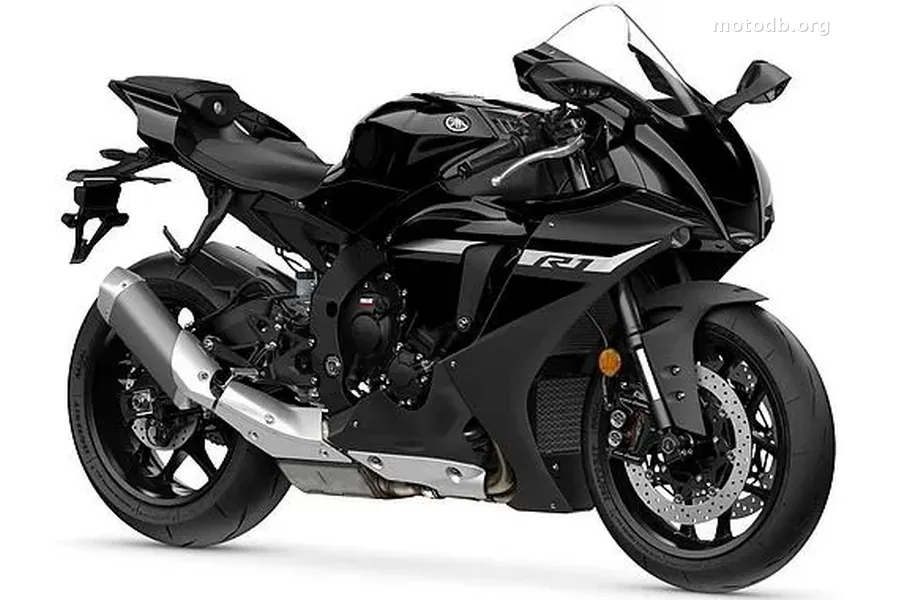
This 2007 Yamaha YZF-R1 1000 is no longer simply a hypersportbike. It is a competition weapon, where technology serves to tame explosive power. On the road, its potential is largely untapped; on the track, it becomes a precision instrument. The audience? The experienced track rider, the one who seeks absolute efficiency more than raw sensation. Faced with the GSX-R 1000, more immediate and less sophisticated, the R1 plays the card of electronic intelligence. An approach that divides: some will regret the dominance of microprocessors, others will applaud the gains in regularity and safety. To know how many horsepower the 2006 or 2010 Yamaha YZF-R1 1000 has, you must refer to the specifications of each year, because this 2007 evolution marks a technological leap. As for its price today, it depends on the condition and the collectors' market.
Ultimately, this R1 is a concentrate of know-how. It is not the lightest, nor the simplest, but it is probably the most technically advanced of its generation. A tool for those who want to tame 180 horsepower with finesse, rather than simply endure them.
Practical info
- La moto est accessible aux permis : A
Reviews & comments
No reviews yet. Be the first to share your opinion!