Key performance
Technical specifications
Engine
- Displacement
- 998 cc
- Power
- 200.0 ch @ 13500 tr/min (147.1 kW)
- Torque
- 112.8 Nm @ 11500 tr/min
- Engine type
- 4 cylindres en ligne, 4 temps
- Cooling
- liquide
- Compression ratio
- 13 : 1
- Bore × stroke
- 79 x 50.9 mm
- Valves/cylinder
- 4
- Camshafts
- 2 ACT
- Fuel system
- Injection
Chassis
- Frame
- périmétrique Diamond en aluminium
- Gearbox
- boîte à 6 rapports
- Final drive
- Chaîne
- Front suspension
- Fourche téléhydraulique inversée Ø 43 mm, déb : 120 mm
- Rear suspension
- Mono-amortisseur, déb : 120 mm
Brakes
- Front brakes
- Freinage 2 disques Ø 320 mm, fixation radiale, étrier 4 pistons
- Rear brakes
- Freinage 1 disque Ø 220 mm, étrier simple piston
- Front tyre
- 120/70-17
- Rear tyre
- 190/55-17
Dimensions
- Seat height
- 855.00 mm
- Fuel capacity
- 17.00 L
- Weight
- 199.00 kg
- Dry weight
- 179.00 kg
- New price
- 18 499 €
Overview
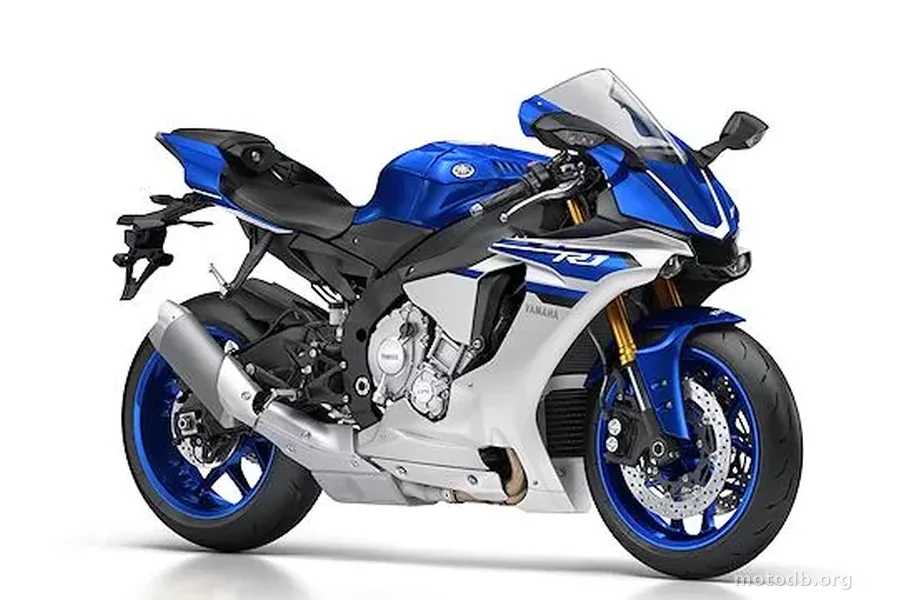
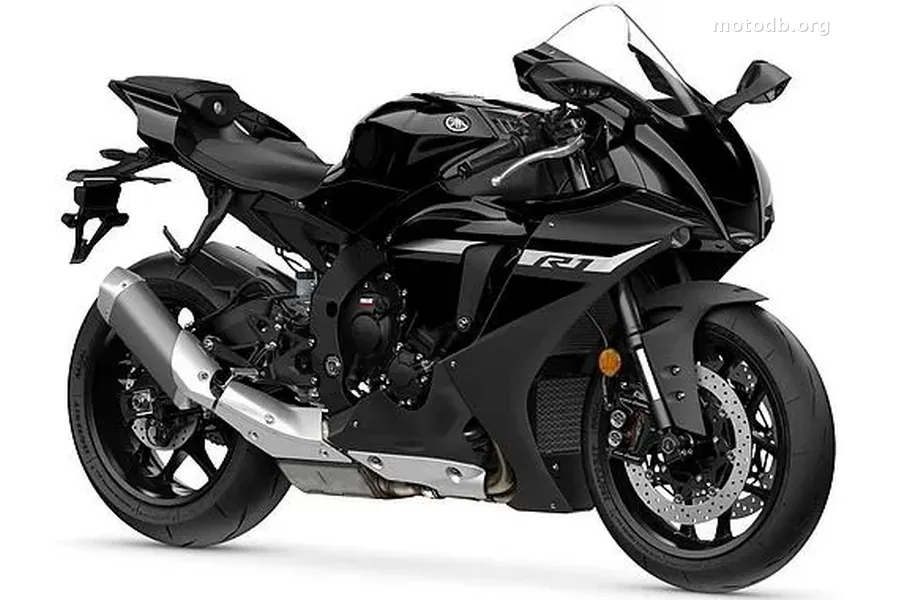
So, what remains of a legend when it decides to transform into a purely functional machine? In 2016, Yamaha took the YZF-R1 and subjected it to a radical process of abstraction. The result is a motorcycle that seems to have escaped from the garage of a MotoGP team, with a face reduced to a simple slit and a silhouette stripped of all frivolity. It no longer seeks to seduce; it clearly announces its intention: to dominate. The era of voluptuous lines and ambiguous charm is closed. Make way for a war machine.
To compete with the BMW S 1000 RR and Ducati 1299, an atomic response was needed. Yamaha therefore extracted 200 horsepower from its 998 cm3 engine, a figure that marks a return to the top after years when power stagnated around 180 hp. This performance surge comes from a fundamental overhaul: compression ratio increased to 13:1, titanium connecting rods, a new crankshaft. The famous cross-plane timing, with its distinctive growl and linear driveability, remains the emotional heart of the machine. But here, it is now coupled with a new voracity, capable of propelling the motorcycle to stratospheric speeds.
Managing 200 horsepower on a chassis weighing less than 200 kg fully fueled requires an omnipotent electronic governance system. The 2016 R1 then becomes a pioneer with its IMU, a 6-axis inertial sensor. This brain oversees everything: traction control that adapts to the lean angle, a wheelie control system to calm impulsive wheelies, and even a launch control for standing starts. The rider navigates between four power maps and four riding modes via a TFT dashboard as sophisticated as a Panigale’s. It is a motorcycle that thinks, that calculates, that anticipates.
The Deltabox frame has been redesigned to be more compact, with a shorter wheelbase, and the mechanics use noble materials such as magnesium for the wheels. The KYB 43 mm fork and the radial monoblock 4-piston braking system are serious equipment, but they also highlight a positioning: this R1 is a base, a platform. For those who want the ultimate, you will need to turn to the R1M with its electronic Öhlins. For the price of a 2016 Yamaha YZF-R1 1000 in France, around €18,499, you get this hyper-technological machine, but without the high-end finishes that distinguish some competitors.
This generation of R1 is a gamble. Yamaha has sacrificed a part of its stylistic identity to become an absolute technological reference. It targets the purebred racer, the one who wants a production machine as close as possible to a race prototype. It is less accessible, less obvious to grasp than a previous 2009 R1, for example. But it is also more determined, more capable. It doesn’t caress you; it challenges you. And on a circuit, with its 200 horsepower and its omniscient electronics, it is probably one of the most efficient machines you can ride. It is a motorcycle of conviction, not compromise.
Standard equipment
- Assistance au freinage : ABS de série
Practical info
- La moto est accessible aux permis : A
Reviews & comments
No reviews yet. Be the first to share your opinion!