Key performance
Technical specifications
Engine
- Displacement
- 1103 cc
- Power
- 216.0 ch @ 13500 tr/min (158.9 kW)
- Torque
- 120.9 Nm @ 11250 tr/min
- Engine type
- 4 cylindres en L à 90°, 4 temps, calage de type Twin Pulse - 0° - 90° - 290° - 380°
- Cooling
- liquide
- Compression ratio
- 14 : 1
- Bore × stroke
- 81 x 53.5 mm
- Valves/cylinder
- 4
- Camshafts
- 2 ACT
- Fuel system
- Injection Ø 52 mm
- Starter
- électrique
- Euro standard
- Euro 5+
Chassis
- Frame
- semi-périmétrique en aluminium
- Gearbox
- boîte à 6 rapports
- Final drive
- Chaîne
- Front suspension
- Fourche téléhydraulique inversée Ø 43 mm, déb : 125 mm
- Rear suspension
- Mono-amortisseur, déb : 130 mm
Brakes
- Front brakes
- Freinage 2 disques Brembo Ø 330 mm, fixation radiale, étrier 4 pistons (Hypure)
- Rear brakes
- Freinage 1 disque Brembo Ø 245 mm, étrier 2 pistons
- Front tyre
- 120/70-17
- Rear tyre
- 200/60-17
Dimensions
- Seat height
- 850.00 mm
- Seat type
- Selle biplaces
- Fuel capacity
- 17.00 L
- Weight
- 191.00 kg
- New price
- 28 190 €
Overview
The flashes aren't white or yellow or blue; they're red. They don't tear through the sky but conquer the racetrack. That rumble in the ether isn's the sound of air slicing through, but of a large 4-cylinder engine bellowing its horde of horsepower. This excessive and obsessive torment bears a name: Ducati Panigale V4.
Ducati presents the latest version of its sportbike; its hypersportbike. Appearing in 2018 with a bang and sublimation, the beauty shook all the conventions established by decades of twins. Perpetually seeking performance, the motorcycle takes a new step, where emotion is tested for every sense.
The Panigale V4 is in its 4th generation (and the 7th generation of Superbike). Each has brought its share of evolutions without significant upheaval. The tone is bolder. The new chapter has decided to give a new look to its Superbike, with this breath of grace, rage and fire recognizable at the first glance.
Ducati claims, as always, that the lines of its latest creation are directly inspired by the 916. It's true, both are red, and each of their wheels are round…..Aside from the fact that the brand cultivates its communication and its aristocratic history, it’s difficult to question its ability to produce beautiful motorcycles. And this one effortlessly joins the long list of divine and sensual Italian sportbikes. The face it has worn since its debut transforms with more tapered eyes, without exuberant cavities but retaining that instinct of menace and provocation. The wings are now painted, integrating better into the silhouette, while the fairing flanks are redesigned with much more simplicity. The ventilation outlets are cut with sharp strokes, in cleaner, more open lines.
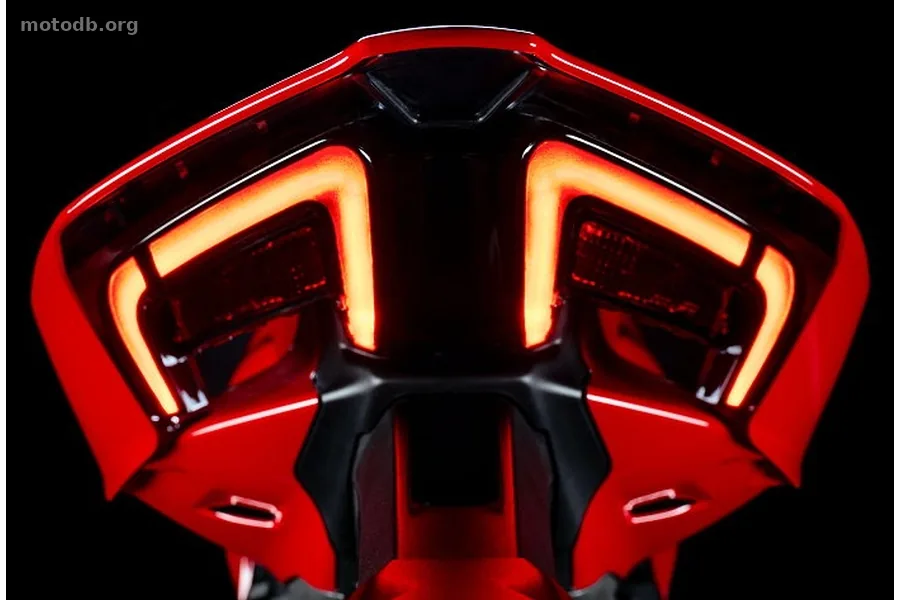
The junction between the shoulders, the holes in the front fender, and the MONOBRAS have disappeared. Its posterior, still alluring, splits the headlight into two entities. The integration of the exhaust into a triangle seems to have been a little more complicated this time. And then, notice the branches of the mirrors. They no longer rest on the face of the motorcycle but curve around the headstock – so that it doesn’t visually suffer from any appendage… or any cover to be removed when all the road equipment is taken off to go on the track. The ergonomics have progressed to allow for better rider movement on the machine. The footpegs are new, as are the wheels, and the throttle control (from the V4 R).
Let’s get straight to what’s going to fuel the debates, heated and technical. Yes, the Panigale V4 abandons its monobras. It’s not the first time that Bologna’s SBKs have made this deviation from the sublime. The 999/749 did it to us, so did the 899 and 959 Panigale. But why? For efficiency, even if it disappoints some. But this time, the double-arm swingarm is surprising in its form. It is made up of strong sections with gaping recesses. Its design has allowed for a reduction of 37% in lateral stiffness, to improve traction and sensations. 16 mm longer, it increases the wheelbase to improve traction and stability.
It has to go fast! Its stylistic overhaul goes hand in hand with aerodynamic improvement, allowing for 4% less rolling resistance. Cooling is also optimized, as is rider protection. As for the winglets, their downforce is the same as the previous model. And to go from corner A to corner B, and then all the others as quickly as possible, the Panigale V4 relies on its 1103 cm3 V4, refined for the occasion. This very powerful engine, drawing on its high displacement and MotoGP-derived technology, gains a small half-horsepower at a 500 rpm higher regime, 13,500 rpm. The engine sends 216 horsepower; or even 228 horsepower and 127.8 Nm when fitted with the Akrapovic complete exhaust. But the essential thing wasn’t to find watts. Rather, a general improvement. To pass Euro5+, gain a kilo on the entire engine, reduce its inertia – for this, camshafts, transmission and distribution components, alternator and oil pump rotor, and gearbox drum are modified.
Let's recall that this engine has a crankshaft rotating in the opposite direction, double-segment pistons, bore values identical to the GP Desmosedici, desmodromic valve timing, variable-length intake trumpets (retouched for the 2025 version), two injectors per 52 mm throttle body, automatic rear cylinder cutoff at idle when it starts to heat up, a “Twin Pulse” ignition with 0°-90°-290°-380°, and 12.3 kgm of torque (slightly down, by 0.3 kgm).
Ducati has abandoned the tubular steel trellis frame for its sportbikes for a long time. On the Panigale V4, the aluminum “Front Frame” semi-perimeter structure is modified to lose weight (730 grams) and lateral stiffness (-40%). Strange, isn't it, this part of the chassis that twists more, after years and years of stiffening chassis?! Not really. The manufacturer wants to give more feeling to the rider and make the chassis work more when the suspensions are under stress. Increasingly efficient tires and the sick performances achieved by current sportbikes require a revision of certain technical approaches.
Its suspensions evolve little, Ducati renewing its trust in the 43 mm Showa BPF upside-down fork as well as the Sachs rear shock absorber, both adjustable in all directions. A Sachs steering damper is also retained. The only evolution is an increase in front travel by 5 mm. As usual, Ducati reserves top-of-the-line equipment for the S version, with Öhlins controlled elements.
Bologna’s sportbikes are often the first to adopt new technology. Brembo brakes are now equipped with a new Race eCBS system, which offers a more precise and controlled braking feel.
The new 1100 Panigale V4 is part of those motorcycles that put your senses on a boil at every moment spent with it. The desire when looking at it, the heart that rises with each acceleration, the adrenaline that pulses at the point of the corner, the force that is extracted from the body during braking, and the mouth that opens when the price tag falls on the table.
In 8 years, its price has increased by 24% while it has gained in “ease” of riding and aerodynamics, gaining a few seconds in the process. But the Panigale does not offer carbon fiber parts, a beautiful open fork or refined parts that can be found with the competition. Nevertheless, and more than ever, the Panigale V4 wants to be the most phantasmagorical sportbike on the market. Reasonable? Surely not. And that’s what the public wants.
The different riding modes of the Ducati 1100 Panigale V4 ’25: “Race: A” - The Race A riding mode offers the rider all the power of the engine (216 hp) with a direct response from the Ride by Wire system at throttle opening (High Power mode). The Race A mode by default offers a non-intrusive electronic setting, designed for track riding, with the Race eCBS system at level 1. “Race: B” - The Race B riding mode retains all the power of the engine with the High Power mode. The default electronic setting remains non-intrusive and designed for track riding, but with a less free DSC calibration (2 instead of 1) and with the Race eCBS at level 3. “Sport” - The “Sport” riding mode is associated by default with the medium power mode (maximum power of 216 hp and a more progressive response from the Ride By Wire system). The electronic controls are set to support the driver during sporty riding on the road. “Road” - The “Road” riding mode is recommended for riding on the road, especially when road surface conditions are not optimal. The RM offers the rider a power of 216 hp with a progressive response to the throttle opening (Medium Power Mode). “Wet” - The “Wet” riding mode is designed for riding on surfaces with low grip or on wet surfaces. The RM limits maximum power to 160 hp with a particularly smooth throttle response (Low Power Mode).
M.B - Manufacturer photos
Standard equipment
- Assistance au freinage : ABS
- Nombre de mode de conduite : 5
- Taille de l'écran TFT couleur : 17,53 cm / 6.9 pouces
- ABS Cornering
- Jantes aluminium
- Shifter
- Amortisseur de direction
- Indicateur de vitesse engagée
- Freinage combiné
- Aide au départ arrêté (Launch Control)
- Contrôle de traction
- Contrôle anti wheeling
- Contrôle de glisse
- Embrayage anti-dribble
- Centrale inertielle
- Contrôle du frein moteur
- Limitateur de vitesse dans les stands
Practical info
- La moto est accessible aux permis : A
- Pays de fabrication : Italie
Reviews & comments
No reviews yet. Be the first to share your opinion!