Key performance
Technical specifications
Engine
- Displacement
- 1103 cc
- Power
- 214.0 ch @ 13000 tr/min (156.2 kW)
- Torque
- 124.0 Nm @ 10000 tr/min
- Engine type
- V4, four-stroke
- Cooling
- Liquid
- Compression ratio
- 14.0:1
- Bore × stroke
- 81.0 x 53.5 mm (3.2 x 2.1 inches)
- Valves/cylinder
- 4
- Camshafts
- 2 ACT
- Fuel system
- Injection. Electronic fuel injection system. Twin injectors per cylinder. Full ride-by-wire elliptical throttle bodies.
- Valve timing
- Desmodromic valve control
- Starter
- Electric
Chassis
- Frame
- Aluminium alloy. Engine is used as a structural chassis element. Trellis subframe.
- Gearbox
- 6-speed
- Final drive
- Chain (final drive)
- Clutch
- Slipper and self-servo wet multiplate clutch with hydraulic control
- Front suspension
- Showa BPF 43mm fork
- Rear suspension
- Fully adjustable Sachs unit. Aluminium single-sided swingarm.
- Front wheel travel
- 120 mm (4.7 inches)
- Rear wheel travel
- 130 mm (5.1 inches)
Brakes
- Front brakes
- Double disc. ABS. Brembo
- Rear brakes
- Single disc. ABS. Brembo
- Front tyre
- 120/70-ZR17
- Front tyre pressure
- 2.30 bar
- Rear tyre
- 200/60-ZR17
- Rear tyre pressure
- 2.10 bar
Dimensions
- Seat height
- 835.00 mm
- Wheelbase
- 1469.00 mm
- Height
- 845.00 mm
- Fuel capacity
- 16.00 L
- Weight
- 198.00 kg
- Dry weight
- 175.00 kg
- New price
- 23 290 €
Overview
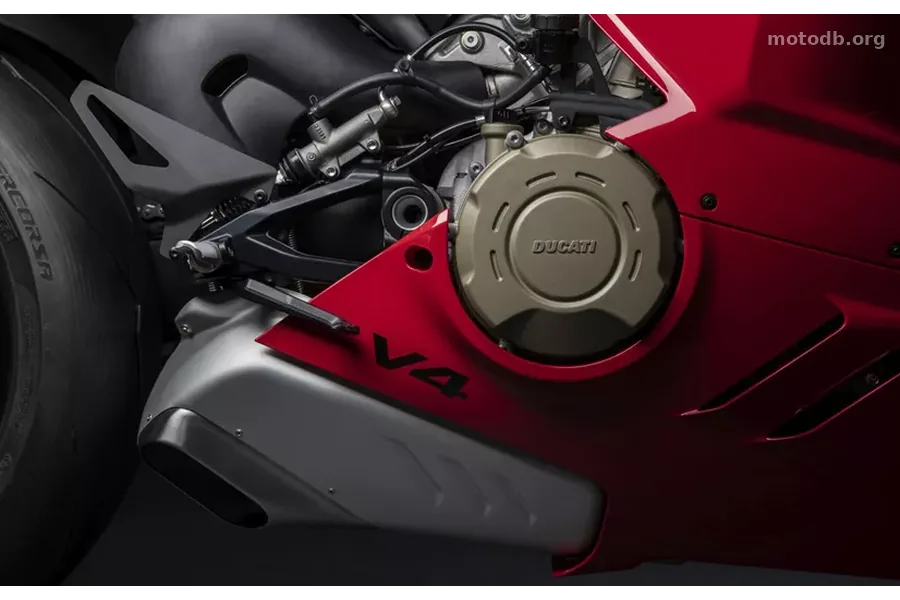
When Bologna decides to betray thirty years of tradition, it doesn’t do it halfway. Breaking with the twin-cylinder engine to embrace a 1103 cm3 V4 engine was the riskiest bet in recent Ducati history, and yet the Ducati Panigale V4 transformed this act of faith into a demonstration of power. The Desmosedici Stradale under the fairing delivers 214 horsepower at 13,000 rpm and 124 Nm of torque at 10,000 rpm. These figures don't fall from the sky: they result from a bore of 81 mm based on MotoGP regulations, a counter-rotating crankshaft to reduce gyroscopic effect, and a Twin-Pulse timing system that gives this V4 the temperament of a twin-cylinder engine. Facing the Yamaha R1 with its 200 horsepower, or the Aprilia RSV4 1100 Factory which responded with its own arguments, the Ducati Panigale V4 places the bar where no one can ignore it.
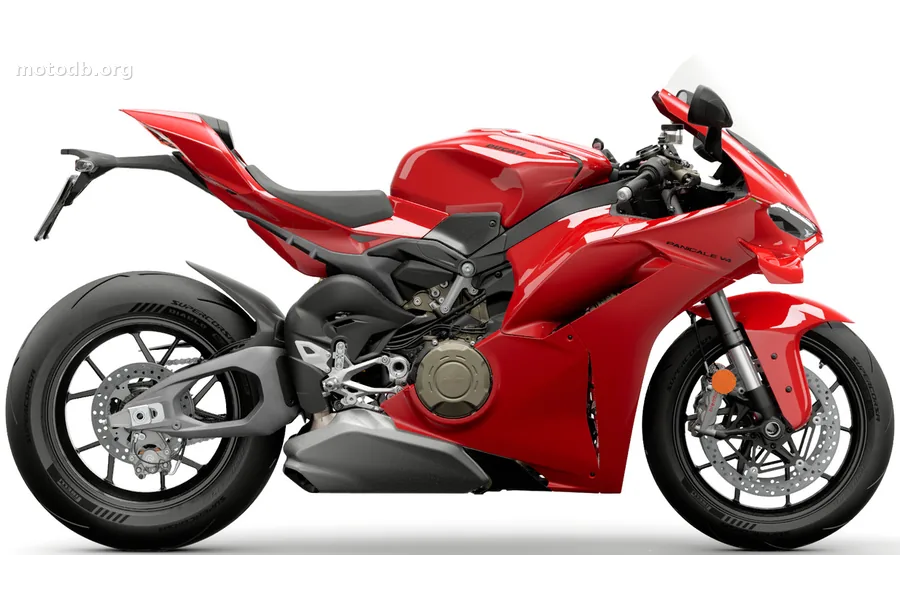
The 2020 version doesn’t simply reprise the recipe. It borrows the bodywork from the competition V4 R, with its winglets directly inspired by the paddock. These aerodynamic fins, made of glass fiber reinforced plastic and not carbon fiber as on the R, generate 30 kg of downforce at 270 km/h. It’s effective, but one might find it a little stingy for a machine priced at €23,290. The Ducati Panigale V4 price raises questions on this precise point: at this price, carbon fiber would have been welcome. The widened bodywork, 30 mm wider at the front, improves rider protection and hardens the profile, at the expense of a line purity that the previous generation mastered better. The suspensions have been recalibrated without being replaced: the Showa BPF 43 mm fork drops 4 mm, the Sachs shock shortens by 2 mm, the center of gravity rises by 5 mm. As a result, a more direct turn-in and reinforced stability at acceleration, without touching the steering geometry.
The chassis deserves attention. The aluminum frame weighs only 4 kg, integrating the engine as a structural element, a solution that allows reaching 175 kg dry and 198 kg fully fueled. This is the best power-to-weight ratio in the category, with 1.1 horsepower per kilogram. The aluminum monocoque swingarm, the Brembo Stylema calipers biting 330 mm front discs with the Bosch cornering ABS, the chain transmission on six gears: all this constitutes a coherent ensemble for a machine capable of reaching 300 km/h. The Ducati Panigale V4 top speed is not a marketing figure, it’s the logical consequence of this architecture.
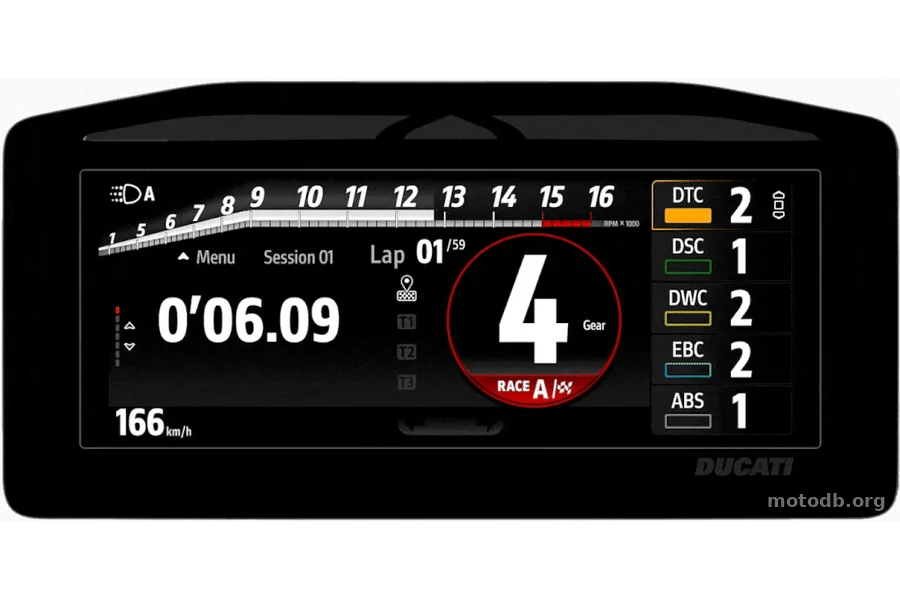
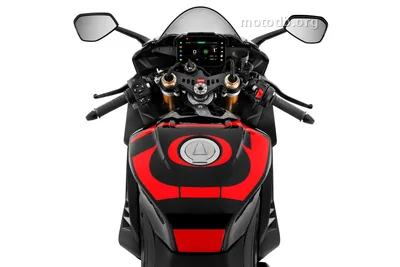
The onboard electronics form a block in their own right. The DTC EVO 2 traction control system communicates with the inertial platform to anticipate wheelspin before it occurs. The DQS EVO 2 shifter adapts its shift times according to the angle and load. Cornering ABS operates on three levels, from circuit setting to road setting. DWC monitors wheelies, DPL manages launch control on three intensities, EBC modulates engine braking according to the inclination. Three riding modes, Street, Sport and Race, customizable, complete the arsenal. The 5-inch TFT screen with its simulated tachometer and Track or Road displays finalizes a cockpit that effectively gives the impression of boarding a prototype homologated for the road. Those who want to push even further can turn to the Ducati Panigale V4 S with its semi-active Öhlins suspensions, to the V4 R for pure track use, or to the Ducati Panigale V4 Superleggera for those whose budget knows no ceiling.
What the Ducati Panigale V4 2020 represents is a hypersport built for the experienced rider who wants the track without giving up registration. It is not intended for beginners, nor really for Sunday afternoon cruisers. Its physical engagement level, its 835 mm seat height, its 6.9 l/100 km fuel consumption in measured use, all point to a specific profile: the track rider who accepts managing 198 kg of Bolognese steel under a Tuesday morning rain. Ducati Panigale V4 used models circulating today remain formidable machines, little depreciated, because the competition has yet to find a simple answer to this proposition. This is the hallmark of successful disruptions.
Standard equipment
- Assistance au freinage : ABS in curves
- Bluetooth
Practical info
- La moto est accessible aux permis : A
Reviews & comments
No reviews yet. Be the first to share your opinion!