Key performance
Technical specifications
Engine
- Displacement
- 1103 cc
- Power
- 216.0 ch @ 13500 tr/min (158.9 kW)
- Torque
- 120.9 Nm @ 11250 tr/min
- Engine type
- 4 cylindres en L à 90°, 4 temps, calage de type Twin Pulse - 0° - 90° - 290° - 380°
- Cooling
- liquide
- Compression ratio
- 14 : 1
- Bore × stroke
- 81 x 53.5 mm
- Valves/cylinder
- 4
- Camshafts
- 2 ACT
- Fuel system
- Injection Ø 52 mm
- Starter
- électrique
- Euro standard
- Euro 5+
Chassis
- Frame
- semi-périmétrique en aluminium
- Gearbox
- boîte à 6 rapports
- Final drive
- Chaîne
- Front suspension
- Fourche téléhydraulique inversée Ø 43 mm, déb : 125 mm
- Rear suspension
- Mono-amortisseur, déb : 130 mm
Brakes
- Front brakes
- Freinage 2 disques Brembo Ø 330 mm, fixation radiale, étrier 4 pistons (Hypure)
- Rear brakes
- Freinage 1 disque Brembo Ø 245 mm, étrier 2 pistons
- Front tyre
- 120/70-17
- Rear tyre
- 200/60-17
Dimensions
- Seat height
- 850.00 mm
- Seat type
- Selle biplaces
- Fuel capacity
- 17.00 L
- Weight
- 191.00 kg
- New price
- 27 990 €
Overview
When a motorcycle costs 27,990 euros, it had better justify every cent without hiding behind brochure arguments. The Ducati Panigale V4 2025 model doesn't justify itself. It asserts itself. The seventh generation of Superbike signed by Bologna, the fourth iteration of the V4, this machine carries on its redesigned flanks the weight of a direct lineage with MotoGP, and it makes that known from the first glance. The winglets integrated into the bodywork, now painted rather than bare, the more tapered headlights that retain that cold aggression typical of Italian sportbikes, the streamlined fairing flanks with their ventilation outlets traced with a scalpel. Visually, the artistic direction has chosen sobriety without ever veering into banality. It's a success.
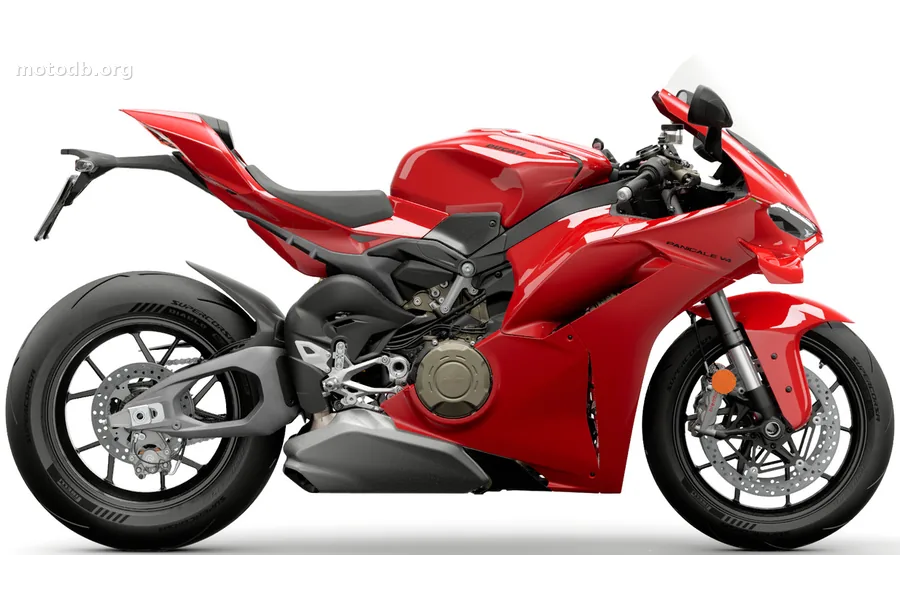
Under this reworked body, the 90-degree V-four cylinder engine with a displacement of 1,103 cm3 remains the heart of the matter. Twin Pulse timing, a counter-rotating crankshaft, desmodromic valve actuation, variable-length intake trumpets retouched for 2025, two injectors per 52 mm throttle body. This engine, derived from the Grand Prix Desmosedici, produces 216 horsepower at 13,500 rpm and 120.9 Nm at 11,250 rpm. For a motorcycle displaying a dry weight of 191 kg, the power-to-weight ratio requires no further comment. The top speed announced at 300 km/h is not a marketing value. It's a physical reality that few other production machines can claim to reach. With the complete Akrapovic exhaust system as an option, the horsepower figure rises to 228. At that point, we're talking about the track, not a commute. The public of the Ducati Panigale V4 is not mistaken.
The real structural novelty that will raise eyebrows is the abandonment of the monobras. Bologna has already made this choice on some models in the past, but here the double-branch swingarm adopts an unusual shape, hollowed out with large recesses, with a lateral stiffness reduced by 37% and an extension of 16 mm. The logic is consistent. Current tires, more effective than ever, transmit information that overly rigid chassis can no longer interpret. The semi-perimeter aluminum frame follows the same philosophy, lightened by 730 grams and softened by 40% in lateral flexion. This seems counterintuitive, but Borgo Panigale engineers have long known that feedback to the rider comes through a certain compliance of the structure. The 43 mm Showa BPF inverted fork retains the manufacturer's confidence, the front travel alone gaining 5 mm. The S version accesses electronically piloted Öhlins trains, and that's where the price gap with the base version begins to weigh.
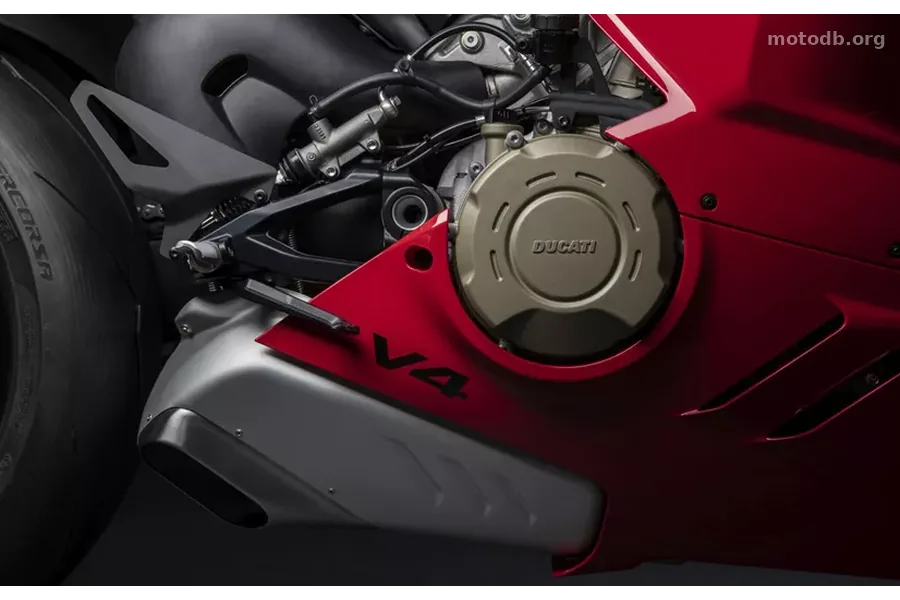
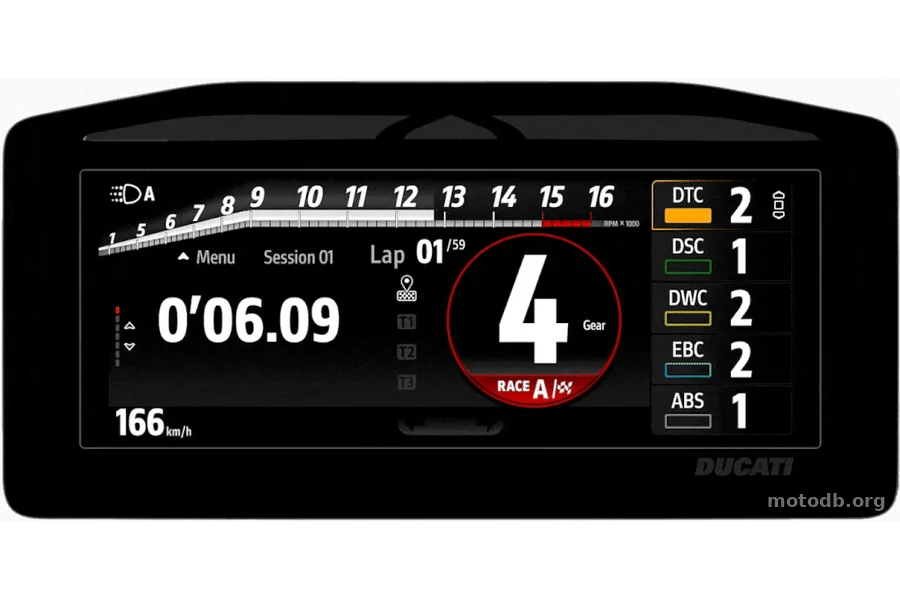
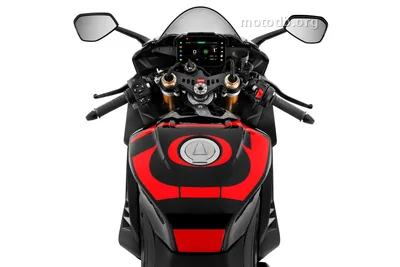
The braking system deserves a special mention. Four-piston Brembo Hypure calipers made of aluminum-silicon, clamping 330 mm discs, replace the Stylema, gaining weight and thermal dissipation. Coupled with the new Race eCBS, a system that automatically modulates rear caliper pressure based on lean angle and load, the braking performance of this Ducati Panigale V4 official technical specification does not really do justice to what the rider feels under their fingers. The Ducati Vehicle Observer algorithm, which simulates seventy sensors to refine traction and wheelie control, integrates into a complete electronic suite. Five riding modes, from the unobtrusive Race A designed for the circuit to the Wet mode, which limits power to 160 horsepower on a slippery surface. The 6.9-inch screen with a resolution of 1280 x 480 finally replaces a screen that was too small, and the rider can switch between road and track interface.
The question of positioning remains. Faced with a BMW M 1000 RR or a Honda CBR1000RR-R Fireblade SP, the Ducati Panigale V4’s price of 27,990 euros sets the bar high without offering carbon fiber parts or premium finishes as standard that some competitors include in their base sport packs. The Ducati Panigale V4 used also retains a solid value, precisely because each generation, from the Ducati Panigale V4 2020 to the Ducati Panigale V4 2023, has set lasting technical milestones. Those who want to go further will look towards the Ducati Panigale V4 R or the Ducati Panigale V4 SP2 for even more competition-oriented specifications, not to mention the Ducati Panigale V4 Superleggera, whose stratospheric price makes it a collector's item as much as a track machine. The standard version, for its part, remains the entry into this red world where reason has never really had its place.
Standard equipment
- Assistance au freinage : ABS
- Nombre de mode de conduite : 5
- Taille de l'écran TFT couleur : 17,53 cm / 6.9 pouces
- ABS Cornering
- Jantes aluminium
- Shifter
- Amortisseur de direction
- Indicateur de vitesse engagée
- Freinage combiné
- Aide au départ arrêté (Launch Control)
- Contrôle de traction
- Contrôle anti wheeling
- Contrôle de glisse
- Embrayage anti-dribble
- Centrale inertielle
- Contrôle du frein moteur
- Limitateur de vitesse dans les stands
Practical info
- La moto est accessible aux permis : A
- Pays de fabrication : Italie
Reviews & comments
No reviews yet. Be the first to share your opinion!