Key performance
Technical specifications
Engine
- Displacement
- 1099 cc
- Power
- 164.0 ch @ 9750 tr/min (120.6 kW)
- Torque
- 122.6 Nm @ 8000 tr/min
- Engine type
- Bicylindre en L à 90°, 4 temps
- Cooling
- liquide
- Bore × stroke
- 104 x 64.7 mm
- Valves/cylinder
- 4
- Fuel system
- Injection
Chassis
- Frame
- treillis à section ovale hybride
- Gearbox
- boîte à 6 rapports
- Final drive
- Chaîne
- Rear suspension
- Monoamortisseur ExtremeTech, déb : 130 mm
Brakes
- Front brakes
- Freinage Brembo
- Rear brakes
- Freinage 1 disque
- Front tyre
- 120/70-17
- Front tyre pressure
- 2.30 bar
- Rear tyre
- 190/55-17
- Rear tyre pressure
- 2.30 bar
Dimensions
- Fuel capacity
- 16.00 L
- Dry weight
- 164.00 kg
- New price
- 39 960 €
Overview
Twenty units. Not one more. That's what Bimota decided to produce for this DB7 Oro Nero, and that figure sums up better than any sales pitch what this machine truly is: a collector's piece to be ridden, not a motorcycle to be bought.
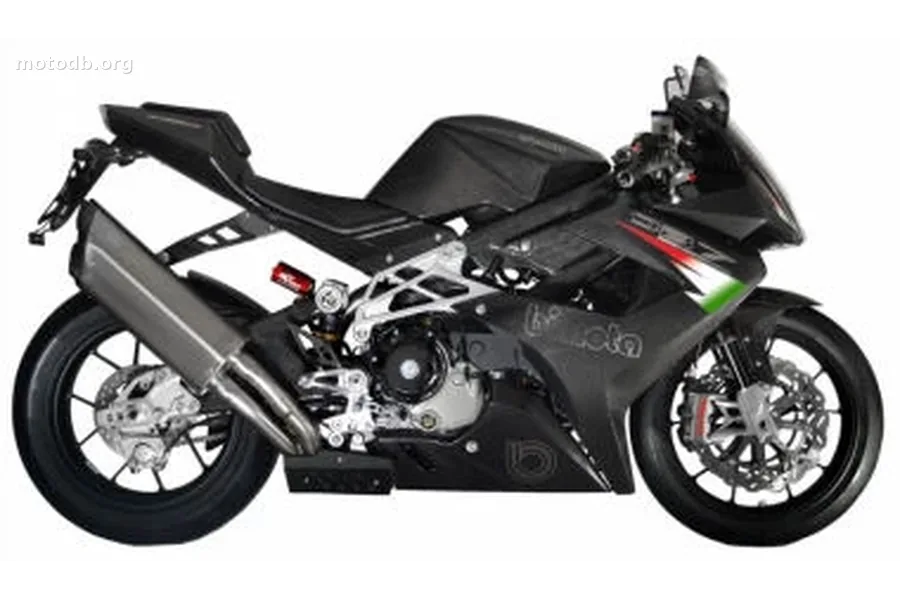
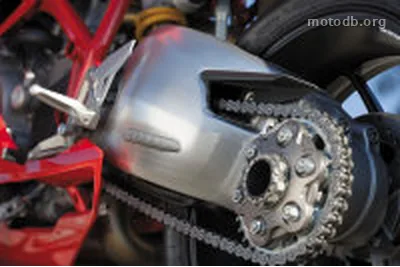
The Oro Nero is, first and foremost, an obsession with materials. Bimota took the lightweight philosophy that has defined its DNA since the 1970s and pushed it to its most radical expression. Carbon fiber literally colonizes every corner of the bike. Not just the fairing — a trivial exercise for a sportbike at this level — but also the swingarm, the self-supporting seat unit, and the tank surround. The tubular elements of the oval-section trellis frame are themselves connected to billet-machined aluminum plates, for an overall result where only the engine block and a handful of road-legal components escape the black weave. This is no longer a motorcycle; it's a demonstration in composites.
The engine, for its part, deserves a closer look. Bimota retained the DB7's philosophy by building around the 90-degree L-twin derived from the Ducati 1098, but the engineers in Rimini weren't content with a simple technology transfer. The 1099 cc twin produces 164 horsepower at 9,750 rpm, with 122.6 Nm of torque available from 8,000 rpm. Combined with a dry weight of 164 kilograms, the power-to-weight ratio reaches perfect unity — one to one. This symmetry is no accident of calculation; it represents a deliberate design target, and on track it translates into a responsiveness that few production machines can claim. A stock Ducati 1098 S is already a formidable sportbike, but it weighs around twenty kilograms more and delivers less power in standard trim.
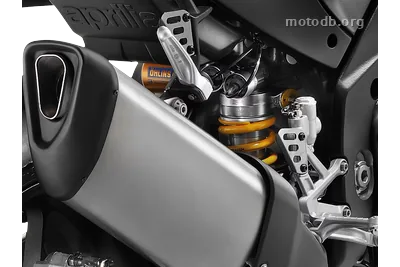
The chassis is equal to these ambitions. The large-diameter Marzocchi inverted fork and the ExtremeTech monoshock offering 130 mm of travel handle maintaining contact with the tarmac under conditions that few riders will ever reach. Radially mounted Brembo calipers do the work at the end of the straight. The instrument cluster integrates a lap-timing function with PC data export, confirming that Bimota intended this machine exclusively for track-day riders, not for timid collectors. The 120/70-17 and 190/55-17 tires complete a coherent package from front wheel to single rear brake.
At €39,960, the DB7 Oro Nero comfortably exceeds the price of a top-tier Japanese hypersport and occupies a category where economic rationality no longer applies. Its audience is not the weekend rider, nor even the dedicated trackday regular who extracts the best from an R1 or CBR 1000RR. This is a piece for the discerning enthusiast — wealthy, and probably already the owner of other Bimota machines. The figure of twenty worldwide units guarantees an absolute rarity that partly justifies this pricing position. This is not a motorcycle you choose; it's a motorcycle that chooses you.
Practical info
- La moto est accessible aux permis : A
Reviews & comments
No reviews yet. Be the first to share your opinion!