Key performance
Technical specifications
Engine
- Displacement
- 1103 cc
- Power
- 214.0 ch @ 13000 tr/min (156.2 kW)
- Torque
- 124.0 Nm @ 9500 tr/min
- Engine type
- V4, four-stroke
- Cooling
- Liquid
- Compression ratio
- 14.0:1
- Bore × stroke
- 81.0 x 53.5 mm (3.2 x 2.1 inches)
- Valves/cylinder
- 4
- Camshafts
- 2 ACT
- Fuel system
- Injection. Electronic fuel injection system. Twin injectors per cylinder. Full ride-by-wire elliptical throttle bodies.
- Valve timing
- Desmodromic valve control
- Starter
- Electric
Chassis
- Frame
- Aluminium alloy. Engine is used as a structural chassis element. Trellis subframe.
- Gearbox
- 6-speed
- Final drive
- Chain (final drive)
- Clutch
- Slipper and self-servo wet multiplate clutch with hydraulic control
- Front suspension
- Öhlins NIX30 43 mm fully adjustable fork with TiN treatment. Electronic compression and rebound damping adjustment.
- Rear suspension
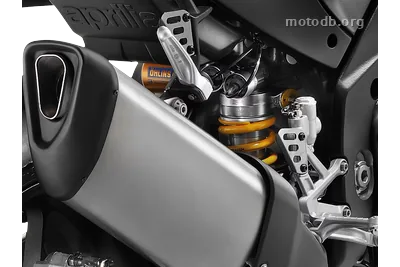
- Fully adjustable Ohlins TTX36 unit. Electronic compression and rebound damping adjustment
- Front wheel travel
- 120 mm (4.7 inches)
- Rear wheel travel
- 130 mm (5.1 inches)
Brakes
- Front brakes
- Double disc. ABS. Brembo
- Rear brakes
- Single disc. ABS. Brembo
- Front tyre
- 120/70-ZR17
- Front tyre pressure
- 2.30 bar
- Rear tyre
- 200/60-ZR17
- Rear tyre pressure
- 2.10 bar
Dimensions
- Seat height
- 835.00 mm
- Wheelbase
- 1469.00 mm
- Fuel capacity
- 16.00 L
- Weight
- 194.00 kg
- Dry weight
- 173.00 kg
- New price
- 28 990 €
Overview
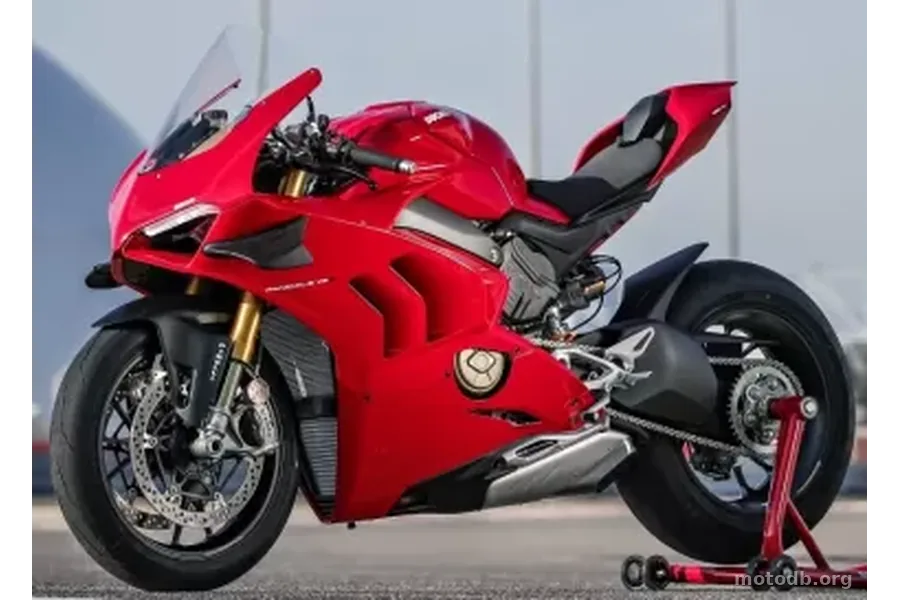
Imagine 214 horsepower extracted from 1103 cm3 in a V4 configuration, compressed into a 173 kg dry weight chassis, sold for 28,990 euros. The Ducati Panigale V4 S (2021) doesn't seek to convince through gentleness or everyday practicality. It’s aimed at riders who know what they’re doing, who have already ridden fast and want to ride even faster, legally road-registered but mentally already on the track. Facing a BMW M 1000 RR or an Aprilia RSV4 Factory, the Bolognese machine maintains its absolute benchmark status in the hypersport category, not through a single argument, but through the total coherence of its proposition.
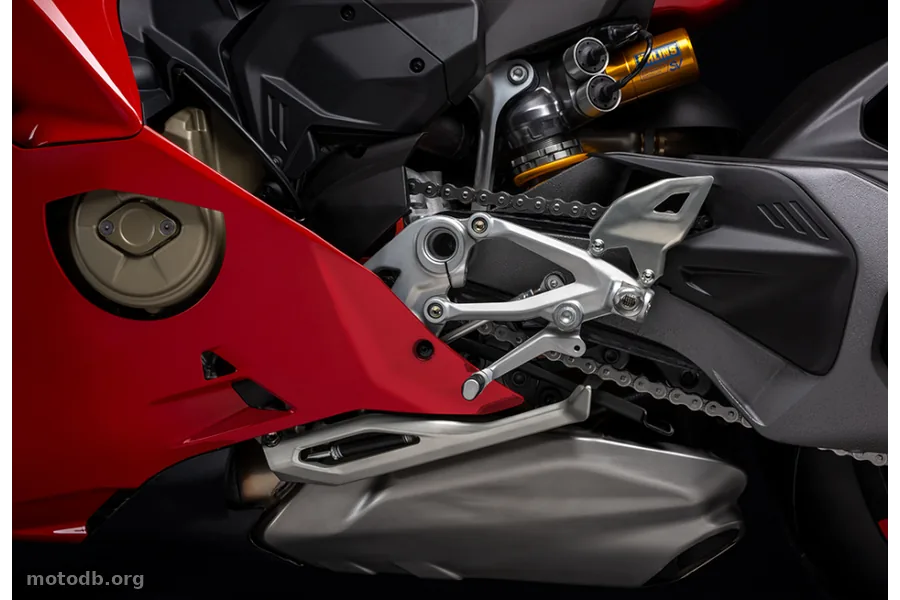
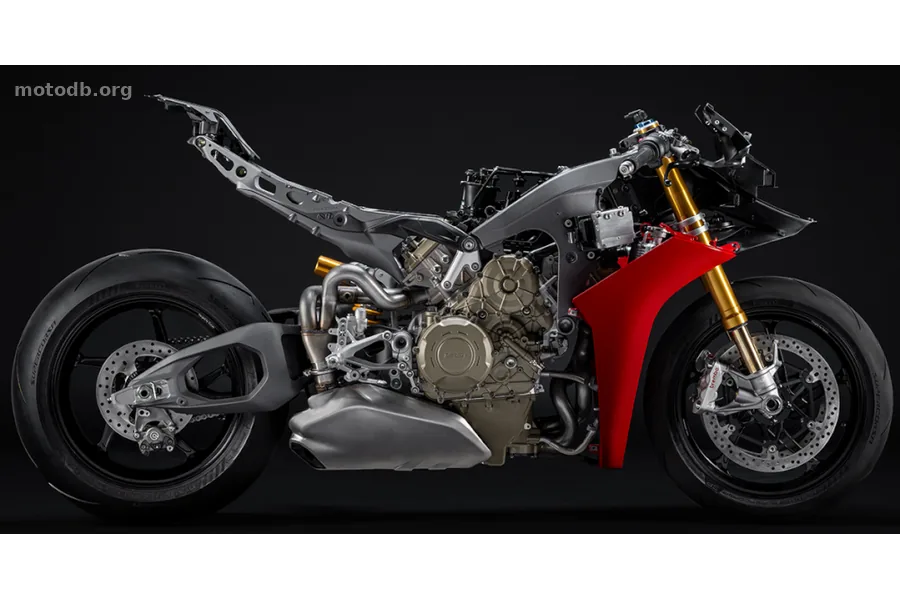
For this model year, Ducati hasn’t reinvented everything. The essential modifications relate to Euro 5 compliance, and the brand has managed this transition with considerable skill. Larger catalysts in the silencers, shortened and reduced exhaust pipes on the rear bank, lambda probes per cylinder, revised intake trumpets: the power remains unchanged, and the 124 Nm of torque even peaks a little earlier in the rev range. For an engine that revs to 13,000 rpm at peak power, this is as much an engineering feat as it is a two-finged salute to regulations. On the chassis side, the frame adopted is that of the V4 R, structurally stiffer at the front. The fork drops 4 mm, the shock absorber shortens slightly, the center of gravity rises 5 mm. These figures seem marginal on paper; in the saddle, they modify the responsiveness when entering corners and acceleration stability in a noticeable way.
What truly distinguishes the V4 S from the standard version is its suspension equipment. The 43 mm Öhlins NIX 30 fork with TiN treatment and the TTX36 shock absorber, both controlled electronically via the Smart EC 2.0 system, represent a level of equipment generally reserved for competition machines. The rider can intervene manually via virtual clicks, 32 for the suspensions, 10 for the steering damper, or leave the 6-axis inertial unit to manage damping in real time according to the selected riding mode. The Brembo Stylema brakes, already a benchmark, receive automatic bleed master cylinders derived from the Superleggera. On this point, no direct competitor offers such a complete package as standard. The 194 kg wet weight, achieved in part thanks to a lithium-ion battery and forged aluminum Marchesini rims, places the Ducati Panigale V4 S among the lightest machines in its class at this level of displacement.
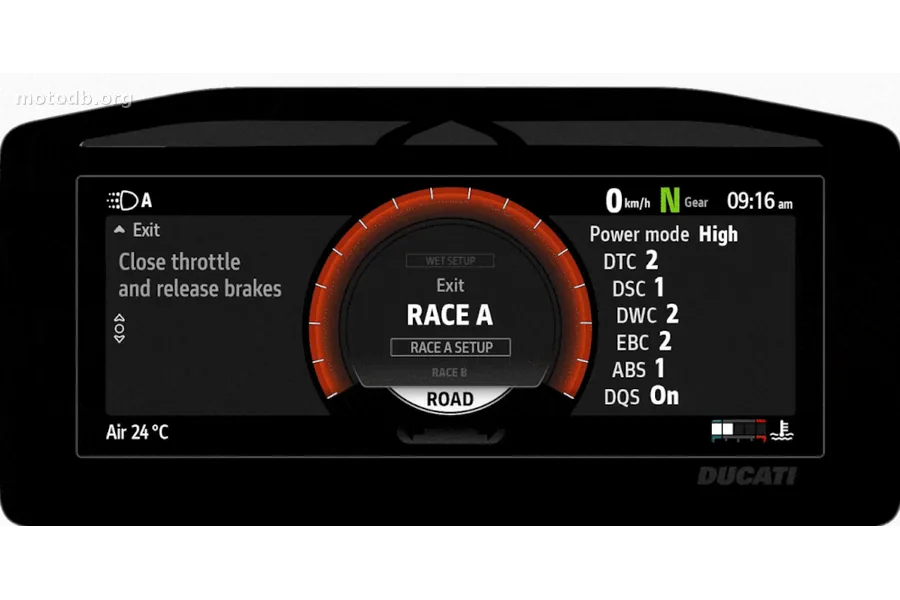
The three riding modes Street, Sport and Race structure access to these 214 horsepower according to the context. In Race mode, divided into sub-modes A and B to adapt the electronics to the quality of the tarmac, the assists recede to let the rider take responsibility. In Street mode, throttle response softens and the suspensions better absorb road surface irregularities. Traction control DTC in its EVO 3 version provides a real gain in precision in the middle of corners, where previous generations sometimes intervened too brutally. It’s not a communication gimmick: it’s a difference that you feel under the wheels.
One caveat deserves to be stated clearly. The aerodynamic wings, which generate downforce at high speed and improve cooling, are here in injection-molded plastic. On the Ducati Panigale V4 S, positioned above the standard V4 and displaying a reference price, the comparison with the carbon elements of the V4 R is inevitable and unfavorable. This choice is all the more frustrating as the rest of the machine flirts without complex with pure racing. For those who want to push even further towards the Ducati Panigale V4 S Corse or the V4 R, the base technical specifications will give them solid arguments; for others, the V4 S 2021 remains the best-balanced superbike on the market between track engagement and road homologation, for those who really know how to exploit its potential.
Standard equipment
- Assistance au freinage : ABS in curves
- Poignées chauffantes
Practical info
- La moto est accessible aux permis : A
Reviews & comments
No reviews yet. Be the first to share your opinion!