Key performance
Technical specifications
Engine
- Displacement
- 1198 cc
- Power
- 162.0 ch @ 9500 tr/min (119.2 kW)
- Torque
- 132.4 Nm @ 8000 tr/min
- Engine type
- Bicylindre en L à 90°, 4 temps
- Cooling
- liquide
- Compression ratio
- 11.5 : 1
- Bore × stroke
- 106 x 67.9 mm
- Valves/cylinder
- 4
- Camshafts
- 2 ACT
- Fuel system
- Injection Ø 58 mm
Chassis
- Frame
- Treillis tubulaire en acier relié à 2 platines en alu
- Gearbox
- boîte à 6 rapports
- Final drive
- Chaîne
- Front suspension
- Fourche téléhydraulique inversée Ø 50 mm, déb : 120 mm
- Rear suspension
- Mono-amortisseur, déb : 120 mm
Brakes
- Front brakes
- Freinage 2 disques Ø 320 mm, fixation radiale, étrier 4 pistons
- Rear brakes
- Freinage 1 disque Ø 265 mm, étrier 2 pistons
- Front tyre
- 120/70-17
- Front tyre pressure
- 2.50 bar
- Rear tyre
- 240/45-17
- Rear tyre pressure
- 2.50 bar
Dimensions
- Seat height
- 770.00 mm
- Fuel capacity
- 17.00 L
- Weight
- 234.00 kg
- Dry weight
- 205.00 kg
- New price
- 21 590 €
Overview
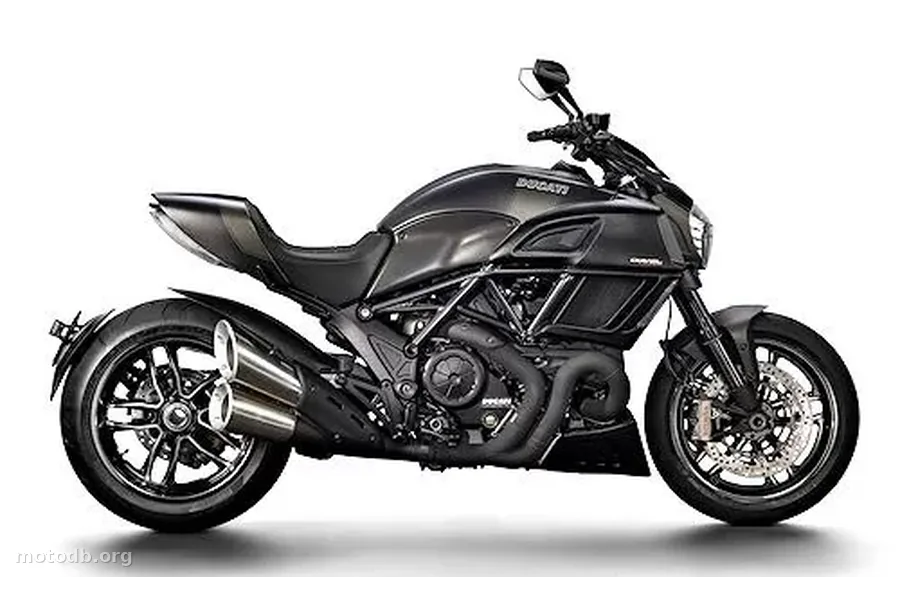
Who said a cruiser had to lumber across the asphalt like an ocean liner anchored off Toulon? Certainly not Ducati. With the 2015 Ducati Diavel Carbon 1200, the Borgo Panigale firm single-handedly invented a segment somewhere between the American power cruiser and the edgy European roadster. A kind of hybrid beast that refuses to choose between showing off and performing. And the result, it must be said, holds the road remarkably well.
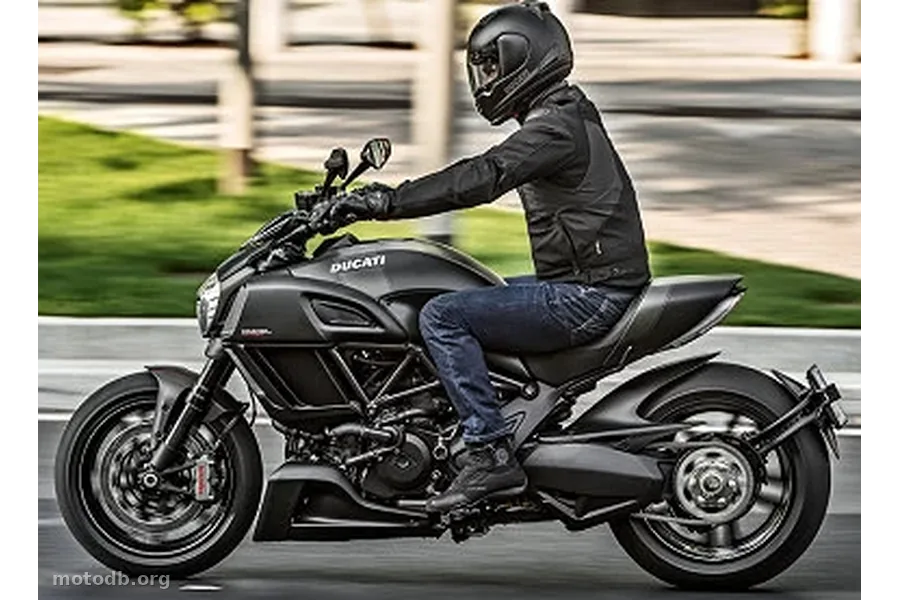
Beneath that massive, sleek silhouette beats the famous 1198 cc Testastretta 11° L-twin, directly descended from the Superbike lineage. The numbers speak for themselves: 162 horsepower at 9,500 rpm and 132.4 Nm of torque available from 8,000 rpm. Enough to catapult the 234 kg wet weight toward a top speed of 250 km/h — territory where no traditional cruiser dares to venture. The tubular steel trellis frame, paired with two aluminum side plates, provides a rigidity that some of the brand's own sportbikes wouldn't have turned down. The 50 mm inverted fork and mono-shock, both calibrated with 120 mm of travel, confirm that this machine was not designed to merely ride in a straight line between traffic lights. We're a long way from the mushy comfort of a VN 1700 or the unapologetic heft of a Rocket III.
What sets the Carbon version apart from the standard Diavel is finishing work geared toward weight savings and prestige. The front fender, tank, and seat cowl are all rendered in carbon fiber. The Marchesini forged aluminum wheels shed 2.5 kg of unsprung mass — a detail that's immediately noticeable on corner entry and acceleration. Dry weight drops to 205 kg, which is still substantial but becomes almost reasonable for a machine of this size wearing a 240 mm rear tire. The surface treatment on the wheels, with that aluminum gleaming at the heart of the matte black finish, adds a visual touch that photos only half capture.
The 2015 version benefits from the Diavel Phase II updates: beveled exhaust design, redesigned front headlight with a daytime LED arc, reworked seat for better support, slightly raised handlebars, and dual-spark ignition on each cylinder for finer combustion. The braking system, with its two radially mounted 320 mm front discs and four-piston calipers, proves equal to the horsepower on tap. That's reassuring when you're pushing hard through first gear out of the six-speed gearbox. The 17-liter tank remains a bit tight for high-mileage riders, but this is clearly no touring bike. The 770 mm seat height accommodates average builds without difficulty and allows you to plant both feet flat on the ground — a real asset in the city.
At €21,590, the Ducati Diavel Carbon 1200 doesn't play in the affordable machine league. It's aimed at an experienced rider who wants a machine with character, capable of eating up miles of open road in the morning and causing whiplash on a café terrace in the evening. Against a Yamaha VMax nearing the end of its run or a considerably heavier BMW K 1600 B, it occupies a unique niche: that of the cruiser that can genuinely corner. Its main flaw remains a fuel appetite poorly matched to the tank's capacity, and passenger comfort that's barely worth mentioning. But those who buy this kind of machine rarely do so to take someone along. They do it for themselves, for that blend of mechanical brutality and Italian refinement that very few manufacturers know how to balance with such precision.
Standard equipment
- Assistance au freinage : ABS de série
Practical info
- La moto est accessible aux permis : A
Indicators & positioning
Similar bikes
XL 1200 SPORTSTER LOW
Bonneville Speedmaster
1200 V4 SV One of One 'RCW 588 replica'
Reviews & comments
No reviews yet. Be the first to share your opinion!