Key performance
Technical specifications
Engine
- Displacement
- 1198 cc
- Power
- 162.0 ch @ 9500 tr/min (119.2 kW)
- Torque
- 126.5 Nm @ 8000 tr/min
- Engine type
- Bicylindre en L à 90°, 4 temps
- Cooling
- liquide
- Compression ratio
- 11.5 : 1
- Bore × stroke
- 106 x 67.9 mm
- Valves/cylinder
- 4
- Camshafts
- 2 ACT
- Fuel system
- Injection Ø 58 mm
Chassis
- Frame
- Treillis tubulaire en acier relié à 2 platines en alu
- Gearbox
- boîte à 6 rapports
- Final drive
- Chaîne
- Front suspension
- Fourche téléhydraulique inversée Ø 50 mm, déb : 130 mm
- Rear suspension
- Mono-amortisseur, déb : 120 mm
Brakes
- Front brakes
- Freinage 2 disques Ø 320 mm, fixation radiale, étrier 4 pistons
- Rear brakes
- Freinage 1 disque Ø 265 mm, étrier 2 pistons
- Front tyre
- 120/70-17
- Front tyre pressure
- 2.50 bar
- Rear tyre
- 240/45-17
- Rear tyre pressure
- 2.50 bar
Dimensions
- Seat height
- 770.00 mm
- Fuel capacity
- 17.00 L
- Dry weight
- 207.00 kg
- New price
- 19 990 €
Overview
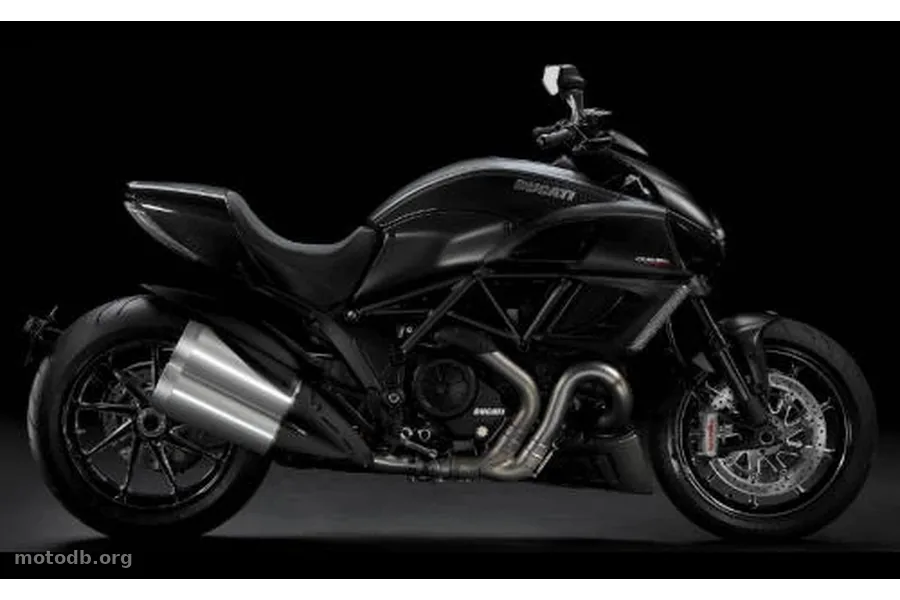
What happens when Bologna decides to cross a bodybuilt roadster with a supercharged cruiser, then sprinkle the whole thing with carbon fiber? You get the Ducati Diavel Carbon 1200, vintage 2012, a machine that refuses to fit into any box and boldly owns its status as a standout piece in the Italian catalog.
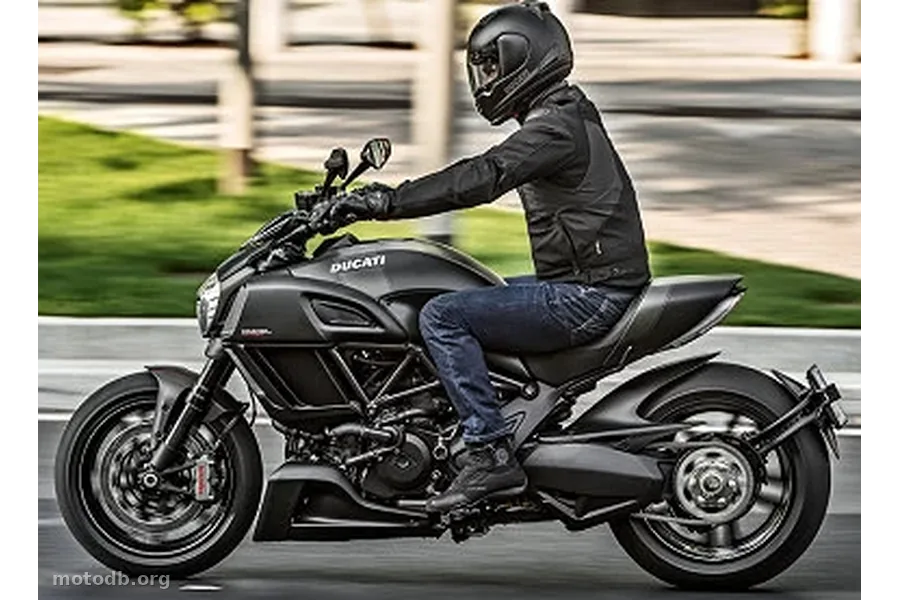
At Ducati, premium variants typically carry the S or R suffix. The Diavel plays its own tune. Its top-tier version swaps the usual letters for a name that says it all: Carbon. The tank, seat cowl, and front fender switch to carbon fiber, delivering admittedly modest weight savings but above all a racing aesthetic that perfectly suits the massive, dark silhouette of the beast. The real weight advantage comes from elsewhere: the Marchesini forged wheels, which shave 2.5 kg of unsprung mass compared to the standard model. A detail you feel directly in the steering responsiveness and weight transitions. Add to that the 50 mm inverted fork with DLC-coated tubes, and you understand that Ducati didn't simply slap carbon stickers on a stock Diavel.
Beneath the tank sits the L-twin Testastretta engine displacing 1198 cc, set at a 90° angle. The numbers speak for themselves: 162 horsepower at 9,500 rpm and 126.5 Nm of torque at 8,000 rpm. To put that in perspective, that's Superbike-level power from that era, housed in a steel trellis frame weighing 207 kg dry. That's in Kawasaki Z750 territory, except here the engine charges like a bull let loose in the arena. The whole package is tied together by radial-mount front brakes with dual 320 mm discs that bite hard and inspire confidence from the very first meters.
The Diavel Carbon's paradox is precisely its agility. With a 240 mm rear tire, you'd expect to be steering an ocean liner. The reality is quite different. The bike accepts direction changes with disconcerting ease, leaning up to 41° without complaint. Three engine maps, ABS, and traction control keep the 162 horses in check for those who prefer a more gradual approach. The seat, perched at just 770 mm, makes the machine accessible even to average-sized riders. The 17-liter tank allows for a decent range before you need to find a gas station, which remains reasonable for a twin as hungry for thrills as it is for premium unleaded.
Who is this Ducati Diavel Carbon 1200 aimed at? Certainly not the beginner, despite its welcoming ergonomics. Rather, it's for the experienced rider who wants to break away from the roadster-sportbike-adventure trifecta and ride a machine with a unique temperament. Against a V-Max or a Rocket III of the era, the Diavel plays the lightness and Italian technology card. Against American muscle bikes, it counters with surgical precision and unmatched mechanical refinement. At a launch price of 19,990 euros, the bill was steep, that's true. But for that price, Ducati delivered a bike capable of putting a smile on your face with every twist of the throttle, from urban crawling all the way to the claimed 250 km/h top speed. A radical proposition that, more than ten years on, still hasn't found a true rival.
Standard equipment
- Assistance au freinage : ABS en série
Practical info
- La moto est accessible aux permis : A
Indicators & positioning
Similar bikes
XL 1200 SPORTSTER LOW
Bonneville Speedmaster
1200 V4 SV One of One 'RCW 588 replica'
Reviews & comments
No reviews yet. Be the first to share your opinion!