Key performance
Technical specifications
Engine
- Displacement
- 999 cc
- Power
- 210.0 ch @ 13750 tr/min (154.5 kW)
- Torque
- 112.8 Nm @ 11000 tr/min
- Engine type
- 4 cylindres en ligne, 4 temps
- Cooling
- liquide
- Compression ratio
- 13.3 : 1
- Bore × stroke
- 80 x 49.7 mm
- Valves/cylinder
- 4
- Camshafts
- 2 ACT
- Fuel system
- Injection Ø 48 mm
- Starter
- électrique
- Euro standard
- Euro 5+
Chassis
- Frame
- double poutre périmetrique en aluminium
- Gearbox
- boîte à 6 rapports
- Final drive
- Chaîne
- Front suspension
- Fourche téléhydraulique inversée Ø 45 mm, déb : 120 mm
- Rear suspension
- Mono-amortisseur, déb : 117 mm
Brakes
- Front brakes
- Freinage 2 disques Ø 320 mm, fixation radiale, étrier 4 pistons
- Rear brakes
- Freinage 1 disque Ø 220 mm, étrier simple piston
- Front tyre
- 120/70-17
- Front tyre pressure
- 2.50 bar
- Rear tyre
- 190/55-17
- Rear tyre pressure
- 2.90 bar
Dimensions
- Seat height
- 832.00 mm
- Seat type
- Selle biplaces
- Fuel capacity
- 16.50 L
- Weight
- 198.00 kg
- Dry weight
- 175.00 kg
- New price
- 21 500 €
Overview
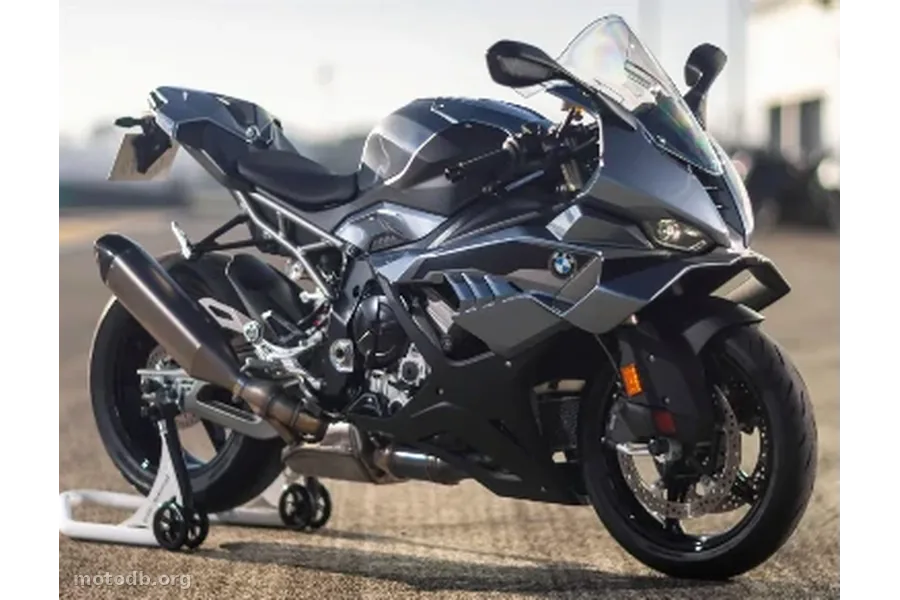
Since its launch in 2009 (over 15 years ago), the S 1000 RR has consistently been one of the most powerful sportbikes in the sector. Programmed, born, designed, and indoctrinated to win in Superbike and Endurance racing, it only relatively recently achieved its ultimate goals. Although its more muscular sibling, the M 1000 RR, is primarily responsible for getting the job done.
The S 1000 RR also enjoys recognition beyond the racetrack. A favorite among Tourist Trophy enthusiasts, it delivers a significant dose of adrenaline-fueled sensations on the road. The BMW is a true machine of overactive adrenaline in addition to its performance. When it came time to revise certain details due to Euro5+, the "RR" asked itself, "what if I went further? Stronger, faster."
This explains the arrival of new and enormous winglets. Modeled after those of the M, they provide 35% more downforce compared to the previous winglets - downforce at 300 km/h now reaches 23.1 kg. Top riders can exploit more speed in corners and relieve some of the anti-wheelie control.
That’s because it has 210 horsepower to manage. A very significant amount of power, which BMW deemed unnecessary to increase. This small privilege is reserved for the M 1000 RR, which gains 6 hp this year. No, there’s already enough in the engine to obliterate all your license points in seconds and make the chronograph heat up considerably. With its four cylinders, a Shiftcam variable distribution system, a maximum engine speed of 14,600 rpm, and 11.5 mkg of torque, the engine is one of the best in current production.
No watts, but more electronics for the S 1000 RR 2025. And a quick-action throttle, requiring 58° of rotation instead of 72° to unleash all the power. The rider assistance package is enhanced with the standard installation of “PRO Riding Modes.” This brings the number of riding modes to 7: Road, Rain, Dynamic, Race, and now Race Pro 1, 2, and 3. Thanks to them, the rider can refine traction control over a wider range, adjust the level of intervention of the wheelie control, enjoy 2 additional throttle response types (gentle or direct, with maximum torque), parameterize engine braking management on 3 levels, enhance the hill-start assistant with automatic detection, adjust ABS on 5 levels (including a special slick tire setting), and benefit from Dynamic Brake Control. This safety system prohibits acceleration during braking phases.
Without undergoing a major overhaul, BMW wanted to refresh its missile. Its fairing panels are redesigned, with a nod to a more aggressive highlighting of the "gills" on the right side; one of the asymmetrical symbols of the first generation of S 1000 RR. The rest of the design offers only new color schemes to dress a charismatic and vindictive sportbike, but without the suave subtlety of an Italian. The front fender is modified to integrate air ducts forcing air towards the Hayes 4-piston radial calipers, in order to improve cooling.
It won’t go any further in its transformation. It remembers that its “Flex Frame” aluminum perimeter frame has evolved relatively recently, wanting to be a little more flexible laterally. In 2023, the chassis focused on more precise steering and more adjustments with the ability to modify the swingarm pivot height. This evolution also brought a lighter M battery, a rear USB port, a more easily removable license plate holder, a shortened transmission, and a simplified rear wheel mounting and dismounting.
Apart from brake caliper ventilation, the front end still consists of a 45 mm Marzocchi inverted fork and large 320 mm discs. The shock absorber is also signed by the Italian equipment manufacturer. As it should be, the suspension is adjustable in all directions.
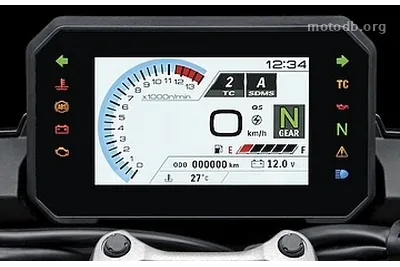
An S 1000 RR also features a 6.5-inch color TFT screen, ABS cornering, a quickshifter, track use with the M GPS Laptrigger, and a few options like pilot suspension, cruise control, heated grips, forged wheels, traction controls, an emergency call system, etc... All in 197 kg ready to pounce.
Even more M, and unconsciously pursuing its entrepreneurial sister of victories, the new S 1000 RR extends its achievements and climbs a small step towards greater efficiency. A mission that is increasingly difficult to accomplish, and this for all manufacturers given the very high level of today's sportbikes.
M.B - Photos manufacturer
Standard equipment
- Assistance au freinage : ABS Pro
- Nombre de mode de conduite : 7
- Taille de l'écran TFT couleur : 16,51 cm / 6.5 pouces
- Jantes aluminium
- Shifter
- Indicateur de vitesse engagée
- Prise USB
- Aide au démarrage en côte (Hill Hold Control)
- Aide au départ arrêté (Launch Control)
- Contrôle de traction
- Contrôle anti wheeling
- Contrôle de glisse
- Embrayage anti-dribble
- Contrôle du frein moteur
- Limitateur de vitesse dans les stands
Practical info
- La moto est accessible aux permis : A
Reviews & comments
No reviews yet. Be the first to share your opinion!