Key performance
Technical specifications
Engine
- Displacement
- 999 cc
- Power
- 210.0 ch @ 13750 tr/min (154.5 kW)
- Torque
- 112.6 Nm @ 11000 tr/min
- Engine type
- In-line four, four-stroke
- Cooling
- Liquid
- Compression ratio
- 13.3:1
- Bore × stroke
- 80.0 x 49.7 mm (3.1 x 2.0 inches)
- Valves/cylinder
- 4
- Camshafts
- 2 ACT
- Fuel system
- Injection. Electronic injection, variable intake pibe
- Valve timing
- Double Overhead Cams/Twin Cam (DOHC)
- Lubrication
- Wet sump
- Starter
- Electric
- Euro standard
- Euro 5+
Chassis
- Frame
- Bridge-type aluminum laminate frame with load-bearing engine
- Gearbox
- 6-speed
- Final drive
- Chain (final drive)
- Clutch
- Multiplate clutch in oil bath, anti-hopping clutch, mechanically controlled
- Front suspension
- Upside-down telescopic fork, diameter 45 mm, spring preload, rebound and compression stages adjustable
- Rear suspension
- Aluminium swing arm, full floater pro, compression and rebound damping adjustable, adjustable preload
- Front wheel travel
- 120 mm (4.7 inches)
- Rear wheel travel
- 117 mm (4.6 inches)
Brakes
- Front brakes
- Double disc. ABS. Floating discs. Four-piston calipers.
- Rear brakes
- Single disc. ABS. Floating disc. Single-piston caliper.
- Front tyre
- 120/70-ZR17
- Front tyre pressure
- 2.50 bar
- Rear tyre
- 190/55-ZR17
- Rear tyre pressure
- 2.90 bar
Dimensions
- Seat height
- 831.00 mm
- Seat type
- Selle biplaces
- Wheelbase
- 1455.00 mm
- Length
- 2073.00 mm
- Width
- 848.00 mm
- Height
- 1151.00 mm
- Fuel capacity
- 16.50 L
- Weight
- 196.90 kg
- Dry weight
- 175.00 kg
- New price
- 20 890 €
Overview
Fifteen years. That's how long it took Munich to transform a radical intuition into doctrine. The BMW S 1000 RR wasn't born a sportbike; it was born a conqueror, designed from the start to bite into the lap times of the Superbike and Endurance championships. The track record took time to catch up, and it's often its supercharged cousin, the M 1000 RR, that reaps the laurels in competition. It doesn't matter: the standard "RR" has built its own legend, on the roads of the Tourist Trophy as much as on homologated circuits. The 2025 version doesn't reinvent the recipe; it refines it with surgical precision.
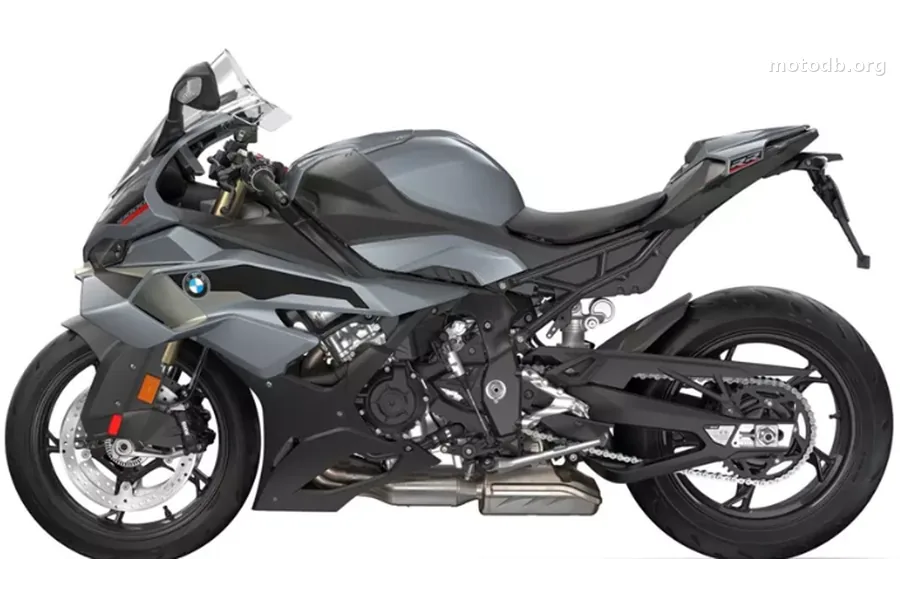
The engine remains the core of the matter. Inline four-cylinder, 999 cm3, ShiftCam variable valve timing, a compression ratio of 13.3:1 for bore diameters of 80 mm on a stroke of 49.7 mm: the engine turns at 13,750 rpm to release 210 horsepower, with 112.6 Nm of torque available at 11,000 rpm. Those wondering how many horsepower the BMW S 1000 RR has will have their answer, and it’s straightforward. BMW hasn't increased this power for the 2025 model – the 6 extra horsepower are reserved for the M – but frankly, at this level of violence, no one is missing anything. What the S 1000 RR 2025 gains is a reduced-travel throttle, rotating from 72° to 58° to trigger full load. The result is immediate, almost brutal in the most aggressive modes.
The most visible evolution remains these new winglets, directly copied from the M. They generate 35% additional downforce compared to the previous generation, bringing the aerodynamic load to 23.1 kg at 300 km/h. A speed that the bike easily reaches, since the speedometer points to 302.6 km/h at top speed. On the track, this downforce relieves the wheelie control system and allows you to approach fast corners with greater confidence. In the same spirit, BMW has revised the front mudguard to channel air towards the Hayes four-piston calipers and maintain braking temperatures within reasonable values. It’s the kind of detail that makes the difference when pushing for multiple consecutive laps.
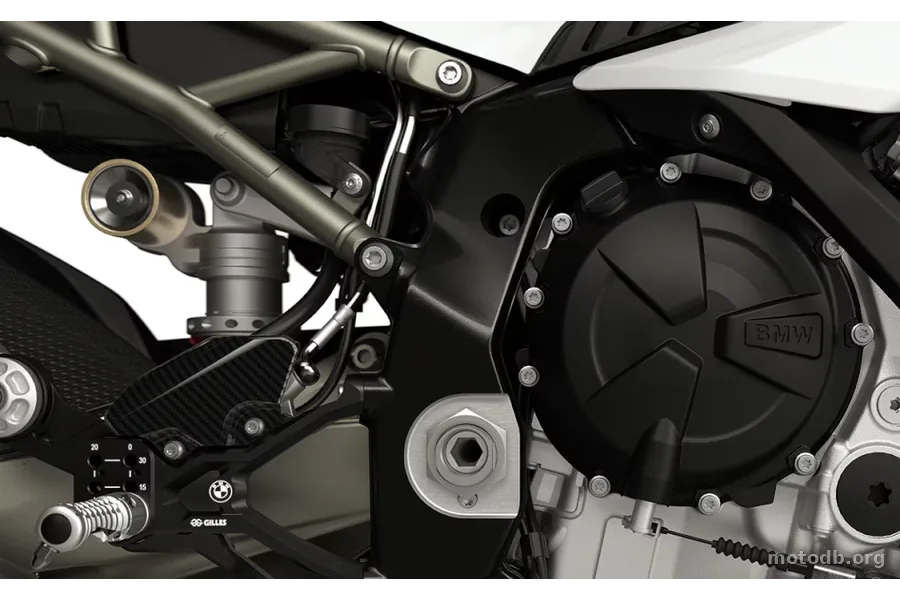
The other 2025 novelty concerns the electronics, already dense on previous generations but which takes an additional step. The PRO riding modes become standard, bringing the total to 7 profiles available: Road, Rain, Dynamic, Race, then Race Pro 1, 2 and 3. Each allows independent adjustment of traction control, wheelie control, throttle response, three-level engine braking, ABS on five levels including one calibrated for slicks, and Dynamic Brake Control which cuts all acceleration during braking phases. Compared to a Ducati Panigale V4 or a Honda CBR1000RR-R, the BMW fares well with at least an equivalent electronic arsenal, perhaps more accessible in its logic of parameterization. The 6.5-inch TFT screen, the bidirectional shifter and compatibility with the M GPS Laptrigger complete a picture very focused on the track.
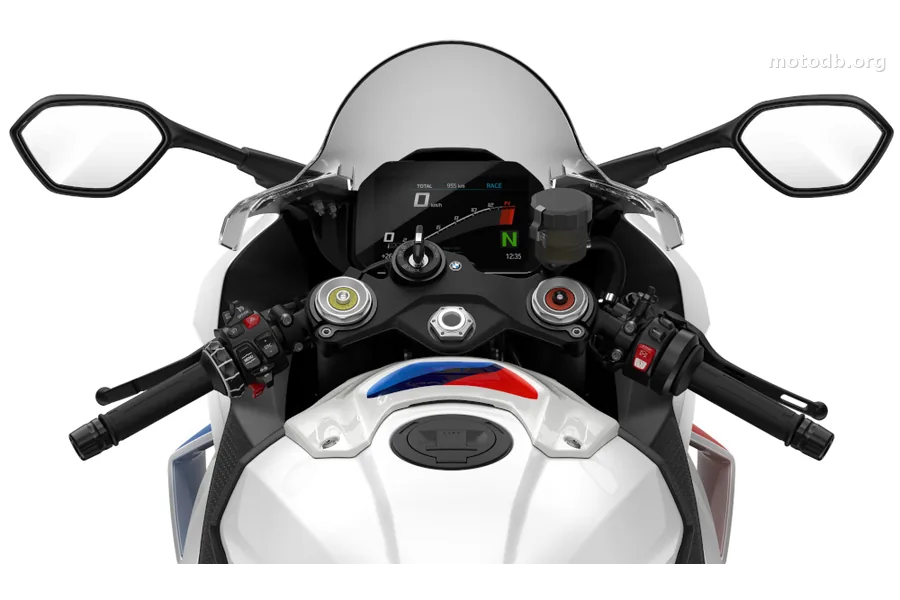
The perimeter aluminum frame with engine as a stressed member, the aluminum swingarm with pivot point adjustment and the 45 mm Marzocchi inverted fork have not changed since the 2023 overhaul. This is good news: this chassis had already reached a good level of balance between longitudinal stiffness and lateral flexibility. The whole thing weighs 196.9 kg fully fueled for a seat height of 831 mm, making it a motorcycle accessible to average builds but certainly not a machine for beginners. The BMW S 1000 RR is aimed at experienced riders, capable of exploiting some of its resources on the open road or on track. At a price of 20,890 euros, it positions itself in the high end of the segment, facing Italian and Japanese competitors playing in the same league. Compared to previous generations, notably the BMW S 1000 RR 2020 or 2021, the technological leap remains measured but consistent. It's a calculated evolution, not a revolution, and that’s exactly what needed to be done.
Standard equipment
- Assistance au freinage : ABS Pro
- Nombre de mode de conduite : 7
- Taille de l'écran TFT couleur : 16,51 cm / 6.5 pouces
- Jantes aluminium
- Shifter
- Indicateur de vitesse engagée
- Prise USB
- Aide au démarrage en côte (Hill Hold Control)
- Aide au départ arrêté (Launch Control)
- Contrôle de traction
- Contrôle anti wheeling
- Contrôle de glisse
- Embrayage anti-dribble
- Contrôle du frein moteur
- Limitateur de vitesse dans les stands
Practical info
- La moto est accessible aux permis : A
Reviews & comments
No reviews yet. Be the first to share your opinion!