Key performance
Technical specifications
Engine
- Displacement
- 999 cc
- Power
- 152.0 ch @ 11000 tr/min (111.8 kW)
- Torque
- 105.9 Nm @ 9250 tr/min
- Engine type
- 4 cylindres en ligne, 4 temps
- Cooling
- liquide
- Compression ratio
- 12.2 : 1
- Bore × stroke
- 73.4 x 59 mm
- Valves/cylinder
- 4
- Camshafts
- 2 ACT
- Fuel system
- Injection
- Starter
- électrique
Chassis
- Frame
- périmétrique en aluminium
- Gearbox
- boîte à 6 rapports
- Final drive
- Chaîne
- Front suspension
- Fourche téléhydraulique inversée Ø 43 mm, déb : 120 mm
- Rear suspension
- Mono-amortisseur, déb : 130 mm
Brakes
- Front brakes
- Freinage 2 disques Brembo Ø 310 mm, fixation radiale, étrier 4 pistons
- Rear brakes
- Freinage 1 disque Nissin, étrier simple piston
- Front tyre
- 120/70-17
- Front tyre pressure
- 2.50 bar
- Rear tyre
- 190/50-17
- Rear tyre pressure
- 2.90 bar
Dimensions
- Seat height
- 810.00 mm
- Seat type
- Selle biplaces
- Fuel capacity
- 19.00 L
- Weight
- 214.00 kg
- New price
- 13 199 €
Overview
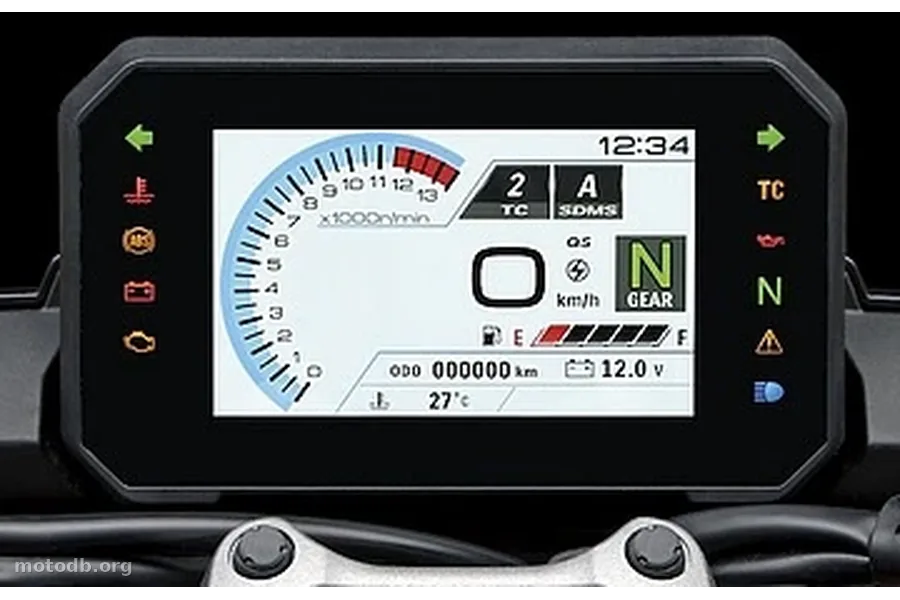
The biggest of Suzuki’s roadsters doesn’t seem worried about its future. It’s right to feel that way: its engineers have adjusted the engine to meet Euro5+ standards thanks to the addition of a second lambda sensor, without loss of power. They are also taking the opportunity to install (finally) a more modern dashboard with the 5-inch TFT color screen found on all new models in recent years. Everything else about the motorcycle remains identical.
The GSX-S1000 wants more than just its share of the hairy big-roadster pie. Its engine has always whispered that its place is on the street; not to intimidate, but to conquer. In this realm of beasts, adrenaline is paramount. Sensations must begin before even the first twist of the key.
So, Suzuki decides to clash with a new interpretation of the GSX-S. Technically? Not really, mostly in terms of styling. Want a slap before you wake up? Take a look at this face emerging from a laboratory where genes and amphetamines are mixed.
Its greedy and bestial gaze seizes your throat... Its face of a hybrid robot with an insect prevents serenity... Aggressive, tormented, offspring of an antarak and a cyclocephale, it provokes with every glance. A true brawler, sharply breaking with the codes of its predecessor. The straight edge is dominant, the lines straight and dry, their nuances as uninduced as on some KTMs. It’s almost approaching the old 690 Duke 3 – but it looks like the drawing board has been contaminated by Kiska’s touch. A strange sensation emanates from some parts imitating the scent of stone (radiator cowls, plates under the tank, back of the instrument panel). It’s not rock, nor a peak, perhaps a new direction for the GSX-S. Should we see this as the peninsula of an evolving character? Fashion adds its seat pad, as evidenced by its small excrescences on the sides.
Apart from Kawasaki, which has joined the clique of fire pumps with its Z H2, the Japanese are not rushing to taunt the high spheres of the segment. It is true that releasing 180... 190... up to 208 horsepower on a roadster is beyond the point of delirium. And it works.
Suzuki remains reasonable, if one can call it that. Because 152 horsepower is already a lot of power. The 4-cylinder has received quite a few updates to keep it in the game. First, it has to meet Euro5 standards. Then, a little extra dose of watts is always good for form and ego. In the numbers game, we discover that the GSX-S1000 Phase II gains two horsepower compared to the first version. Except that... the maximum surge is injected later, at 11,000 rpm – 1,000 more than before. For torque, it’s the opposite. There’s a little less, 10.8 mkg instead of 11. But this peak is held 250 rpm earlier, at 9250 rpm. Let’s put these numbers aside to look at the engine curves. With the modifications made here and there, the engine designers claim more availability, especially in the mid-range dips. The two “pause” zones, one in the middle of the tachometer and the other approaching maximum output, have been noticeably smoothed out to maintain punch throughout acceleration.
Some will be surprised that Suzuki isn’t exploiting the block of the latest GSX-R1000s, with variable distribution and more power, instead of the engine from the K5-K6. Why keep this mechanics from a bountiful but almost distant era? Because it had it in the trunk! The most powerful of its time, gorged with force and a formidable response at mid-range. Moreover, they are taking care of it thoroughly. To offer the initially mentioned capabilities, a new engine ECU has been installed, injection throttle bodies have been modified, the airbox has been revised, camshafts have been revised, and the exhaust has been adapted to the new constraints. Externally, you don’t really see the change. Yet, the catalytic converters have taken on a significant role in the intermediate silencing chamber.
Closely following the Hayabusa in the renewal of tactical models, the GSX-S1000 is also stocking up on electronics. Not as much, but the right dose compared to the power it has under the seat. Previously only equipped with Traction Control and ABS, it was more than time to update. Suzuki begins by adding 3 injection maps via its S-DMS. They all deliver the same maximum power, but the curves are more or less aggressive depending on the mode. A is the most responsive, B is more supple and best suited for everyday use, and C rhymes with comfort for a calmer distribution and better adapted to delicate conditions.
Traction control is renewed, with 5 levels this time and still disconnectable. The throttle becomes ride-by-wire, an Up&Down shifter makes its entrance, and the classics of the house are reiterated, such as Low RPM Assist and Easy Start. However, you will have to forgo ABS in curve, the inertial unit, the cruise control... All these more or less useful trinkets depending on the user profile. With its Suzuki Intelligent Ride System pack, the manufacturer provides the necessary and the price reflects it, with moderate inflation. There is also no engine braking management, capable of bucking the rear wheel torque. Suzuki trusts a mechanical system, with an SCAS anti-dribble clutch. Its slip technique allows the clutch to partially disengage when downshifting too generously – it also benefits from an assistance function to reduce lever effort.
Engine, silhouette, face, identity, electronics, plastic – everything is revised? Almost. The cycle part maintains the status quo. The frame inspired by the sportbike and the suspension elements are unchanged. The Hamamatsu roadster can therefore count on a serious perimeter aluminum frame, a KYB inverted fork of 43 mm fully adjustable, an adjustable KYB shock absorber in preload and rebound, Brembo 4-piston monoblock brakes around 310 mm discs, and a high-section swingarm (borrowed from the GSX-R). To appreciate and judge this material for longer with each outing, the tank gains 2 liters to display a capacity of 19 units. This explains part of the 4 kilos gained in the mutation.
It’s not so much for economy that Suzuki retains these acquisitions, but rather for pragmatism. The chassis of the previous GSX-S was recognized as both effective and enjoyable. So, they don’t take risks and renew what has proven its worth. The rider will still feel a slight change, in the riding position. The seat is 5 mm lower and the handlebars have been revised. It is 23 mm wider, which will improve (slightly) the leverage to engage the motorcycle, and its shape brings the grips 20 mm closer to the rider. This will straighten him up a little on his seat.
Let's venerate the brutes of the '20s! We also wonder if a more sporty tire wouldn’t be better suited than the Dunlop Roadsport2, focused on dynamic road use. With this GSX-S 1000, Suzuki plays the card of price and places its big roadster among the least expensive in the category. The other high-cylinder roadsters evolve on higher orbits.
M.B - Photo manufacturer
The Suzuki GSX-S 1000 new version facing the 2015-2020 generation - the style change is striking.
Standard equipment
- Assistance au freinage : ABS
- Nombre de mode de conduite : 3
- Taille de l'écran TFT couleur : 12,70 cm / 5 pouces
- Shifter
- Indicateur de vitesse engagée
- Aide au démarrage
- Aide à la manoeuvre
- Contrôle de traction
- Embrayage anti-dribble
Practical info
- La moto est accessible aux permis : A
- Pays de fabrication : Japon
Reviews & comments
No reviews yet. Be the first to share your opinion!