Key performance
Technical specifications
Engine
- Displacement
- 125 cc
- Power
- 15.0 ch (11.0 kW)
- Engine type
- Monocylindre, 4 temps
- Cooling
- par air
- Bore × stroke
- 54 x 54 mm
- Valves/cylinder
- 2
Chassis
- Frame
- Double tube triangulaire en acier àdouble poutre
- Gearbox
- boîte à 5 rapports
- Final drive
- Chaîne
- Front suspension
- Fourche inversée Showa Ø 35 mm
- Rear suspension
- Mono-amortisseur, déb : 120 mm
Brakes
- Front brakes
- Freinage
- Rear brakes
- Freinage 1 disque
- Front tyre
- 100/80-17
- Rear tyre
- 130/80-17
Dimensions
- Fuel capacity
- 10.40 L
- Dry weight
- 110.00 kg
- New price
- 2 999 €
Overview
Girona, 1934. Two partners, Riera and Juanola, set out to manufacture bicycle accessories. Thirty years later, the company shifted into motorcycles through an agreement with Minarelli, and Rieju began to establish itself on the Iberian scene. A long period of obscurity, interrupted occasionally by flashes of competition success, including a Spanish championship title won by Carlos Checa, a future GP 500 rider. No small feat. Yet beyond the Pyrenees, the name still goes largely unnoticed. The RS2 deserves a closer look.
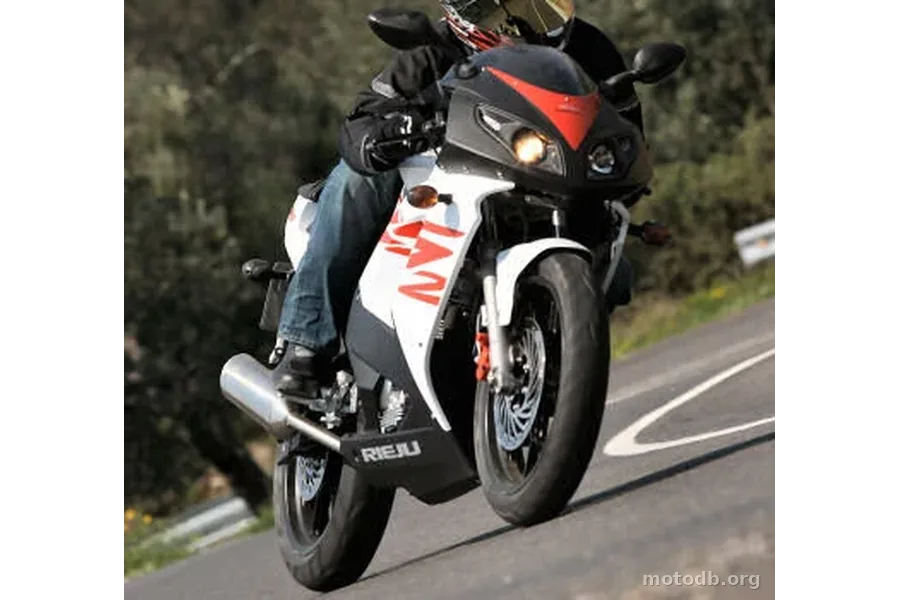
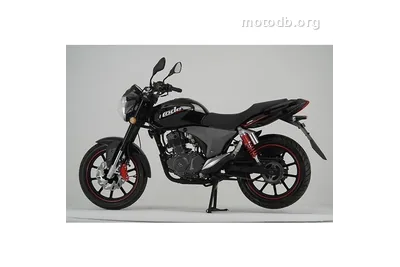
The first impression is sharp. The RS2 sports a taut, angular bodywork with genuine graphic personality. The steel double-tube triangular frame recalls, in its general lines, that of the Aprilia SL 1000 Falco — which is quite a compliment for a 125. Admittedly, the Italian machine benefits from an aluminium-magnesium chassis while the Spanish one makes do with steel, but the visual result holds up. The hybrid analogue-digital instrument cluster completes a coherent and well-finished package.
Beneath the bodywork, the RS2 makes no attempt to be something it is not. The engine is an air-cooled Yamaha four-stroke single cylinder, square-bore at 54 x 54 mm, producing 15 horsepower for 11 kW. This is not a racing engine — it is an engine for urban riding and secondary roads. Paired with a five-speed gearbox and a dry weight of 110 kg, it offers a respectable power-to-weight ratio for an entry-level 125. The claimed top speed of 120 km/h confirms this positioning: the RS2 is built for everyday use and learning, not for lyrical adventures on track. The 35 mm Showa inverted fork and the monoshock with 120 mm of travel provide a sound foundation, without attempting to mimic large-displacement sportsbikes.
Compared to the Honda CBR 125, the undisputed benchmark of the segment in 2010, the RS2 is positioned at around €3,000 — roughly a hundred euros above the Japanese machine. The gap is narrow. What Rieju offers in exchange for this slight difference is a more assertive, more aggressive look that stands apart from the somewhat conventional restraint of the CBR. For a young rider who wants to stand out without sacrificing the reliability of a proven Yamaha engine, it is a defensible proposition. The 10.4-litre tank provides reasonable everyday range, and the 100/80-17 front and 130/80-17 rear tyres are standard for the segment.
The RS2 clearly targets young A1 licence holders looking for a sporty machine with flattering styling, free from the mechanical temperament of the more highly strung Italian 125s. It makes no claim to rival an Aprilia RS or a Derbi GPR in terms of outright sensation. It sells reliability wrapped in convincing style, at a controlled price. For a brand that most buyers are discovering for the first time at the dealership, that is already a coherent and well-executed positioning.
Practical info
- La moto est accessible aux permis : A
Reviews & comments
No reviews yet. Be the first to share your opinion!