Key performance
Technical specifications
Engine
- Displacement
- 998 cc
- Power
- 175.0 ch @ 11700 tr/min (128.7 kW)
- Torque
- 114.7 Nm @ 9500 tr/min
- Engine type
- 4 cylindres en ligne, 4 temps
- Cooling
- liquide
- Compression ratio
- 12.7:1
- Bore × stroke
- 76 x 55 mm
- Valves/cylinder
- 4
- Camshafts
- 2 ACT
- Fuel system
- Injection Ø 43 mm
Chassis
- Frame
- Epine dorsale double poutre alu
- Gearbox
- boîte à 6 rapports
- Final drive
- Chaîne
- Front suspension
- Fourche téléhydraulique inversée Ø 43 mm, déb : 120 mm
- Rear suspension
- Mono-amortisseur, déb : 125 mm
Brakes
- Front brakes
- Freinage 2 disques en pétale Ø 300 mm, fixation radiale, étrier 4 pistons
- Rear brakes
- Freinage 1 disque en pétale Ø 200 mm, étrier 2 pistons
- Front tyre
- 120/70-17
- Rear tyre
- 190/55-17
Dimensions
- Seat height
- 825.00 mm
- Fuel capacity
- 17.00 L
- Dry weight
- 175.00 kg
- New price
- 13 799 €
Overview
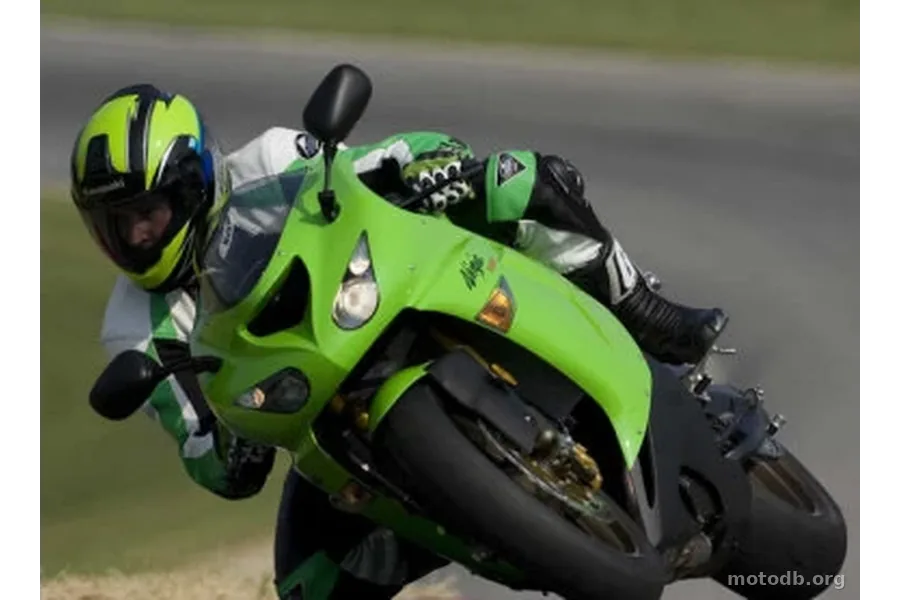
Can a 175-horsepower sportbike really afford to become more civilized? In 2006, Kawasaki answered yes with this revised ZX-10R, a machine that clearly embraces its quest for pure efficiency. It's a far cry from the unpredictable thoroughbred of the early days; here, engineers worked to tame the beast without taking away its claws. The result is an hypersportive that has nothing left to prove in terms of raw power – it still delivers its 175 horsepower at 11,700 rpm – but now chooses to deliver it with scalpel-like precision. A philosophy that strangely echoes that adopted by its rivals at the time, the Yamaha R1 and the Suzuki GSX-R 1000, in their pursuit of manageability.
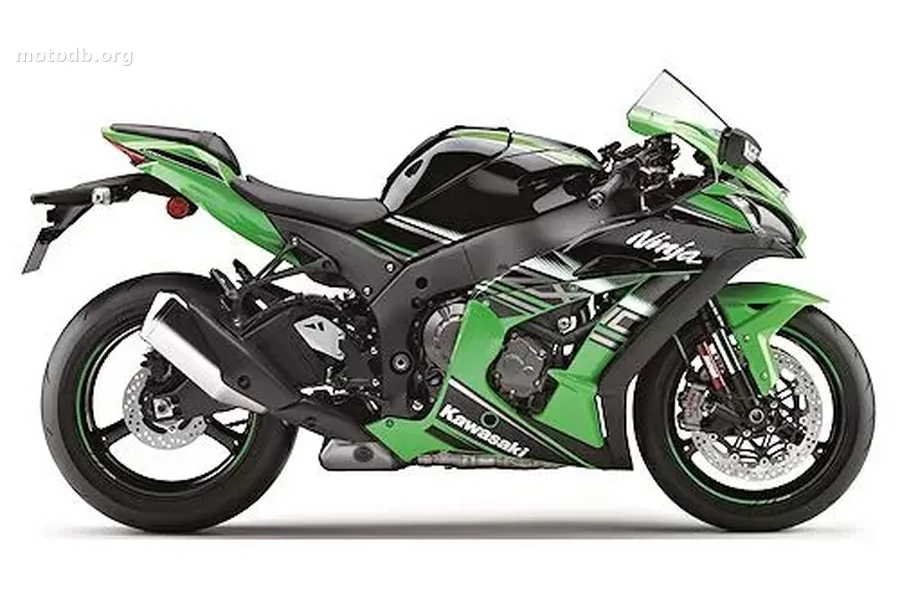
Visually, the mutation is clear. Farewell to the feline gaze, replaced by a batrachian face with narrow optics, directly inspired by the smaller ZX-6RR. Aerodynamics take precedence, dictating a smoother line at the front and a streamlined rear where the turn signals are integrated. The large single exhaust gives way to a double exhaust under the seat, an aesthetic signature that will become classic. But the biggest work is invisible. The twin-spar frame, the reinforced swingarm, the radial master cylinder and especially the Öhlins steering damper as standard equipment: everything is designed to offer a chassis of exemplary rigidity and precision. It's a motorcycle that gets in your legs with an almost unsettling coolness.
Because the real subject is character. The power of the 2008 Kawasaki ZX-10R 1000, derived from this evolution, proves that the brand has found the right formula. The 998 cm3 engine hasn't gained horsepower, but it has gained intelligence. Thanks to new injectors, a friction reduction treatment and a reworked mapping, the acceleration curve is more linear, the torque of 114.7 Nm is more present from the mid-range. It's no longer an uncontrollable explosion, but a massive and progressive wave of power that the rider can modulate. On the track, this is a decisive advantage: you apply the power earlier on exit from the corner, with renewed confidence. The beast has been educated for the stopwatch.
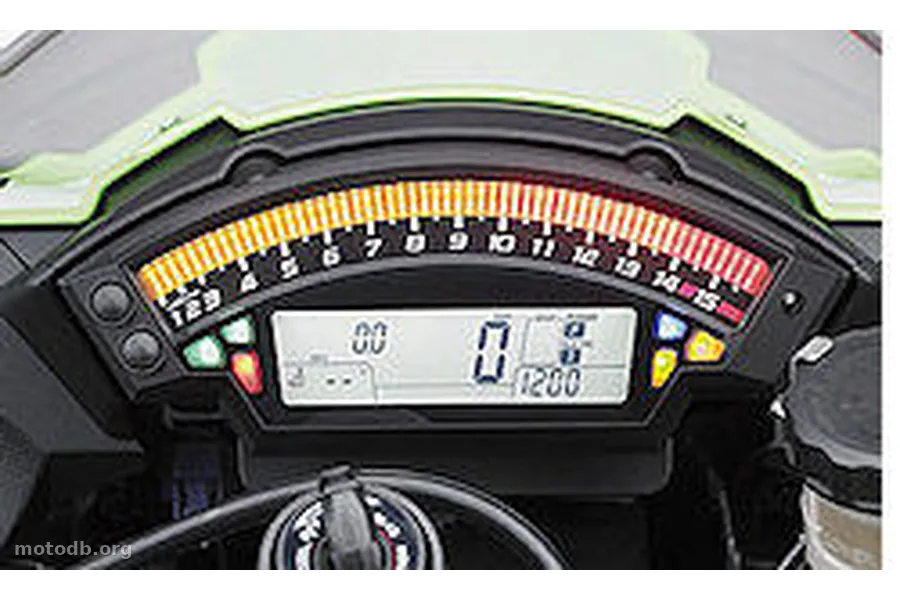
So, is this new docility a betrayal? Some purists, nostalgic for the wild bite of the early versions, may think so. Opinions on the 2005 Kawasaki ZX-10R 1000, its immediate predecessor, are often divided on this point: should character or efficiency be prioritized? Kawasaki chose the second option. This ZX-10R 2006-2007 is aimed at the demanding track rider who wants a precision weapon, not a lover of brutal sensations. It loses a little of its diabolical soul to join the very select circle of high-end hypersportives, ready for battle in WSBK. With a price at the time approaching 14,000 euros, it clearly targeted the top of the range. Today, wondering what the price of a 2016 or 2018 Kawasaki ZX-10R 1000 is in France is to seek the heir to this philosophy: a machine that is always more accomplished, but which has retained this fundamental search for absolute control. A sharpened blade for the hand of an expert.
Practical info
- La moto est accessible aux permis : A
Reviews & comments
No reviews yet. Be the first to share your opinion!