Key performance
Technical specifications
Engine
- Displacement
- 890 cc
- Power
- 120.0 ch @ 10750 tr/min (88.3 kW)
- Torque
- 93.3 Nm @ 8250 tr/min
- Engine type
- Bicylindre en L à 90°, 4 temps
- Cooling
- liquide
- Compression ratio
- 13.1 : 1
- Bore × stroke
- 96 x 61,5 mm
- Valves/cylinder
- 4
- Camshafts
- 2 ACT
- Fuel system
- Injection
- Starter
- électrique
- Euro standard
- Euro 5+
Chassis
- Frame
- monocoque en aluminium
- Gearbox
- boîte à 6 rapports
- Final drive
- Chaîne
- Front suspension
- Fourche téléhydraulique inversée Ø 43 mm, déb : 120 mm
- Rear suspension
- Mono-amortisseur, déb : 150 mm
Brakes
- Front brakes
- Freinage 2 disques Brembo Ø 320 mm, fixation radiale, étrier 4 pistons (M50 monobloc)
- Rear brakes
- Freinage 1 disque Ø 245 mm, étrier 2 pistons
- Front tyre
- 120/70-17
- Rear tyre
- 190/55-17
Dimensions
- Seat height
- 837.00 mm
- Seat type
- Selle biplaces
- Fuel capacity
- 15.00 L
- Weight
- 179.00 kg
- New price
- 16 490 €
Overview
When Bologna decides to change everything except the badge, it deserves a closer look. The Ducati Panigale V2 2025 model arrives with a new engine, a new silhouette, a revised lower price, and a philosophy that sharply contrasts with its predecessors. No cosmetic evolution, no simple electronic recalibration: it’s a thorough overhaul, driven by an 890 cm3 90-degree L-twin cylinder that abandons desmodromic valve actuation in favor of a variable valve timing (IVT) system. Let's just say that the guardians of the temple will be grinding their teeth.
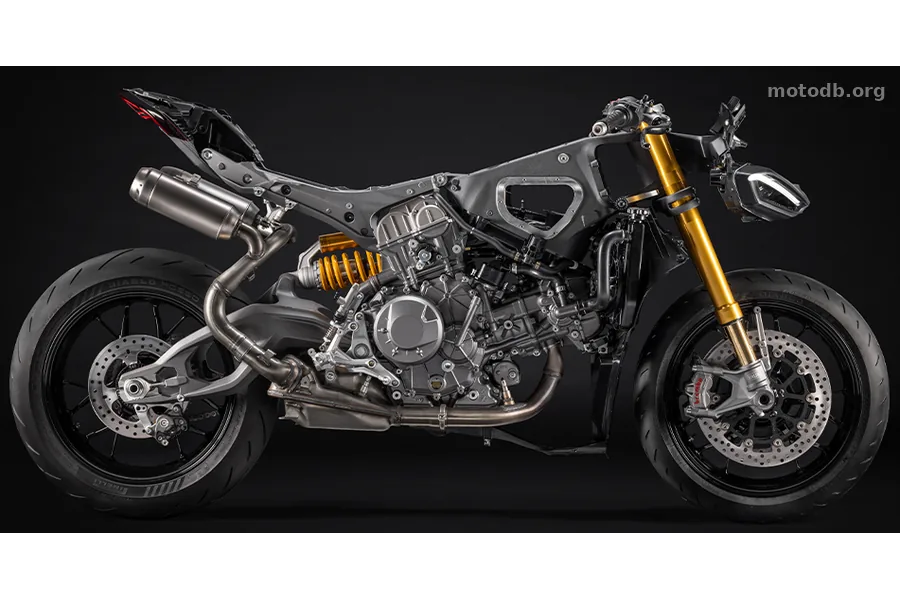
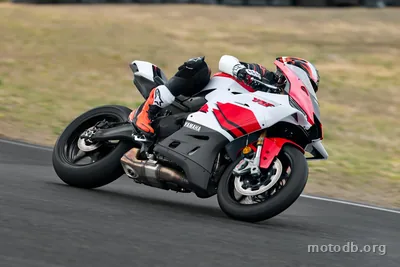
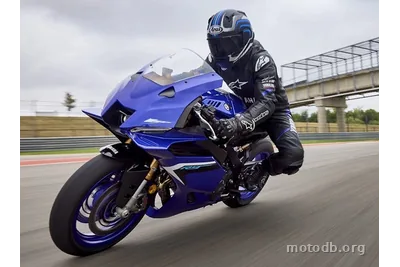
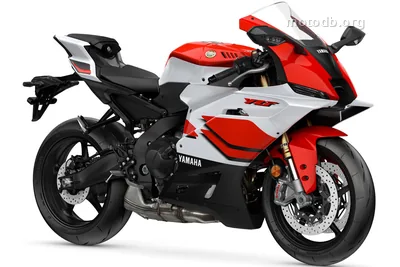
Let’s start with the figure that stings. One hundred twenty horsepower at 10,750 rpm, that’s 35 less than the 955 Superquadro it replaces. Thirty-five. On a machine bearing the Panigale name, that’s information that doesn’t go down well at first glance. Ducati responds with the torque curve, 93.3 Nm available at 8,250 rpm, and above all, 70% of that torque already present at 3,000 rpm. The engine also gains in lightness, with only 54.4 kg on the scale, nearly ten kilos less than its predecessor. Valve inspection intervals go to 30,000 kilometers. The argument for ease of use is real, but on a circuit with real straights, the Panigale V2, top speed limited to 250 km/h, will be tested against machines that haven’t made that compromise. A comparison with the Yamaha R9 is relevant: same horsepower, same torque, a five-kilo difference. Ducati has repositioned itself on the same target as the Japanese. It’s a discreet but clear admission.
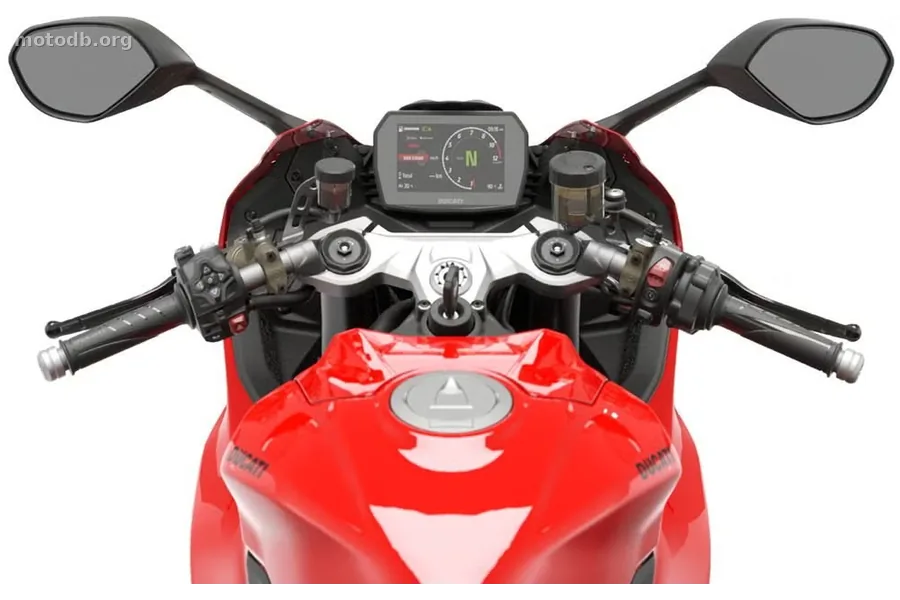
The chassis, however, deserves no criticism. The aluminum monocoque frame accommodates a low-pressure die-cast swingarm based on the V4, an adjustable 43 mm Marzocchi inverted fork, a repositioned monoshock, and Brembo M50 calipers on two 320 mm front discs. Braking performance truly progresses. The tire fitment goes to 190 at the rear. The wheelbase lengthens slightly. All of this contributes to increased traction and stability, at the expense of a pure agility that purists of the previous Ducati Panigale V2 2020 or Ducati Panigale V2 2021 cherished. The clip-on handlebars raised above the fork crown confirm the shift towards the road, not the track.
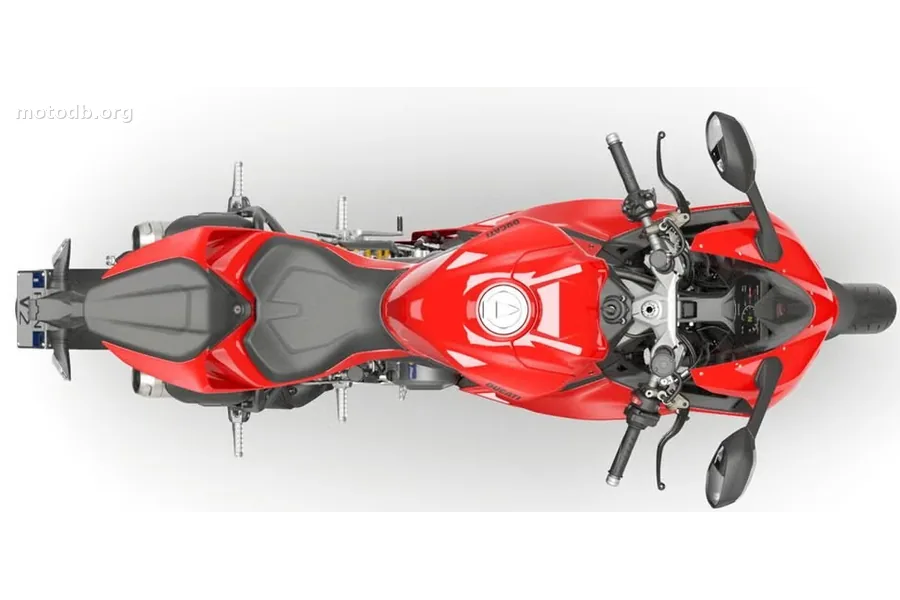
The design is not open to debate. The bodywork based on the V4 is worked, taut, with the exhausts pushed under the tail to free the flanks. No winglets. A sobriety that contrasts with the current trend. The 5-inch 16/9 TFT screen structures the four riding modes, including Rain, with the inertial platform piloting the ABS and cornering traction control. The up/down shifter goes to the second generation. The electronics are complete, well thought out, and adapt to the rider's level.
The price, €16,490, represents a €4,000 reduction over the price of the previous generation. This is unprecedented at Ducati, and it changes the positioning of the machine. For those looking for a used Ducati Panigale V2, the market will inevitably be reconfigured. The S version adds manually adjustable Öhlins suspensions, a lithium battery, and three kilos less. The Termignoni line as an accessory recovers six horsepower, five Nm, and further reduces weight by 4.5 kg, against a significant budget. As for the A2 version, restricted to 47.5 horsepower on such a sophisticated engine, it's a difficult commercial decision to defend technically.
This Ducati Panigale V2 technical specifications 2025 targets a specific audience: the experienced rider who wants a sportbike exploitable on the road, usable on a daily basis, capable of track sessions without being a radical competition tool. It’s no longer quite the same promise as the Ducati Panigale V2 1299 or the Superquadro generations. It’s a more accessible, more versatile motorcycle, industrially rationalized because this engine will equip other models in the range. This economic realism is intelligent. It is simply honest to name it.
Standard equipment
- Assistance au freinage : ABS
- Nombre de mode de conduite : 4
- Taille de l'écran TFT couleur : 12,70 cm / 5 pouces
- ABS Cornering
- Jantes aluminium
- Shifter
- Indicateur de vitesse engagée
- Contrôle de traction
- Contrôle anti wheeling
- Embrayage anti-dribble
- Centrale inertielle
- Contrôle du frein moteur
Practical info
- La moto est accessible aux permis : A, A2
- Pays de fabrication : Italie
Reviews & comments
No reviews yet. Be the first to share your opinion!