Key performance
Technical specifications
Engine
- Displacement
- 889 cc
- Power
- 119.0 ch @ 10000 tr/min (87.5 kW)
- Torque
- 93.0 Nm @ 7000 tr/min
- Cooling
- liquide
- Bore × stroke
- 78 x 62.1 mm
- Valves/cylinder
- 4
- Camshafts
- 2 ACT
- Fuel system
- Injection
- Starter
- électrique
- Euro standard
- Euro 5+
Chassis
- Frame
- périmétrique en aluminium
- Gearbox
- boîte à 6 rapports
- Final drive
- Chaîne
- Front suspension
- Fourche téléhydraulique inversée Ø 43 mm, déb : 120 mm
- Rear suspension
- Mono-amortisseur, déb : 118 mm
Brakes
- Front brakes
- Freinage 2 disques Brembo Ø 320 mm, fixation radiale, étrier 4 pistons (Stylema monobloc)
- Rear brakes
- Freinage 1 disque Ø 220 mm, étrier simple piston
- Front tyre
- 120/70-17
- Rear tyre
- 180/55-17
Dimensions
- Seat height
- 830.00 mm
- Seat type
- Selle biplaces
- Fuel capacity
- 14.00 L
- Weight
- 195.00 kg
- New price
- 13 999 €
Overview
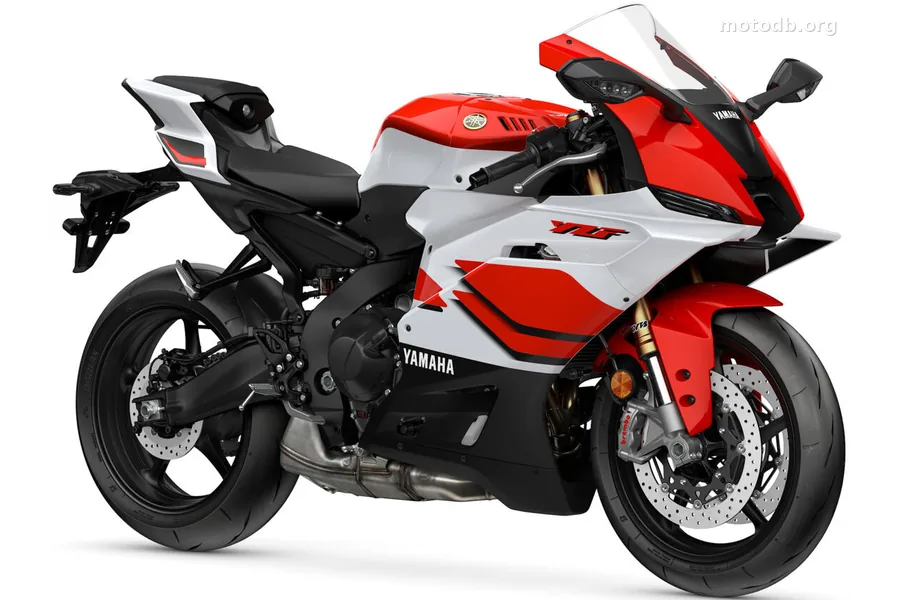
The market for sportbikes is moribund, to say the least. Competition has killed this category on the road, and many manufacturers have withdrawn their flagship models, including Yamaha, which no longer markets the R1 in homologated form but only a track-only model. It’s a real shame because riders eager to wear their racing gear find themselves without options, or at least with somewhat diluted solutions.
The Aprilia RS 660 is a superbike, but for some, its displacement leaves it lacking in low-end torque. The R7 rekindled the flame at Yamaha, but 73 hp might have still been a bit lacking… So, what to do? Well, graft the fabulous CP3 three-cylinder engine onto a sportbike chassis and sprinkle the whole thing with a few electronic assists. The recipe for rediscovered happiness?
This takes us back to the 1980s when Yamaha first used a Deltabox aluminum frame for the TZR 250. From then on, the Japanese would never cease their efforts to perfect this technology, and it would succeed with all the sportbikes born since the name Deltabox appeared. The YZF-R 750 contributed to popularizing the name.
For the R9, Yamaha started from a blank sheet of paper to give the CP3 engine a unique body. The goal for the sportbike (compared to the MT-09) was to offer more rigidity in the three directions: longitudinal, lateral, and torsional. Engineers played with different thicknesses of frame in various places, as well as holes in the frame to achieve the desired result. The frame weighs only 9.7 kg and is the lightest chassis developed by Yamaha for a Supersport model. Note that Yamaha does not speak of Superbike despite the displacement. In this way, with all fluids full, the R9 weighs only 195 kg! In this sense, it recalls another ballerina, now disappeared, the Triumph 675 Daytona, which had many points in common with the Yamaha: a featherweight and a three-cylinder engine to shake its rider.
The front and rear suspensions are entrusted to KYB, specifically designed for the machine, and Yamaha inevitably brings up the marketing argument that they draw their origins from the work done for the R1 GYTR and R1 RACE 750.
The new KYB 43 mm inverted fork has separate settings for rebound and compression on the left and right tubes. Each can be adjusted individually: the left tube for rebound damping and the right tube for compression, at high and low speed. Each fork tube is also equipped with a valve designed to optimize pressure in the cylinder by limiting or completely preventing oil from flowing into the bottom of the fork. This new design results in improved damping response, better feel, and optimal stability in all conditions.
In terms of detail, Yamaha chose a Kashima coating that darkens the gold/bronze color of the fork tubes for the machine's sporty look. The shock absorber is also adjustable for preload, rebound, and compression to adapt to your road or track use.
In all cases, in extreme use, the R9 has a braking system that can be described as solid. The sportbike is equipped with Brembo Stylema monobloc calipers. These calipers receive four 30 mm diameter pistons. A legacy of the track, their shape accentuates airflow for better cooling. They bite into 320 mm discs. And Yamaha, to maintain constant lever pressure even under repeated efforts, retained aviation-grade brake hoses. The braking feel is also improved by a radial master cylinder.
Still aiming to offer you maximum performance in all conditions, Yamaha chose from the Bridgestone catalog the Battlax Hypersport RS11.
Now, here’s the surprise! There will be pros and cons. The cons will be those who will be offended that the R9 is not more powerful than the MT-09. Indeed, for its R9, Yamaha took the CP3 three-cylinder engine of 890 cm³ with liquid cooling, injection, and double overhead camshafts from its roadster. The values are as follows: 119 hp (87.5 kW) at 10,000 rpm and a torque of 93 Nm (9.5 mkg) at 7,000 rpm. The engine will not offer quite the same reactions, Yamaha having optimized the fuel supply, ignition, and final ratio.
The pros (including myself) will say that this is already a great engine and that it will take a lot to twist the bike on the open road… Ultimately, it’s also and perhaps what allows to offer a relatively accessible sportbike and less ruinous than the superbikes.
To flatter the rider, Yamaha says it has paid particular attention to the three-cylinder’s roar and attempted to amplify its vocalizations as much as possible with homologation standards.
This is an interesting point. How to make a sportbike accessible? Accessibility is the price, but it’s also a machine that puts at the service of its rider assists that are as easy to use as to adjust. The big superbikes have become gas factories on this point, and it takes a real instruction manual to be able to enter all the configuration menus. The R9 brings us back to the essentials with a few riding modes, traction control (TC), slide control (SCS), and engine braking control (BC), in addition to ABS, of course.
To achieve its goals, the Japanese manufacturer chose a six-axis IMU that also works on the angle. The level of intervention of the aids should then be quite fine.
Factory-installed, Yamaha offers in Ride Control three pre-configured riding modes: Sport, Street, and Rain. The owner of an R9 will have the possibility to add two personal modes and four trackable modes (ideal for those who will regularly go on the circuit). Four power modes are available to adjust the character of the engine and how it delivers its power. A launch control and an anti-wheeling system are also available. Engine braking is also adjustable in two levels and the anti-back torque limiter monitors for wheel lockups during downshifts.
Gear changes can be made with the quickshifter up and down. Those who are startled by great highway links will be happy to learn that the bike is equipped with a speed limiter effective from 40 km/h.
Details that for greater simplicity, the bike can be connected to a phone (which will have previously downloaded an application called MyRide) from which the riding modes are managed. Up to 40 different modes can be saved on the application to adapt to specific road or track conditions, then downloaded to the bike before starting.
Style is always a matter of personal taste. And well, I love this R9! I fell in love with the last generation of R6 and I was not entirely convinced by the front of the R7. Yamaha has found the right dosage for the R9 even if we could have done without the winglets on the fairing. Let's say that R9 owners will be delighted to have a little something extra that R7 owners don't. Yamaha justifies their presence by a reduced straight-line wheelie angle of 6 to 7%, and when combined with the front spoiler placed under the fork, the R9 will be more “welcoming” than the last R6. The seat height is 830 mm.
The beautiful fairing conceals a 5-inch color TFT screen. It is customizable according to four themes, while a track mode displays information such as a stopwatch useful for having lap times. The R9's screen can be connected to a smartphone via the Yamaha MyRide app. A complete integrated Garmin StreetCross navigation system is also available via the app. Users can display various information and images on the screen, including phone calls, SMS messages, and weather updates.
As an option, R9 owners can subscribe to the Y-TRAC app. This allows you to analyze your data during track use.
The R9 2025 is available in Icon Blue and Tech Black colors, and will be visible at your favorite dealer in March 2025. Its price is targeted, with 13,499 euros (at the beginning - then 13,999 €); the same amount as the XSR 900 GP - A value in line with the level offered, frankly pleasing!
Indeed, seeing a daily sportbike on the road had almost become a pious wish. Just for the beauty of the gesture, the intention, one can congratulate Yamaha. The response of buyers will be crucial to ensure the longevity of the model and to encourage the competition to do the same.
The R9 will also have a whole catalog of options / parts to personalize its machine, including an Akrapovic line with titanium muffler.
The essential technical details:
Vincent Beaucousin - Photos manufacturer
Standard equipment
- Assistance au freinage : ABS
- Nombre de mode de conduite : 9
- Taille de l'écran TFT couleur : 12,70 cm / 5 pouces
- ABS Cornering
- Shifter
- Indicateur de vitesse engagée
- Régulateur de vitesse
- Aide au départ arrêté (Launch Control)
- Contrôle de traction
- ABS déconnectable
- Contrôle anti wheeling
- Jantes forgées
- Contrôle de glisse
- Embrayage anti-dribble
- Centrale inertielle
- Contrôle du frein moteur
- Limitateur de vitesse dans les stands
Practical info
- La moto est accessible aux permis : A, A2
Reviews & comments
No reviews yet. Be the first to share your opinion!