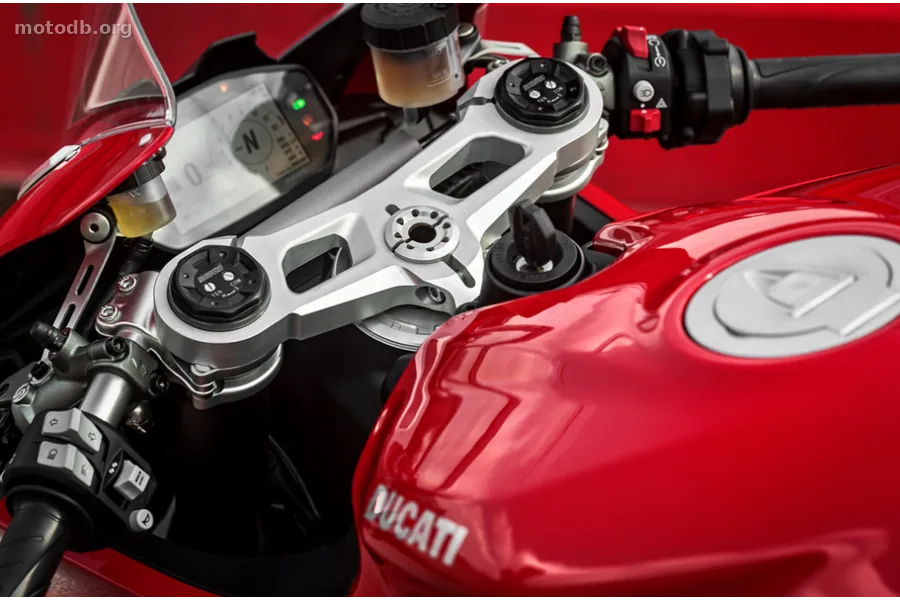
Key performance
Technical specifications
Engine
- Displacement
- 955 cc
- Power
- 155.0 ch @ 10750 tr/min (113.1 kW)
- Torque
- 104.0 Nm @ 9000 tr/min
- Engine type
- V2, four-stroke
- Cooling
- Liquid
- Compression ratio
- 12.5:1
- Bore × stroke
- 100.0 x 60.8 mm (3.9 x 2.4 inches)
- Valves/cylinder
- 4
- Camshafts
- 2 ACT
- Fuel system
- Injection. Twin injectors per cylinder. Full ride-by-wire elliptical throttle bodies.
- Valve timing
- Desmodromic valve control
- Starter
- Electric
Chassis
- Frame
- Monocoque Aluminium
- Gearbox
- 6-speed
- Final drive
- Chain (final drive)
- Clutch
- Oil bathed
- Front suspension
- 43 mm Showa BPF fork
- Rear suspension
- Fully adjustable Sachs unit. Remote spring preload adjustment. Aluminium single-sided swingarm
- Front wheel travel
- 120 mm (4.7 inches)
- Rear wheel travel
- 130 mm (5.1 inches)
Brakes
- Front brakes
- Double disc. ABS. Brembo.
- Rear brakes
- Single disc. ABS. Brembo.
- Front tyre
- 120/70-ZR17
- Front tyre pressure
- 2.50 bar
- Rear tyre
- 180/60-ZR17
- Rear tyre pressure
- 2.50 bar
Dimensions
- Seat height
- 830.00 mm
- Wheelbase
- 1436.00 mm
- Length
- 2070.00 mm
- Width
- 745.00 mm
- Height
- 1105.00 mm
- Fuel capacity
- 17.00 L
- Weight
- 200.00 kg
- Dry weight
- 176.00 kg
- New price
- 18 290 €
Overview
When Ducati unleashed its V4 on the world, Bologna’s twin-cylinder enthusiasts held their breath. Would the brand with the red devil logo sacrifice its sporty twin on the altar of pure performance? The answer is now called Panigale V2, and it definitively buries the numbering system that accompanied each Superbike since the 851. The 899, 959, and other cryptic numbers are a thing of the past; a name, two cylinders, an assumed identity.
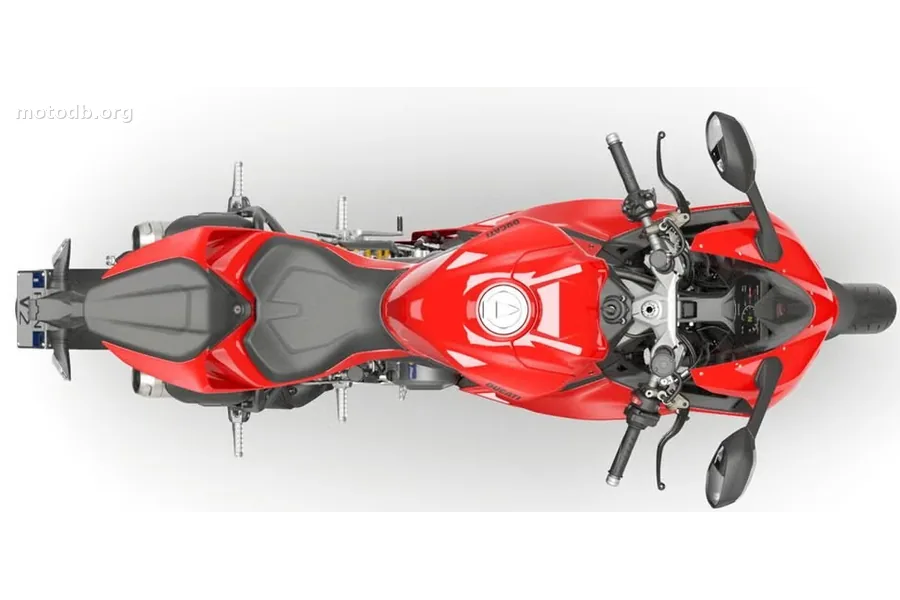
What immediately strikes you is the stylistic consistency with the four-cylinder big sister. The Ducati Panigale V2 doesn’t just copy the lines of the V4 as previous generations did with their predecessors, it reinterprets them. The fairing shares the same headlamp architecture, the flanks respond to each other, but the base has been redesigned to accommodate the tubular exhaust pipe located under the engine. A direct result: the monobrach swingarm finds its place, the rear wheel is revealed without visual obstacles, and the silhouette gains the consistency that the 959 lost with its cumbersome exhaust outlets. On a white Ducati Panigale V2 in particular, the fairing sculpture takes on an almost sculptural dimension.
Underneath this bodywork, the 955 cm³ Superquadro inherits a Euro5 upgrade that truly benefits it. A bore of 100 mm for a stroke of 60.8 mm defines an engine designed for high RPM, and the 155 horsepower at 10,750 rpm confirms it. The torque of 104 Nm arrives at 9,000 rpm, values that remain manageable where the V4 flirts with the irrational. Revised intake ducts and new injectors improve filling without transforming the mechanics into something it’s not. Faced with an Aprilia RS 660 or a Yamaha R7, the Panigale V2 specification sheet displays a clear superiority in raw power, but plays in a different price category.
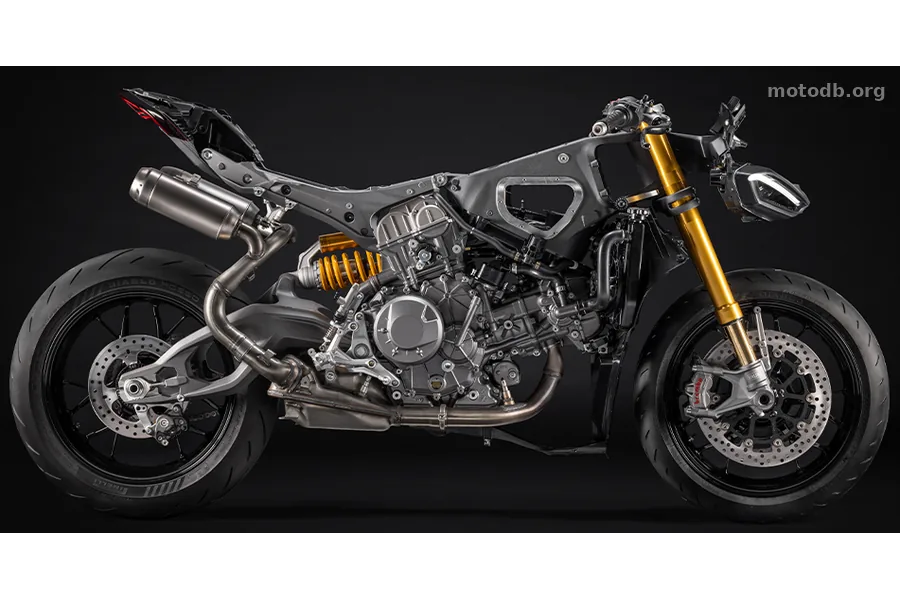
The aluminum monocoque frame, which simultaneously serves as a structural cell and an airbox, remains one of the technical signatures of the lineage. Ducati hasn’t touched it, and that’s wise. The 43 mm fully adjustable Showa BPF fork works in tandem with the Sachs shock absorber, also fully adjustable with progressive preload. The short wheelbase of 1436 mm promises sharp handling, confirmed by the geometry inherited from the 959. Brembo M4.32 calipers bite down on two 320 mm discs at the front; it’s a step below the M50s of the V4, but the difference is measured on a timed track, not on the road.
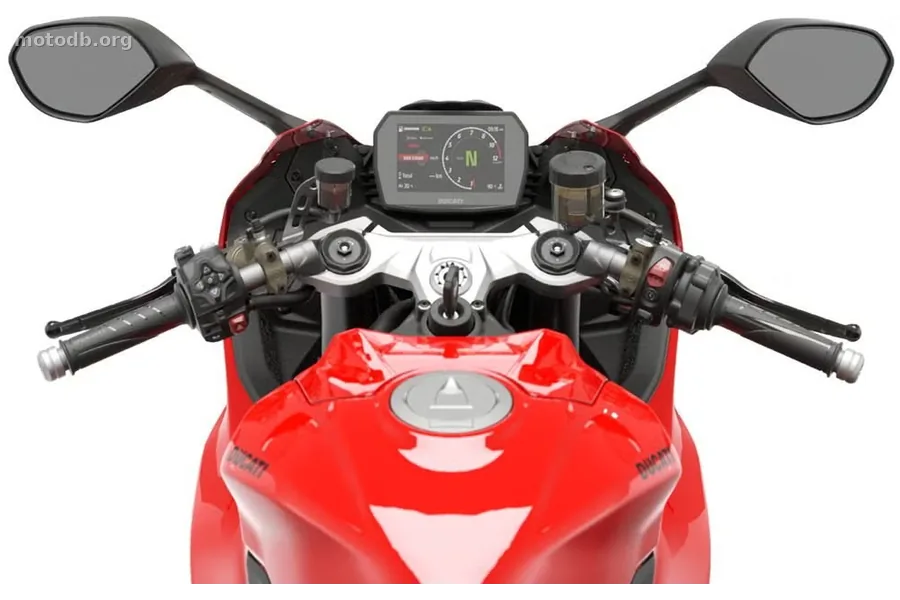
The electronics constitute the real generational leap compared to the 959. The six-axis IMU finally arrives on the twin, making cornering ABS operational with three distinct levels of intervention. The traction control DTC evolves into version EVO 2, more responsive and capable of anticipating situations thanks to the density of the data processed. The DQS EVO 2 quickshifter works both up and down, taking into account the lean angle, and the 4.3-inch color TFT screen closes the list of welcome upgrades. At €18,290, the Ducati Panigale V2 price is well above an R7 or a rebuilt CBR600RR, but significantly below the €24,000 of a base V4. For the occasional track rider or sporty tourer who wants a real Panigale without the V4’s theatrical madness, the proposition is consistent. Lovers of the Ducati Panigale V2 used will also find 2020 and 2021 models at more digestible prices, without sacrificing the electronic equipment that makes the difference daily and on the circuit.
Standard equipment
- Assistance au freinage : ABS de série
Practical info
- La moto est accessible aux permis : A
Reviews & comments
No reviews yet. Be the first to share your opinion!