Key performance
Technical specifications
Engine
- Displacement
- 1254 cc
- Power
- 136.0 ch @ 7750 tr/min (100.0 kW)
- Torque
- 143.0 Nm @ 6500 tr/min
- Engine type
- Bicylindre à plat, 4 temps
- Cooling
- Liquid
- Compression ratio
- 12.5:1
- Bore × stroke
- 102.5 x 76.0 mm (4.0 x 3.0 inches)
- Valves/cylinder
- 4
- Camshafts
- 2 ACT
- Fuel system
- Injection. Electronic intake pipe injection
- Valve timing
- Double Overhead Cams/Twin Cam (DOHC)
- Lubrication
- Dry sump
- Starter
- Electric
Chassis
- Frame
- Two-section frame, front- and bolted on rear frame, load-bearing engine
- Gearbox
- 6-speed
- Final drive
- Shaft drive (cardan) (final drive)
- Clutch
- Wet clutch with an anti-hopping function, hydraulic activation
- Front suspension
- BMW Motorrad Telelever; stanchion diameter 37 mm, central spring strut
- Rear suspension
- Cast aluminium single-sided swing arm with BMW Motorrad Paralever; WAD strut (travel-related damping), spring pre-load hydraulically adjustable (continuously variable) at handwheel, rebound damping adjustable at handwheel.
- Front wheel travel
- 190 mm (7.5 inches)
- Rear wheel travel
- 200 mm (7.9 inches)
Brakes
- Front brakes
- Double disc. ABS. Floating discs. Four-piston calipers.
- Rear brakes
- Single disc. ABS. Floating disc. Two-piston calipers.
- Front tyre
- 120/70-R19
- Front tyre pressure
- 2.50 bar
- Rear tyre
- 170/60-R17
- Rear tyre pressure
- 2.90 bar
Dimensions
- Seat height
- 850.00 mm
- Wheelbase
- 1514.00 mm
- Length
- 2207.00 mm
- Width
- 953.00 mm
- Height
- 1430.00 mm
- Fuel capacity
- 19.68 L
- Weight
- 249.00 kg
- New price
- 19 890 €
Overview
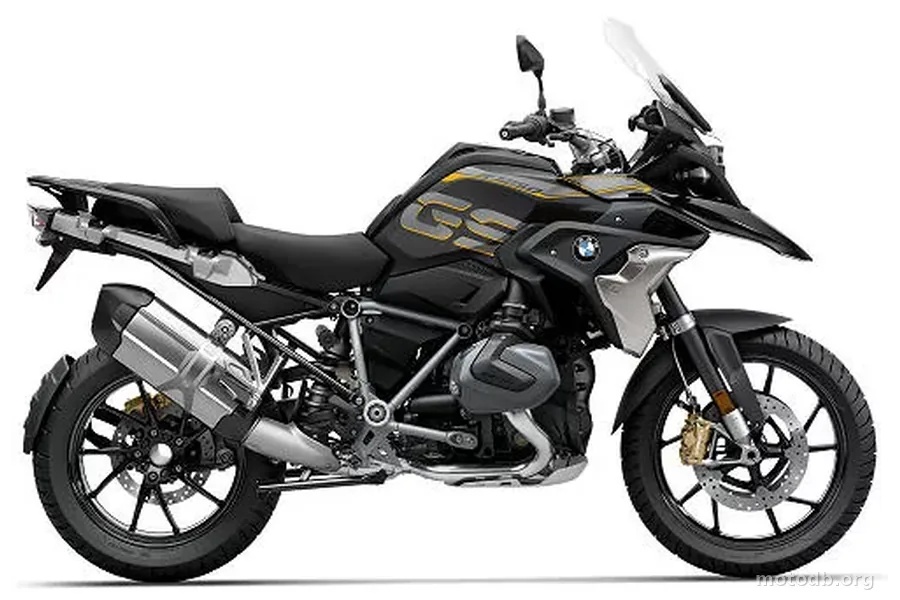
A troop of 1250 GS motorcycles specially prepared is heading to Albania for the International GS Trophy. They receive a special livery, largely featuring the new GS Trophy style available as an option this year: Metallic Gravity Blue paint, a rally seat, black spoke wheels (alternative gold spoke wheels), a sport windshield, radiator protection, and enduro footrests. Just what’s needed to further assert its Gelände (off-road) character over Straße (road). And before?
Before, it implemented the Euro5 standard in 2021. The R 1250 GS had been preparing for this for a long time; complying with it was therefore negotiated as a formality. BMW took the opportunity to enrich the standard equipment of its flagship model. Traction control (DTC), Integral ABS Pro, and 12V and USB sockets were added.
A new ‘Eco’ riding mode joins the equipment. Subsequently, the innovations are in the realm of options: riding mode preset selection, heated seats, adaptive headlight, multi-function turn signals, handlebar risers, and a new enduro pack. The GS likes to indulge, as it always has.
It all began with a trial. Without a doubt, the most demanding, requiring compromise, sacrifice, doubt, and conviction. The moment of choice. When estimating which one will accompany us on the roads, for the length of a breath, an evening ride, or a week in the wanderings of a continent. And then, there is sometimes a savior feeling: the obvious. For most BMW GS owners, not much, or nothing else, could meet their expectations. It must be recognized that the Bavarian trail has solid arguments. The same ones from yesterday will be enhanced with a larger, more powerful engine with variable valve timing.
Shall we be verbose or direct? The engine will be both. By cramming it with additional technology, BMW has endowed its beloved boxer with commendable and adaptable power. As the pistons were tired of this confined space at 1170 cc for 15 years, they pushed the walls to express themselves in 84 cc more. The result is gratifying: 136 horsepower now and a strong torque peaking at 14.5 Nm. Available in abundance over a wide range of RPM. More than the power, it’s the spectacular increase in Nm that is striking. You don’t gain 18 with just a coffee cup’s worth of explosion volume. At least double would be necessary. So!?
So, ShiftCam comes to the rescue. This is the name of the variable valve timing process implanted in the cylinder heads of the 1250. The idea is to change the shape of the camshafts depending on the engine speed. At low RPM, you need an engine that is responsive, generous in torque and flexibility – for this, a low and short valve lift is better. However, to search for watts at high RPM, the valves need to lift more and for longer. You therefore need two different sets of camshafts. But how do you make them coexist and switch?
This is the job of ShiftCam. The intake camshaft therefore supports two cams at each valve. To select one or the other, an electromechanical actuator acts on a kind of barrel at the end of the ACT to shift it onto one set of cams or the other. And bingo, we have our two valve timing profiles. Furthermore, a phase shift between the left and right valves creates a more efficient vortex for combustion. Engine specialists have therefore really wrestled with getting what many expect from an engine used for multiple missions: a generous muscle when evolving and plenty of tonus when excited.
Thus are the entrails of the R 1250 GS. From the outside, you will only see a modified cylinder head cover and the updated denomination monogram. Even the exhaust, modified for the occasion, reveals nothing of the changes. The general and detail design does not evolve, unlike the usual where each major change engenders a different generation and a renewed silhouette. Fretful BM? Not exactly; we consolidate the gains instead. However, a touch of freshness would have judiciously accompanied this evolution.
Important? Not sure. You don’t really buy a GS for its design but for its road qualities. Some will not be disappointed with the 1250, because...
The 1200 was already an excellent machine, among the most homogeneous and most enjoyable on the market. Some will say that the media praises it because they are sold to BMW... Others who have tried it, or those endowed with this recent concept called intelligence, will understand the legitimacy of the opinions, tests, and excursions of all kinds. So yes, everyone says that this trail is great... and it is. Its handling does not immediately mask its certain weight, overcome from 10 km/h by the efficient balance of masses and the chassis design. The 1200 GS proved to be remarkably convincing in terms of efficiency, driving pleasure, and homogeneity. With a typically German rigor abandoning the fun and playful side for a feeling of unlimited, fatigue-free, kilometer-free riding.
The 1250 GS takes everything from the 1200, whether it's the steel tubular frame, the fork, the monobrach cardan, the 20-liter tank, the robust appearance, and the suite of assistance systems. Only the wheelbase and weight change, upwards, with 5 kilos more on one side and 18 mm on the other. Braking is still entrusted to 305 mm discs pinched by radial 4-piston calipers - however, the calipers no longer come from Brembo but from Hayes.
Habitués will therefore find the intrinsic qualities of this trail-GT, strengthened by a new lightness and youthfulness offered by the twin.
Although this engine is THE novelty of this chapter of the GS, we would remain a little hungry for innovation... if it weren't for a few digital insertions. Like? The new 6.5-inch 'Connectivity' TFT screen. Not entirely new as it was offered as an option on the previous GS. Except that now, it is mounted as standard. This screen allows for an on-board full-color digital display, smartphone pairing, music connection, headset and telephone calls, as well as a basic GPS system.
Let's stay in this area. A sensor here, a cable there, a box to the right, another sensor to the left, one... Ah, there are plenty of them. Sensitive and reactive with its assistance systems, the German remains among the most equipped with electronic co-pilots, provided that original equipment and additional equipment are combined. As standard, it includes three riding modes (Eco / Rain / Road), traction control, hill start control (HSC), active cornering ABS, and LED headlights.
As an option, everything quickly becomes expensive. The 'Riding Mode Pro' unlocks the Dynamic, Enduro, and Enduro Pro modes, a combination of engine braking control (DBC) and full rear braking force to stabilize and better slow the motorcycle, dynamic taillight, and the Pro version of Hill Start Control – depending on the slope, HSC automatically activates by acting on the brake controls after stopping the motorcycle. Those most fond of dynamic damping combinations will be delighted to be able to offer the 'Next Generation' ESA, available on the large GS since 2017. BM's semi-active suspensions are sensitive to load and continuously adjust the ride height in addition to adapting to road conditions, rider requirements, and the selected riding mode. To perfect safety, eCall is available in the catalog.
The problem with travel is the destinations. Asphalt, sand, pebbles, 16th arrondissement, Tombouctou, Grésivaudan valley, or Monument Valley. The BMW R 1250 GS has found a way to adapt to all of that. Well, almost. Rather than having several colors, it is offered in several styles, each arguing for a distinctive equipment. Let's see: - The 'Triple black' and 'Light White' are the most road-oriented with spoked wheels, a double-layer seat, and a touring windshield - The 'Rallye' and '40 years' versions are more dynamic with striking colors, a sport windshield, spoked wheels, and the absence of a center stand.
The R 1250 GS clearly wants to surprise. Absolutely not at the level of appearance, simply copying its predecessor. More demonstrably at the engine level, with enough to make the competition suffer a little more. Increased power, less noise, less consumption, and a multi-level carafon. As usual, BMW charges dearly for its qualities; and some services would be better placed as standard than as an option. The Spezial Option 719 elements, the chrome silencer, or the flashlight, that makes sense. But heated grips have been installed as standard by many competitors for a long time.
This will not cool the ardor of the GS. It knows how to dominate its market, the roads, and the adventures. There is no doubt that it will write a very interesting new chapter.
M.B - Photos manufacturer
Standard equipment
- Assistance au freinage : ABS deactivatable
- Poignées chauffantes
Practical info
- La moto est accessible aux permis : A
Indicators & positioning
Similar bikes
CVO Pan America
CVO Pan America 1250
ST 1300 Pan European
Reviews & comments
No reviews yet. Be the first to share your opinion!