Key performance
Technical specifications
Engine
- Displacement
- 890 cc
- Power
- 119.0 ch @ 10000 tr/min (87.5 kW)
- Torque
- 93.2 Nm @ 7000 tr/min
- Cooling
- liquide
- Compression ratio
- 11.5 : 1
- Bore × stroke
- 78 x 62.1 mm
- Valves/cylinder
- 4
- Camshafts
- 2 ACT
- Fuel system
- Injection
- Starter
- électrique
- Euro standard
- Euro 5+
Chassis
- Frame
- périmétrique Deltabox en aluminium
- Gearbox
- boîte à 6 rapports
- Final drive
- Chaîne
- Front suspension
- Fourche téléhydraulique inversée Ø 41 mm, déb : 130 mm
- Rear suspension
- Mono-amortisseur, déb : 131 mm
Brakes
- Front brakes
- Freinage 2 disques Sumitomo Ø 298 mm, fixation radiale, étrier 4 pistons
- Rear brakes
- Freinage 1 disque Sumitomo Ø 267 mm, étrier simple piston
- Front tyre
- 120/70-17
- Rear tyre
- 180/55-17
Dimensions
- Seat height
- 845.00 mm
- Seat type
- Selle biplaces
- Fuel capacity
- 19.00 L
- Weight
- 219.00 kg
- New price
- 12 499 €
Overview
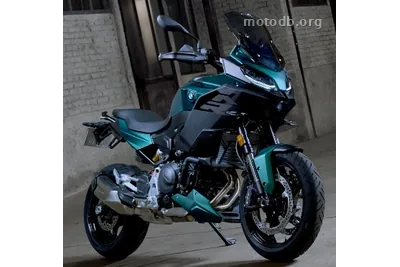
Within this generation, Yamaha is redesigning (or deconstructing?) its TRACER 9 model. The most visible change, both day and night, is the worldwide introduction of LED matrix headlights. Another benefit for long-distance riders, the TRACER 9 is now equipped with an automatic transmission (optional). These modifications represent a significant gamble on a model that had established a certain appeal with customers.
Where the previous TRACER played the role of a Swiss Army knife in a still fairly stylish or sporty outfit, the current TRACER 9 must integrate, as introduced, LED matrix headlights. Although these are only installed on the GT and GT+ versions, the standard Tracer 9 must adopt the styling chosen for their implementation. And these headlights are particularly imposing! Some Yamaha designers apparently found the front of the Harley-Davidson Pan America cool enough to add no fewer than 6 LED blocks to the front fascia, in addition to the daytime running lights. The front end now resembles the face of a teenager in the throes of puberty. The design function has outgrown the styling office. The look is likely to be divisive, starting with the community of owners of the previous TRACER, who may not find the balance of the old model.
Let's talk a bit about this technology for those considering the TRACER 9 GT. Tech enthusiasts will be delighted to learn that the matrix manages the high and low beam headlights. It is connected to a camera integrated into the upper section; this technology automatically detects surrounding traffic, natural light sources, and weather conditions. Thus, the intensity and distribution of the lighting automatically adjusts to provide the best possible visibility. Long-distance nighttime riders will certainly benefit from increased comfort and safety. And there’s more, as a bonus, the lighting is also adaptive in corners. Indeed, the LED matrix headlight system works with the six-axis IMU to adjust the beam when an inclination angle of 7 degrees or more is detected.
Fully automated, the system also allows for manual adjustment by the rider, who can at any time select one of three sensitivity levels manually.
The TRACER 9 has modified its fairing and windscreen since 2025. The windscreen is now larger and manually adjustable in 10 positions. Behind it, the rider will see that the motorcycle is equipped with a 7-inch TFT dashboard that can be configured to display one of three distinct themes. The screen is also compatible with Garmin’s Motorize app for optimal map-based navigation. The dashboard also displays Yamaha Ride Control (YRC) riding modes, tire pressure monitoring systems, and heated grips. You can connect your smartphone to the motorcycle via the free Yamaha MyRide app. The connection can be made via USB, Wi-Fi, or Bluetooth, and once connected, the rider can view incoming calls, emails, and SMS messages, while the rider and passenger can also listen to music and answer calls via connected Bluetooth headphones (optional). For 2025, the fairing now features an integrated storage compartment, located to the right of the fuel tank and containing a USB outlet.
Yamaha has not fundamentally changed the technical basis of the TRACER. Well-designed and effective both for touring and sporty riding, the motorcycle still relies on the aluminum Deltabox frame. Yamaha varies the thickness of its frame to provide rigidity where it is needed and offer some flex for the perfect compromise.
The modification for 2025 involves a steel rear subframe, 50 mm longer (+50 mm) and 150 grams lighter (-150 g) than before, to offer more space for those who regularly ride two-up. This modification, of course, required a new seat. It tapers at the junction with the fuel tank while offering more padding and a longer seat in the rear for increased comfort, according to Yamaha. The TRACER is no longer just a machine that excels at commuting in the morning; it is increasingly focused on travel. The ergonomics for these new aspirations have been finalized with the addition of a new handlebar and footrests.
Finally, the seat offers two height settings. It can be raised by 15 mm, without any tools. The standard seat height is 845 mm.
It is rare to have this type of information in press releases, but Yamaha has also specified that the TRACER 9 2025 benefits from a change in rim thickness on the rear wheel to optimize rigidity. The tire fitment uses Bridgestone Battlax Sport Touring T32 tires designed specifically for the TRACER 9. The internal structure of the tires has been developed to complement and improve the handling of the TRACER 9, reducing the weight of the front wheel by approximately 200 g and the rear by 300 g. We continue to repeat it, but limiting the weight of the wheels limits the unsprung mass and ensures a more manageable motorcycle. The TRACER 9 now weighs 212 kg when fully fueled. That’s a kilo less than the previous model.
The base TRACER 9 receives KYB suspension. The front fork offers 130 mm of travel (131 mm for the rear shock mounted on connecting rods). Braking uses 298 mm front discs and 267 mm rear discs. They are clamped at the front by 4-piston calipers and at the rear by a single-piston caliper.
The anchoring of the front fork to the frame has been revised to give more rake to the handlebar, thus reducing the minimum turning radius from 3.1 m to 2.9 m.
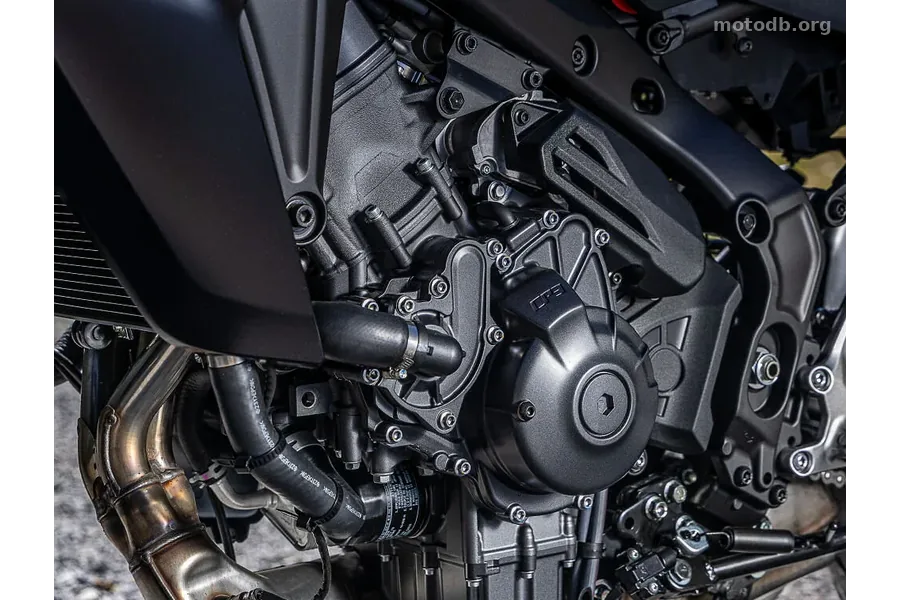
The heart of the TRACER 9 is, of course, the 890 cm3 three-cylinder engine, nicknamed “CP3.” It is here in a version that delivers a strong surge of torque in the midrange to best suit the motorcycle’s character. In this EURO 5+ configuration, it delivers a maximum power of 119 hp at 10,000 rpm, with a torque of 93 Nm at 7,000 rpm. No gain or loss compared to the previous configuration.
To ride according to your mood (or the conditions), you will have at your disposal five riding modes (three pre-set and two customizable) that are associated with the six-axis IMU and other technologies, such as the lean-sensitive suite of riding aids and cruise control. These riding modes (Sport, Street, Rain, Custom 1, and Custom 2) can be activated via the control located on the new right-hand handlebar control. The Custom mode allows the owner to adjust the parameters one by one in the TFT dashboard menu or using the app. When using the app, all new YRC custom settings will be loaded and available for the rider to select when the app is next connected to the motorcycle.
Optionally, you can equip the motorcycle with a Y-AMT (Yamaha Automated Manual Transmission). This transmission gives you the choice between fully automatic and manual gear shifting with an electronic control clutch.
Gear changes are then performed manually, unlike a foot-hand combination. Gear changes are performed using a control located on the left handgrip. The rider can either use their thumb to shift up to the next gear with the “+” control and their index finger to downshift with the “-” control, or opt for one-finger operation using only the index finger to pull the “+” control (upshift) and push it (downshift). The operation is of course performed without action on a clutch lever.
At a standstill and at low speed, the Y-AMT controls the clutch and gearbox to prevent stalling. The system fully takes over the gear shifting functions in each of the two automatic sub-modes: D and D+. Mode D offers smoother gear changes when mode D+ holds each gear longer for a more sporty ride. The rider can switch between riding modes using a simple button on the right-hand handlebar control.
Those who choose this automatic gearbox as an option will also include automatic turn signals and heated grips. The grips offer 10 levels of heat. Finally, for those who desire an old-fashioned gearbox, the quickshifter is optional.
In conclusion, Yamaha has perfected its machine in every possible way to make it hyper versatile. These undeniable qualities could only be marred by a style that is likely to be divisive…
Vincent Beaucousin - photos manufacturer
Standard equipment
- Assistance au freinage : ABS
- Nombre de mode de conduite : 5
- Taille de l'écran TFT couleur : 17,78 cm / 7 pouces
- ABS Cornering
- Jantes aluminium
- Béquille centrale
- Indicateur de vitesse engagée
- Régulateur de vitesse
- Bluetooth
- Prise USB
- Démarrage sans clé
- Contrôle de traction
- Pare brise réglable
- Contrôle anti wheeling
- Jantes forgées
- Contrôle de glisse
- Embrayage anti-dribble
- Selle réglable
- Phares adaptatifs en virage
- Contrôle du frein moteur
Practical info
- La moto est accessible aux permis : A
Indicators & positioning
Similar bikes
Multistrada V2 890
Multistrada V2 S 890
Norden 901
Reviews & comments
No reviews yet. Be the first to share your opinion!