Key performance
Technical specifications
Engine
- Displacement
- 675 cc
- Power
- 108.0 ch @ 11700 tr/min (77.4 kW)
- Torque
- 69.0 Nm @ 9100 tr/min
- Engine type
- In-line three, four-stroke
- Cooling
- Liquid
- Compression ratio
- 12.7:1
- Bore × stroke
- 74.0 x 52.3 mm (2.9 x 2.1 inches)
- Valves/cylinder
- 4
- Camshafts
- 2 ACT
- Fuel system
- Injection. Multipoint sequential electronic fuel injection with SAI
- Valve timing
- Double Overhead Cams/Twin Cam (DOHC)
- Starter
- Electric
Chassis
- Frame
- Aluminium beam twin spar
- Gearbox
- 6-speed
- Final drive
- Chain (final drive)
- Clutch
- Wet. multi-plate
- Front suspension
- Kayaba 41mm upside down forks, with adjustable preload, rebound and compression damping
- Rear suspension
- Kayaba monoshock with piggy back reservoir, adjustable for preload, rebound and compression damping
Brakes
- Front brakes
- Double disc
- Rear brakes
- Single disc
- Front tyre
- 120/70-ZR17
- Rear tyre
- 180/55-ZR17
Dimensions
- Seat height
- 805.00 mm
- Wheelbase
- 1385.00 mm
- Length
- 2030.00 mm
- Width
- 755.00 mm
- Height
- 1110.00 mm
- Fuel capacity
- 17.40 L
- Weight
- 189.00 kg
- Dry weight
- 167.00 kg
- New price
- 8 790 €
Overview
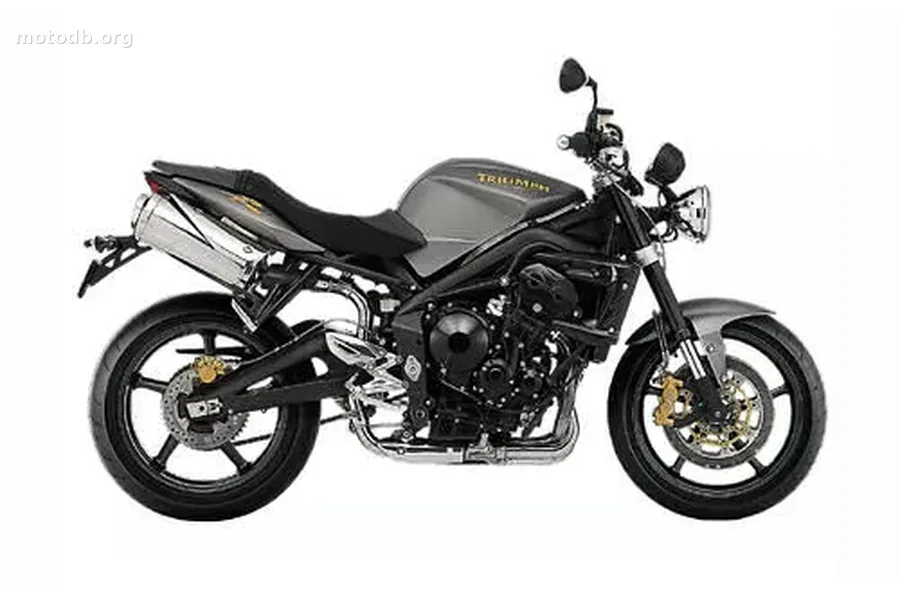
Do you remember that moment, around 2010, when the world of roadsters began to become seriously competitive? While the Japanese offered inline fours that were sometimes a little bland, Triumph pulled a rabbit out of the hat with its Street Triple R. It wasn’t just a simple badge stuck on a fairing. Take the Daytona 675’s beating heart, that 675 cc three-cylinder engine that growls with a unique soul, remove the fairing, and you have the base. But the R version went much further in its premeditation. For around €8790 at the time, it brought heavy artillery directly from the track.
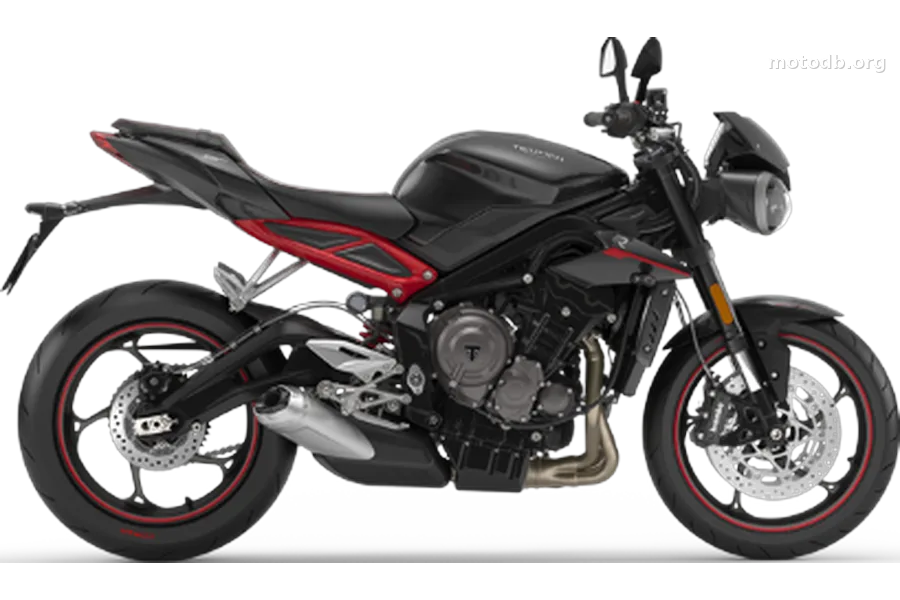
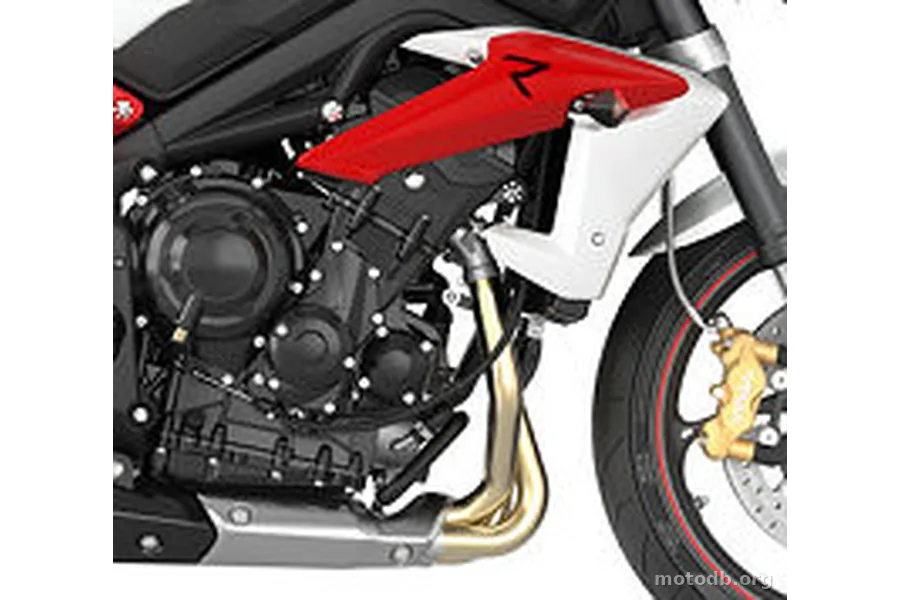
The secret lies in its suspension and braking equipment. Triumph literally grafted the entire front end from the Daytona, with its 41 mm Kayaba adjustable inverted forks, and those famous four-piston radial calipers that bite down on full-size discs. Braking goes from effective to lethal, offering bite and progressivity that transforms the approach to corners into pure pleasure. The twin-spar aluminum frame and the adjustable rear fork complete a chassis of surgical precision for its 189 kg in running order.
And the engine? This 675 cc three-cylinder remains one of the jewels of the era. It wasn’t seeking brute power – 108 horsepower at 11700 rpm and 69 Nm of torque – but delivery. The curve is linear, elastic, with a raspy sound that becomes an addiction from the mid-range. Coupled with a precise six-speed gearbox, it propels this Street Triple R to 220 km/h with a disconcerting ease. It’s a mechanical system that communicates, that encourages you to play with the tachometer, much more than a simple number-crunching machine.
Faced with a Yamaha FZ8 of the time or a Suzuki GSR750, the 2010 Triumph Street Triple R clearly positioned itself as the weapon of the urban track rider. It demanded a little more from its rider, with a 805 mm seat height and Magura handlebars offering an engaged riding position. It wasn’t the most comfortable bike for very long journeys, but the most communicative for a winding daily commute. Its 17.4-liter tank and contained weight made it an agile accomplice in the city and explosive as soon as you left the urban areas.
Today, when we look at the evolution towards the Street Triple R 765, we measure the leap. But the 2010 version, and its entire lineage up to the Street Triple R 2016 or 2017, wrote an essential page. It proved that a roadster could have the soul of a sportbike without its constraints. It was a bike with character, for a rider who sought pure interaction, long before the segment became overcrowded. Trying a Street Triple R from this generation still helps you understand why this model remains an absolute reference in the technical specifications of sporty roadsters.
Practical info
- La moto est accessible aux permis : A
Reviews & comments
No reviews yet. Be the first to share your opinion!