Key performance
Technical specifications
Engine
- Displacement
- 689 cc
- Power
- 73.4 ch @ 8750 tr/min (54.0 kW)
- Torque
- 68.0 Nm @ 6500 tr/min
- Engine type
- Bicylindre en ligne, 4 temps
- Cooling
- liquide
- Compression ratio
- 11.5 : 1
- Bore × stroke
- 80 x 68.6 mm
- Valves/cylinder
- 4
- Camshafts
- 2 ACT
- Fuel system
- Injection
- Starter
- électrique
- Euro standard
- Euro 5+
Chassis
- Frame
- type Diamant en tubes d'acier
- Gearbox
- boîte à 6 rapports
- Final drive
- Chaîne
- Front suspension
- Fourche téléhydraulique inversée Ø 41 mm, déb : 130 mm
- Rear suspension
- Mono-amortisseur, déb : 130 mm
Brakes
- Front brakes
- Freinage 2 disques Advics Ø 298 mm, fixation radiale, étrier 4 pistons
- Rear brakes
- Freinage 1 disque Nissin Ø 245 mm, étrier simple piston
- Front tyre
- 120/70-17
- Rear tyre
- 180/55-17
Dimensions
- Seat height
- 805.00 mm
- Seat type
- Selle biplaces
- Fuel capacity
- 14.00 L
- Weight
- 183.00 kg
- New price
- 7 999 €
Overview
Who remembers the price of a Yamaha MT-07 700 back in 2014, when it landed on the French market like a fragmentation bomb in the mid-size roadster segment? Nobody would have bet a penny on a 689 cc twin to shake up the established hierarchy. And yet. For over a decade, the MT-07 700 has sat atop the sales charts, becoming the benchmark every competitor tries to dethrone. Except that lately, the Honda Hornet 750 has been seriously eating into its lead. More powerful, better equipped, sold at a similar price point. Yamaha took the hit, conceded ground, then struck back. This 2026 version represents the most ambitious counterattack since the model was born.
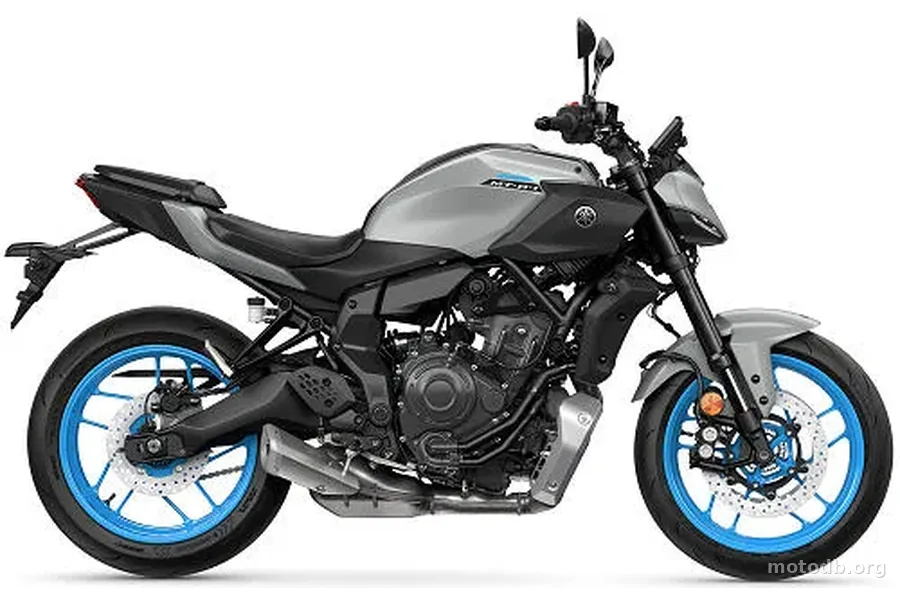
The first thing you notice is visual. The design is more refined, borrowing the sharp signature of the MT-09, gaining coherence. The side panels tighten up, the tank is more sculpted, the tail is shorter. The whole package exudes a certain stylistic maturity, even if Yamaha insists on keeping that divisive front light appendage. Moving on. Beneath this reworked bodywork, the entire architecture has been rethought. The diamond steel-tube frame retains only its original steering head. Everything else has been optimized to gain 12 to 13 percent more rigidity without adding weight to the structure. The swingarm ditches its decorative cutouts in favor of solidity. And above all, a 41 mm inverted fork makes its debut, flanked by radially mounted Advics calipers with four pistons on 298 mm discs. The front end moves into another league. The Spinforged aluminum wheels, produced by flow forming, save 480 grams of unsprung mass, which translates to 4 percent less inertia. The Yamaha MT-07 700 tips the scales at 183 kg wet. One kilo less than the outgoing model, when the upgrades should logically have added four and a half.
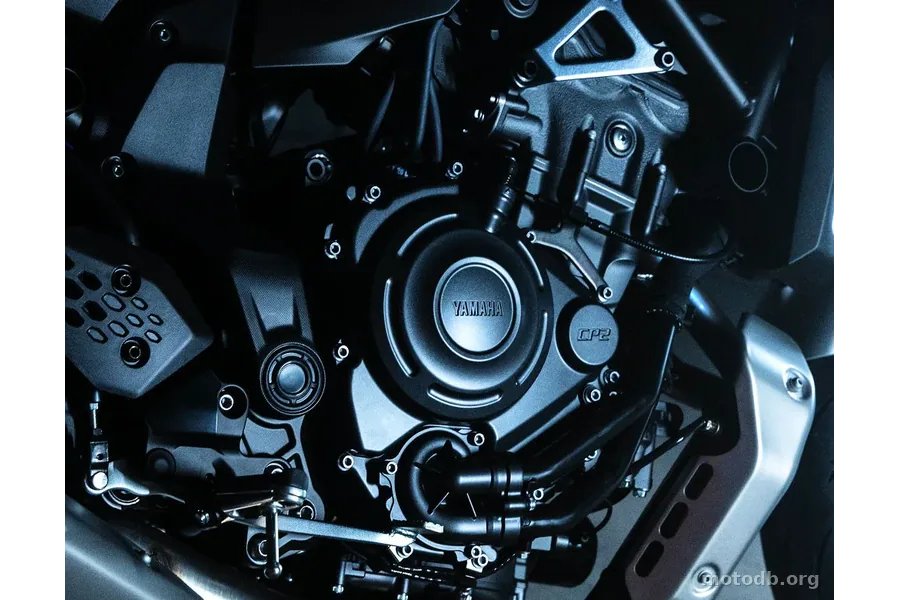
On the engine side, no revolution. The 689 cc CP2 parallel twin still produces 73.4 horsepower at 8,750 rpm and 68 Nm of torque at 6,500 rpm. Those wondering how much power the Yamaha MT-07 700 puts out will find the same answer as in 2023: output remains unchanged. The engine has simply been recalibrated to meet the Euro 5+ standard, with the compression ratio maintained at 11.5:1. Yamaha chose to hand the brief to acoustics engineers rather than engine developers. A sound amplification system, inherited from the MT-09 and MT-10, channels sound waves toward the rider to strengthen the mechanical connection. The result is divisive, but the concept is there. The intake has been revised, with an optimized air filter and ducts, and a new assist and slipper clutch makes daily riding and aggressive downshifts easier.
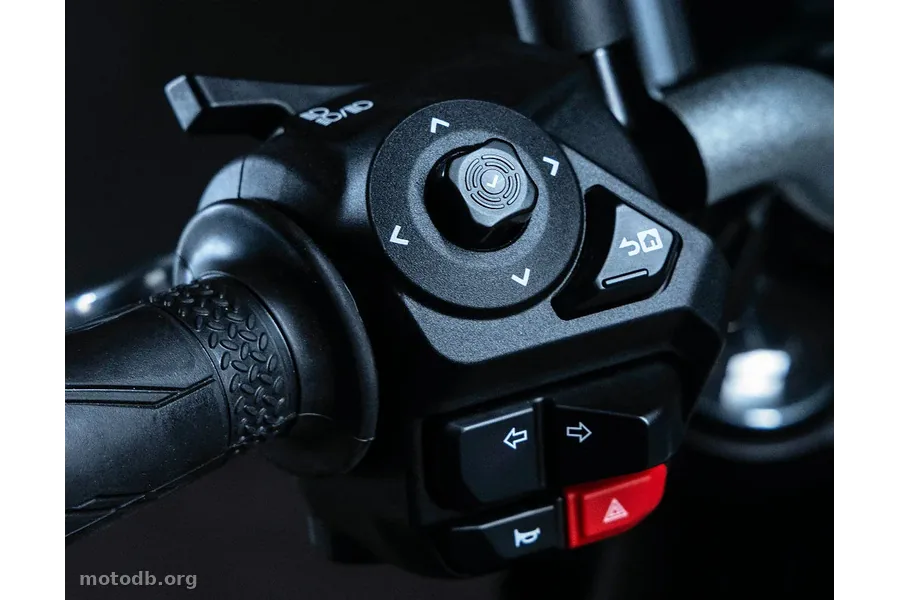
The real leap forward lies in the electronics. The MT-07 finally catches up with the competition. The ride-by-wire throttle opens the door to two-level traction control, three engine maps, and three riding modes: Sport, Street, and Custom. The 5-inch TFT screen keeps its dimensions but doubles the number of display themes and retains smartphone connectivity with Garmin StreetCross navigation. The new-generation switchgear simplifies operation, and the turn signals become smart with automatic cancellation after 15 seconds or 150 meters. The quickshifter is offered as an option. For those who want to go further, the Y-AMT version offers an automated transmission with an assisted manual mode or two automatic programs, D and D+. Virtually unheard of at this price point, only the Honda NC 750 DCT offered anything comparable.
At 7,999 euros, the Yamaha MT-07 700 remains positioned in the strategic A2 license segment, targeting riders looking for a versatile roadster without breaking the bank. Whether you compare its price to a 2015, 2016, or 2017 MT-07, the bill has climbed, but the equipment is in a completely different league. Against the Hornet 750, the Kawasaki Z 650, the Triumph Trident, and the onslaught from Chinese manufacturers, this overhaul answers every criticism point by point. The Yamaha MT-07 700 phase 2's average fuel consumption was already one of its selling points, with a 14-liter tank allowing decent range. This fourth generation doesn't change the recipe — it sharpens it. Yamaha puts its best-seller back on track, with the right weapons, at the right time.
Standard equipment
- Assistance au freinage : ABS
- Nombre de mode de conduite : 3
- Taille de l'écran TFT couleur : 12,70 cm / 5 pouces
- Jantes aluminium
- Indicateur de vitesse engagée
- Bluetooth
- Contrôle de traction
- Jantes forgées
- Embrayage anti-dribble
Practical info
- Véhicule accessible au permis A2 ou bridable à 47.5ch / 35 Kw
- La moto est accessible aux permis : A, A2
Reviews & comments
No reviews yet. Be the first to share your opinion!