Key performance
Technical specifications
Engine
- Displacement
- 997 cc
- Power
- 91.0 ch @ 8600 tr/min (66.9 kW)
- Torque
- 84.3 Nm @ 6250 tr/min
- Engine type
- 4 cylindres en ligne, 4 temps
- Cooling
- liquide
- Compression ratio
- 10.2:1
- Bore × stroke
- 74 x 58 mm
- Valves/cylinder
- 4
- Camshafts
- 2 ACT
Chassis
- Frame
- ouvert de type Diamond en acier
- Gearbox
- boîte à 6 rapports
- Final drive
- Cardan
- Front suspension
- Fourche téléhydraulique Ø 41 mm, déb : 140 mm
- Rear suspension
- mono-amortisseur unitrack, déb : 140 mm
Brakes
- Front brakes
- Freinage 2 disques Ø 300 mm, étrier 2 pistons
- Rear brakes
- Freinage 1 disque Ø 280 mm, étrier simple piston
- Front tyre
- 110/80-18
- Front tyre pressure
- 2.50 bar
- Rear tyre
- 150/80-16
- Rear tyre pressure
- 2.50 bar
Dimensions
- Seat height
- 790.00 mm
- Fuel capacity
- 28.50 L
- Weight
- 294.00 kg
- Dry weight
- 270.00 kg
- New price
- 9 298 €
Overview
Eighteen years on the market, and still here. When Kawasaki presented its 1000 GTR in 1986, no one imagined that this grand touring machine would cross the decades with so much tenacity. From the Kawasaki 1000 GTR 1987 and 1988 models to the 1996 and 1997 versions, passing through the 1989, 1990 and 1992 models, each year added a few thousand additional kilometers to the legend of this machine. Without fanfare, without revolution. Just work.
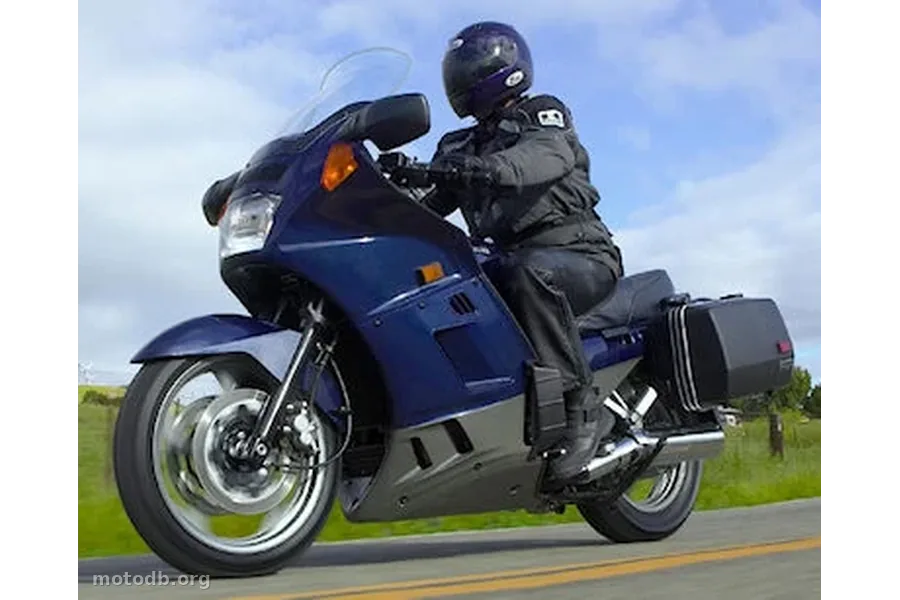
The inline four-cylinder engine of 997 cm³ produces 91 horsepower at 8,600 rpm and 84.3 Nm of torque at 6,250 rpm. Sensible figures, almost conservative for a liter bike. The anti-noise standards imposed during the 1994 update clearly hampered acceleration and silenced an engine that, in its earlier versions, had much more sonic personality. On the open road, the GTR proves sufficient. Loaded, with a passenger and luggage in the storage compartment, the limitations begin to be felt on highway portions. This is not alarming for normal use, but the touring rider who pushes hard during overtaking will feel the machine working.
The steel Diamond-type chassis has been doing the job for years. Effective under normal grand touring conditions, it reveals its age beyond 160 km/h, with a few lacing movements that remind you that you are on an older architecture. The suspension, 41 mm telescopic fork with 140 mm of travel and a Unitrack mono-shock at the rear, correctly manage comfort over long distances. The braking system with two 300 mm front discs and a 280 mm rear disc remains adapted to the machine's philosophy. Nothing sporty here, but a clean and progressive deceleration.
What makes the Kawasaki 1000 GTR’s reputation is its absolute practicality. The 28.5-liter tank was the largest in its class. With reasonable consumption, autonomy easily exceeds 400 kilometers, which places the GTR far ahead of rivals like the Honda ST1100 Pan European on this single criterion. The fairing really protects, the riding position preserves the back, the shaft drive eliminates chain maintenance constraints. The Kawasaki 1000 GTR technical specifications confirm it, 294 kg all full with a 790 mm seat remains a machine of serious proportions. Maneuverability in the city is therefore limited, the turning radius too large and the weight penalizing in slow maneuvers.
At €9,298, the 2004 GTR offers an equipment/price ratio that its competitors struggle to match. Those looking for a Kawasaki 1000 GTR used, whether on Le Bon Coin or on other specialized platforms, find well-maintained machines, often with low mileage for their age, because GTR owners are not Sunday pilots. Kawasaki 1000 GTR reliability is recognized on dedicated forums, and Kawasaki 1000 GTR maintenance proves to be inexpensive in use. As for Kawasaki 1000 GTR unlocking, the question arises little since the available power remains consistent with the touring vocation of the machine.
Its only real problem is aesthetic. The GTR has never been beautiful, and the 1994 update did not solve the problem. The integrated luggage lacks visual refinement. Some enthusiasts imagine transformation projects, Kawasaki 1000 GTR cafe racer or scrambler, but these are diversions that completely move away from what this motorcycle is. The GTR is a worker, not a style object. It is perfectly suited to the grand touring rider who covers 30,000 kilometers per year, who wants to arrive dry, without pain and without looking for a gas station every two hours. For this specific profile, few machines in this price range do better.
Practical info
- La moto est accessible aux permis : A
Indicators & positioning
Similar bikes
CRF 1000 L AFRICA TWIN Adventure Sports
1000 Stelvio
Reviews & comments
No reviews yet. Be the first to share your opinion!