Key performance
Technical specifications
Engine
- Displacement
- 1084 cc
- Power
- 102.0 ch @ 7500 tr/min (75.0 kW)
- Torque
- 112.0 Nm @ 5500 tr/min
- Engine type
- Bicylindre en ligne, 4 temps, calé à 270°
- Cooling
- liquide
- Compression ratio
- 10.5 : 1
- Bore × stroke
- 92 x 81.5 mm
- Valves/cylinder
- 4
- Camshafts
- 1 ACT
- Fuel system
- Injection
- Ignition
- Full transistorized ignition
- Starter
- électrique
- Euro standard
- Euro 5+
Chassis
- Frame
- Double poutre + simple berceau dédoublé en acier
- Gearbox
- boîte à 6 rapports
- Final drive
- Chaîne
- Clutch
- Wet, multiplate with coil springs, aluminium cam assist and slipper clutch, DCT 2 wet multiplate clutches with coil springs
- Front suspension
- Fourche téléhydraulique inversée Ø 45 mm, déb : 210 mm
- Rear suspension
- Mono-amortisseur, déb : 200 mm
Brakes
- Front brakes
- Freinage 2 disques Nissin Ø 310 mm, fixation radiale, étrier 4 pistons
- Rear brakes
- Freinage 1 disque Ø 256 mm, étrier simple piston
- Front tyre
- 110/80-19
- Rear tyre
- 150/70-18
Dimensions
- Seat height
- 835.00 mm
- Seat type
- Selle biplaces
- Wheelbase
- 1570.00 mm
- Ground clearance
- 220.00 mm
- Fuel capacity
- 24.80 L
- Weight
- 243.00 kg
- New price
- 18 599 €
Overview
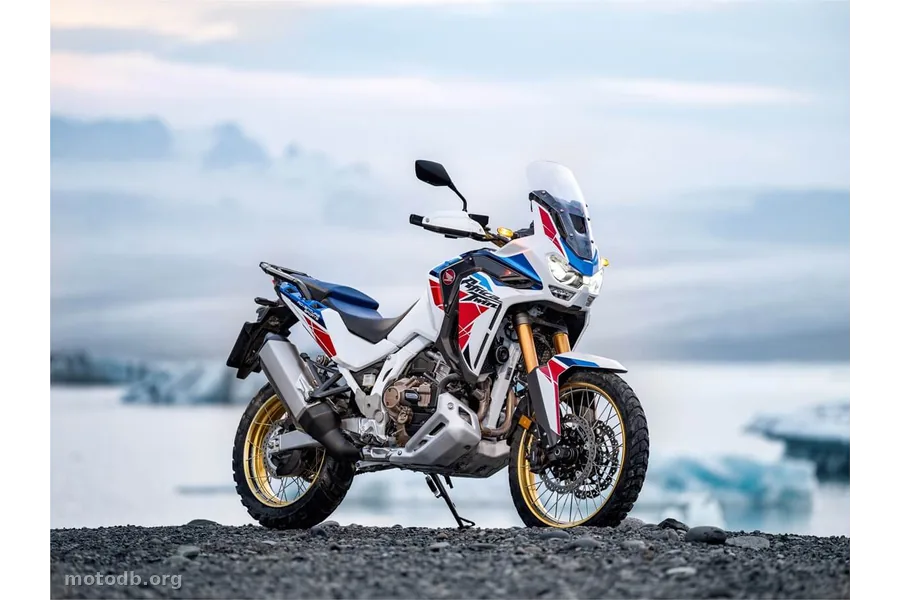
Why do people buy maxi-trails? To go chase some canyon runs, jungle adventures, and escapes? Some do. But for the vast majority, it will be for road use, always road use, still road use. Honda has seriously taken this consideration into account for the evolution of its large Africa Twin, the Adventure Sports. On the menu is a front end that changes philosophy, some modifications, and added vigor.
Whatever the version, the ATs are known and recognized for their very off-road approach. Particularly with a 21-inch spoke wheel that is quite thin. That’s finished for the Adventure Sport, now guided by a 19-inch rim fitted with a 110-width tire. It also reduces the travel of its suspension by 20 mm, with 21 cm of droop at the front and 23 cm at the rear. As for the frank off-road-oriented AX41T tires, they are replaced by mixed A41 tires. There, it’s clear, the large adventurer is drawing a line through some TT capabilities to improve its road efficiency.
Consequently, less rough terrain but more comfort. The Adventure Sport is committed to providing more grip, stability, and maneuverability. It will also be a little easier to place your foot on the ground during stops thanks to a seat height of 835 mm; at its lowest – it rises to 855 in the high position. But... The seat is 15 mm lower than the previous Adventure, while the suspensions have been lowered by 20 mm and the new seat contains a 15 mm thicker urethane foam cushion. Let the backside not clear the labyrinth of numbers....
The CRF 1000 "XXL" lifts a bit of its face and flanks for better protection for the rider, also helped by a new, still adjustable in 5 positions, windshield. Also in the name of well-being, the semi-active Showa EERA suspensions are now standard. Consequently, when choosing the Africa Twin, you either choose the standard model still very off-road in its boots, or you take the top-of-the-line Honda trail-GT with the maximum of embedded technologies. The electronic aids have also been recalibrated to adapt to the new front end.
More responsiveness from the engine as well. The large twin doesn’t want anyone to mess with its innards but from the point of view of the intake, no problem. The new intake ducts gulp more air, the injection bodies are repositioned, and the compression ratio is increased. The entire exhaust system has also been revised. This does not change its 102 horsepower at 7,500 rpm except that the engine is fuller at low and mid-revs. The torque is also up by 7% with a maximum of 11.5 mkg at 5,500 rpm (750 rpm lower than before). Honda is taking advantage of this power gain to recalibrate the DCT, with a smoother motorcycle launch and earlier gear changes.
A good update, for a machine that is gradually moving towards comfort and moving away from its original concept, without really denying it. When I was still a youngster, bikers who had sand in their dreams and ears looked like corsairs of the horizons. A backpack, a 660 Ténéré, a G/S, an Africa Twin, or a 650 Djebel, a knife, a passport, a pack of cigarettes, and they would set off. There wasn’t much power and almost nothing in electronics. The ignition perhaps...?! No, not always and not often.
The renewal of the Africa Twin has nothing to do with that era, with a real inspiration nonetheless. The Adventure Sports series also seeks to escape very far beyond the hills with its increased autonomy and protection arrangements. When it moved to 1100, it freed itself from that role to become a true demonstration of Honda’s striking power. The Honda 1100 Africa Twin Adventure Sports II is no longer an expedition; it is a diplomatico-strategic raid.
This more 'traveler' version stands out, today as yesterday, by its thicker physique. It’s not a question of ego or exacerbated presence but the desire to offer more protection for the rider. Moreover, road, travel, and long stages rhyme with more autonomy. Here, the tank carries 24.8 liters of fuel. 6 more than the Africa Twin; Honda announces 500 miles of riding in a relaxed manner.
The equipment shows heated grips, a substantial engine guard, and a 12V socket. However, with the two additional pupils under its beveled gaze, we suspect that other things have approached this hull of roads and sands. These two small optical units are for cornering lighting. As is modern, an IMU is found on board, allowing more functions at the electronic level. Including these electronically controlled headlights. Detail of the riding modes:
-TOUR: for use with a passenger and luggage; Maximum power level (1), engine brake at level 2 and cornering anti-lock braking system activated.-URBAN: responds to most situations; Intermediate power level (2), engine brake at level 2 and cornering anti-lock braking system activated.-GRAVEL: use on track/TT. Minimum power level (4), weak engine brake (3), cornering anti-lock braking system activated but off-road specific settings. In this configuration, the ABS cannot be disconnected on the rear wheel.-OFF-ROAD: intermediate power level (3), weak engine brake (3), cornering anti-lock braking system activated but off-road specific settings. The ABS can be disconnected on the rear wheel.-USER 1 & 2: allows the rider to define two distinct custom settings. He can choose his power level (between 1 and 4) and his engine brake level (between 1 and 3) as well as the type of intervention of the ABS(road/off-road parameters).
Remember the EERA acronym used earlier?
It notifies the 'Electronically Equipped Ride Adjustment'. In less barbaric terms, this means that these are electronically managed components. This piloted damping reacts in 5 modes, including one for free user settings. One is chosen, then the electrical systems adjust the preload and damping at the front, the compression and damping at the rear, to best suit the selected mission. In SOFT, the damping prioritizes comfort and smoothness. The MID mode is the most versatile. HARD stiffens the suspensions to the maximum for sporty riding. OFF-ROAD gradually increases the damping force as the front fork sinks, using the stiffest settings at the rear. Incidentally, the system allows you to adjust the preload based on the load according to 4 choices: Solo – Solo with luggage – Duo – Duo with luggage. Almost at the level of a BMW this stuff; except that the Teutons have a system that automatically corrects the attitude. No modes suit you? No worries: the USER lets you adjust the damping force with the fingertips.
Let's go back to the DCT gearbox. Honda's robotic gearbox is becoming increasingly efficient, although it still lacks that little something that no AI will ever be able to replace. Instinct, or something like that. Maybe free will... ? Well, we don’t care. The important thing is that the operation of this gearbox is real comfort. It will be even more effective with the inertial unit. The all-automatic D mode is perhaps a little too gentle; but in the city, we let it manage and evolve smoothly. Once out of there, the S mode and its three variations (S1 - S2 – S3) allow for more nervous driving. The nice and practical little extra is being able to take control of the gears with a nudge on the + or -. Oops, we're arriving on soft ground!? Perfect, there's a G mode, for Gravel, designed to better feel the traction.
By listening to its public and accumulating elements of comfort and technologies, the Honda Africa Twin Adventure Sports reaches a form of Grand Touring capable of confronting the leaders of the segment. Too much, one might think. Unless the standard model is there to preserve the notion of escape. Its weight close to 250 kilos and its price finish placing it on a stratum of premium road machine.
M.B. - Photo manufacturer
Standard equipment
- Assistance au freinage : ABS
- Nombre de mode de conduite : 6
- Taille de l'écran TFT couleur : 16,51 cm / 6.5 pouces
- ABS Cornering
- Jantes à rayon
- Indicateur de vitesse engagée
- Régulateur de vitesse
- Bluetooth
- Prise USB
- Poignées chauffantes
- Suspensions réglables électroniquement
- Contrôle de couple
- Contrôle anti wheeling
- Centrale inertielle
- Phares adaptatifs en virage
- Contrôle du frein moteur
Practical info
- La moto est accessible aux permis : A
- Pays de fabrication : Japon
Indicators & positioning
Similar bikes
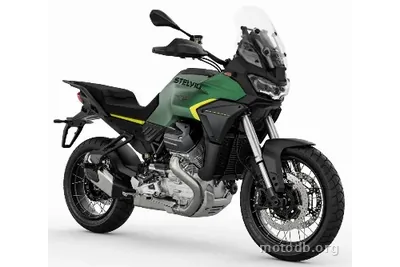
1000 Stelvio
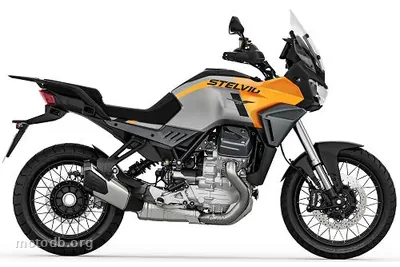
1000 Stelvio PFF Rider Assistance Solution
Reviews & comments
No reviews yet. Be the first to share your opinion!