Key performance
Technical specifications
Engine
- Displacement
- 1137 cc
- Power
- 164.0 ch @ 9500 tr/min (112.0 kW)
- Torque
- 119.0 Nm @ 7250 tr/min
- Engine type
- In-line four, four-stroke
- Cooling
- liquide
- Compression ratio
- 11.0:1
- Bore × stroke
- 79.0 x 58.0 mm (3.1 x 2.3 inches)
- Valves/cylinder
- 4
- Camshafts
- 2 ACT
- Fuel system
- Injection
- Lubrication
- Wet sump
- Ignition
- Computer-controlled digital transistorized
- Starter
- Electric
Chassis
- Frame
- double poutre en alu
- Gearbox
- 6-speed
- Final drive
- Chain (final drive)
- Clutch
- Hydraulic wet multi plate
- Front suspension
- Fourche téléhydraulique inversée Ø 43 mm, déb : 120 mm
- Rear suspension
- Mono-amortisseur, déb : 120 mm
- Front wheel travel
- 120 mm (4.7 inches)
- Rear wheel travel
- 120 mm (4.7 inches)
Brakes
- Front brakes
- Dual disc
- Rear brakes
- Single disc
- Front tyre
- 120/70-ZR17 58W
- Front tyre pressure
- 2.90 bar
- Rear tyre
- 180/55-ZR17 73W
- Rear tyre pressure
- 2.90 bar
Dimensions
- Seat height
- 810.00 mm
- Wheelbase
- 1490.00 mm
- Ground clearance
- 130.00 mm
- Length
- 2160.00 mm
- Width
- 720.00 mm
- Height
- 1200.00 mm
- Fuel capacity
- 23.00 L
- Weight
- 255.00 kg
- Dry weight
- 224.00 kg
- New price
- 13 600 €
Overview
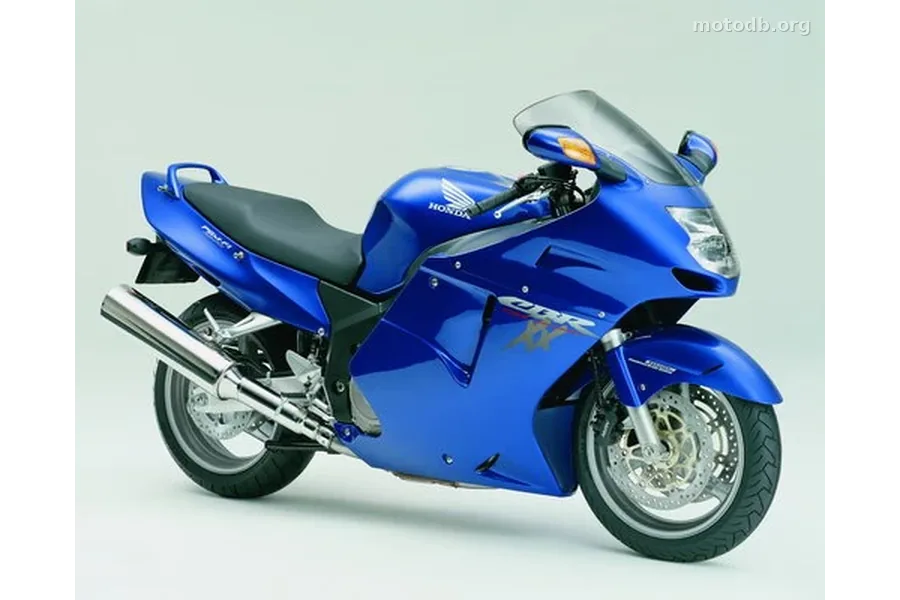
What machine could, in the late 1990s, claim to carry its rider to 300 km/h while remaining as civilized as a proper touring bike? Honda answered that question as early as 1996 with the CBR 1100 XX Super Blackbird, a velvet-clad missile that literally invented the hyper-touring category. This 2002 version, heir to several notable evolutions, remains a fascinating testament to Honda's philosophy: performance in service of comfort, never the other way around.
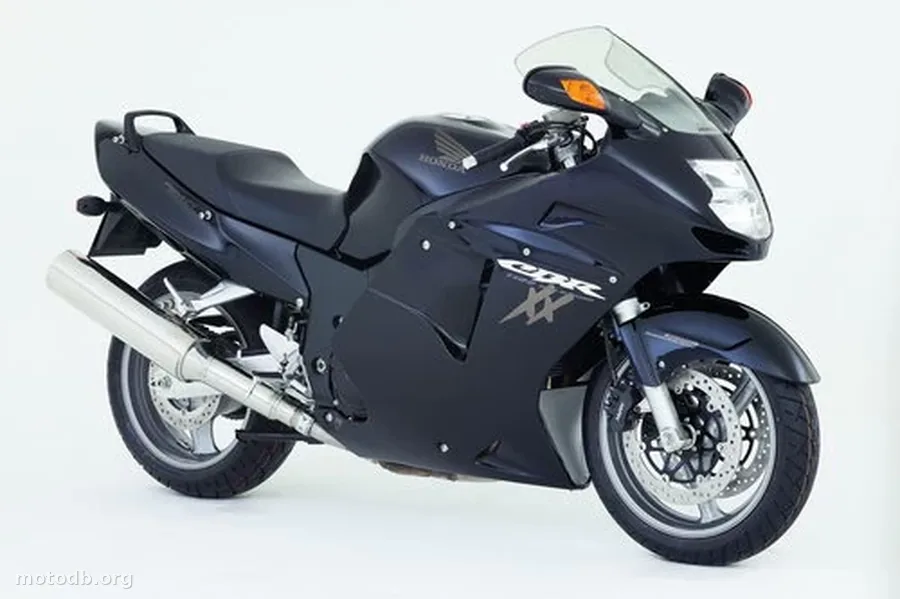
Beneath the streamlined fairing, shaped like an aircraft wing, the 1137 cc inline four-cylinder engine develops 164 horsepower at 9,500 rpm and, more importantly, 119 Nm of torque from just 7,250 rpm. Impressive figures, but they don't tell the whole story. The true character of this engine lies in its smoothness. It pulls without hesitation from the lowest revs, with an almost disconcerting linearity. Some will criticize precisely this overly polished temperament, this lack of grit in the power delivery. No vibrations, no mechanical roughness, no theatrical surge of power. The Blackbird delivers its horses with the discretion of a German sedan. It's a deliberate choice, and a divisive one. Since 1999, fuel injection and ram-air induction have further refined the character, adding flexibility to an already supremely smooth package.
The aluminum twin-spar frame, with its 1,490 mm wheelbase, offers a rare compromise between high-speed stability and agility through sequences of bends. The 43 mm inverted fork and rear monoshock, both calibrated for comfort, absorb road imperfections without turning the bike into an ocean liner. The dual front disc braking system with Dual-CBS inspires confidence, even though current standards have largely surpassed it. At 255 kg wet, the Super Blackbird makes no claim to being a lightweight, but it makes you forget that fact from the very first corners thanks to a well-placed center of gravity. You catch yourself riding it like a 750 sportbike, which borders on a magic trick for a machine of this size.
Then there's the matter of long-distance comfort. With its 23-liter tank and seat height of 810 mm, the Blackbird devours miles with ease for the rider. The downsides come from wind protection that falls a bit short beyond 200 km/h, and a riding position slightly tipped forward, betraying its sporting ambitions. The passenger, meanwhile, inherits adequate space but nothing more. On that front, a BMW R 1150 RT from the same era did considerably better. Against the Suzuki Hayabusa 1300 and the Kawasaki ZX-12R, its direct rivals in raw power, the Honda CBR 1100 XX concedes a few horsepower but retains a clear advantage in terms of overall balance and ease of handling.
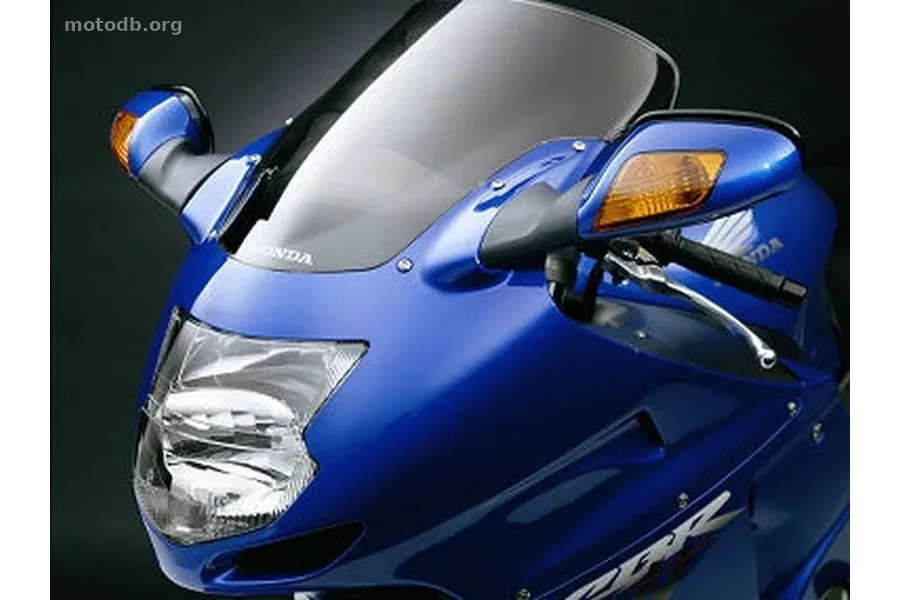
Priced at 13,600 euros in 2002, the Super Blackbird was aimed at riders who wanted to do everything with a single motorcycle: swallow a Paris-to-Marseille run in one sitting, have fun on a network of winding back roads, and keep a thread of throttle in reserve for effortless highway overtakes. Not the most exciting, not the most radical, but probably the most well-rounded of its generation. A fast GT in the noblest sense of the term, proving that you can flirt with 300 on the speedometer without sacrificing civility. Honda never truly replaced this formula, and that may be the finest tribute one can pay it.
Standard equipment
- Assistance au freinage : Double CBS
Practical info
- La moto est accessible aux permis : A
Reviews & comments
No reviews yet. Be the first to share your opinion!