Key performance
Technical specifications
Engine
- Displacement
- 937 cc
- Power
- 114.0 ch @ 9000 tr/min (83.8 kW)
- Torque
- 96.0 Nm @ 7250 tr/min
- Engine type
- Bicylindre en L à 90°, 4 temps
- Cooling
- liquide
- Compression ratio
- 13.3 : 1
- Bore × stroke
- 94 x 67.5 mm
- Valves/cylinder
- 4
- Camshafts
- 2 ACT
- Fuel system
- Injection Ø 53 mm
- Starter
- électrique
- Euro standard
- Euro 5
Chassis
- Frame
- treillis tubulaire en tubes d'acier
- Gearbox
- boîte à 6 rapports
- Final drive
- Chaîne
- Front suspension
- Fourche téléhydraulique inversée Ø 45 mm, déb : 170 mm
- Rear suspension
- Mono-amortisseur, déb : 150 mm
Brakes
- Front brakes
- Freinage 2 disques Brembo Ø 320 mm, fixation radiale, étrier 4 pistons
- Rear brakes
- Freinage 1 disque Ø 245 mm, étrier 2 pistons
- Front tyre
- 120/70-17
- Front tyre pressure
- 2.50 bar
- Rear tyre
- 180/55-17
- Rear tyre pressure
- 2.50 bar
Dimensions
- Seat height
- 870.00 mm
- Seat type
- Selle biplaces
- Fuel capacity
- 14.50 L
- Weight
- 193.00 kg
- Dry weight
- 178.00 kg
- New price
- 15 490 €
Overview
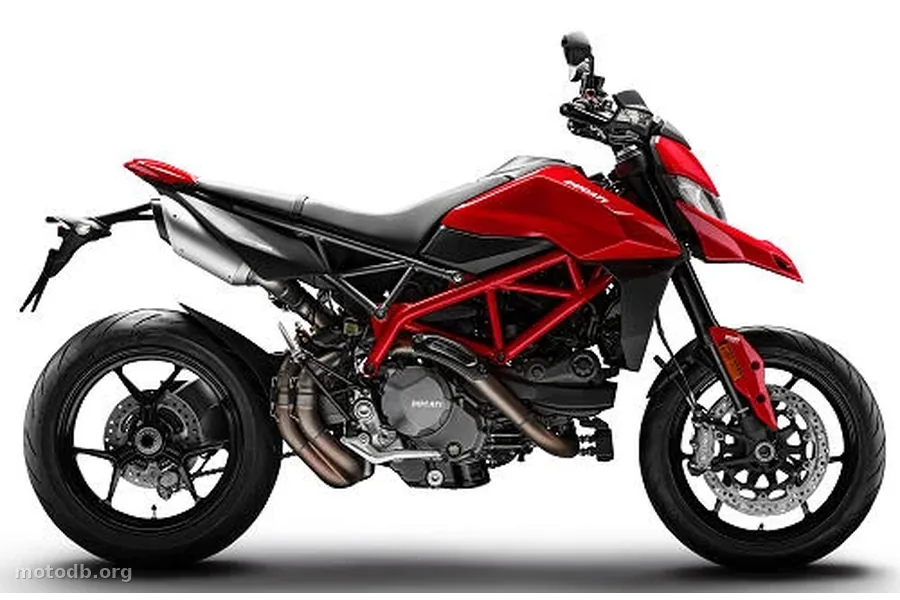
The Hypermotard from Ducati is a bit like a road version of kitesurfing, skateboarding, or a wolf and black rabbit hunt: a machine dedicated to fun and mischief. We leave the office, we put the suit in the trash and let off steam with plenty of sideways drifts as long as muscular wheelies are in order. Having developed a certain versatility with its 939, the HM is now returning to more exclusive, more physical loves, more “Etienne, hold him tight!”. But it's more like hard rock that we'd sing once gripped by the 950 Hypermotard.
The Italian supermotard seems to say – “Don’t stay lying down, I’m going to light you up.” Since its beginnings in 1100, its design has consistently conveyed this sense of madness. If the transition from 821 to 939 was done with almost no changes, the 950 chapter is much more demonstrative. Its beak has gained cheekbones, its shoulders have been aired, its seat is flatter, and the exhausts return to their original attachments by positioning themselves under the seat. Even if this fashion has passed long ago, it still looks good on some machines.
Above all, the Hypermotard plays fair with its appearance, which announces without hesitation its machinations: it’s going to be sporty, dry, crazy and Machiavellian. Without needing a large dose of brutes like on a Panigale V4. Half as much is already substantial and more than enough. Isn’t it a 950 twin?
Oops, let’s not confuse things. Yesterday 939, today 950, but the model names are just as out of sync with the displacement. The engine cubes 937 cm3, as was the case on the HM of before. No major changes are to be reported for this block but a nice series of adjustments allows it to gain 4 horsepower and a small boost in torque. Increased compression ratio, different profile for the exhaust cams, revised injection bodies (+1 mm), modified exhaust, lightened side casings, magnesium valve covers, aluminum chain tensioner, weight loss of 1.5 kilos and now hydraulic clutch give a technical facelift to this engine that isn’t very old. The result is a more efficient power curve with 4/5ths of the maximum torque responding to the call from 3000 rpm.
In 2021, the Euro5 regulations didn’t change the maximum power and torque values. Regardless of its version, the HM develops 114 horsepower at 9,000 rpm and 9.8 mkg at 7,250 rpm. We keep the 12 key, the CAD, the smoky boot, then the staff retouches the gearbox to give it more precision in locking the ratios and an easier-to-locate neutral.
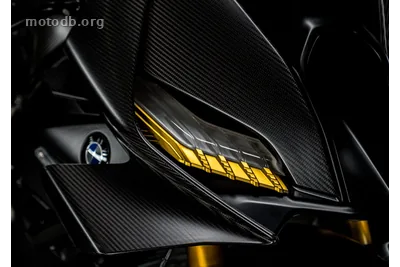
We were talking about the Panigale when discussing a chapter above. The 950 HM drew inspiration from its dashboard to update its instrumentation. It’s fashionable and modern to equip yourself with a color TFT screen, here 11 cm (approximately, or the size of an old Galaxy S4 mini). With a well-readable virtual tachometer, an indication of the engaged gear in its center and the display of the speed in good signage, the gaze is immediately drawn to the essentials. A little more attention will allow you to be informed about multiple parameters. The bike will not only be content with a beautiful instrumentation as a techno-digital evolution. It also wants a daytime running light, resembling viper hooks in its eyes. An inertial unit will soon be installed as well. Its dynamic recognition in 6 axes allows it to optimize traction control and anti-wheeling. ABS takes over to become active in curves. The more experienced will quickly disable some of these assists (or all) in order to draw numerous figures, sideways drifts, and parts of rims in the air. Three riding Modes (Sport – Touring – Urban) are part of the package. If all this isn’t enough for you, the options corner allows you to add the Up&Down shifter (standard on the SP) and the DMS multimedia interface to pilot the essential functions of your smartphone. To recharge it, a USB socket is located under the seat; as standard equipment.
More electronic luggage; and less weight! Ducati hasn’t forgotten to exercise its brainpower on the fundamentals. When transitioning from 939 to 950, some 4 kilos were shed. The engine cure is responsible for almost half. For the rest, we gained on the rims (800 grams), the brakes (600 gr), the fork (500 gr) and the frame. The Hypermotard now weighs only 200 kilos fully fueled. As a result, it’s almost back to its weight as a young man, when it adopted the 821 boiler. It hasn’t yet managed to regain its adolescent slenderness, when it was the 796 desmo with air that amused itself at the top of its 189 kilos for... 81 horsepower – But that version didn’t have to suffer from the necessary pollution standards and liquid cooling.
Having fun, especially with two - The HM 950 and its rider. The manufacturer wanted to strengthen the symbiosis between these players. To do this, the handlebar is even wider, in order to have more leverage; the seat is 53 mm thinner at the crotch and the ergonomics are generally revised to offer greater freedom of movement conducive to supermotard-style riding. However, plan for two knees to get on board, because the seat is 870 mm from the ground. A strategic part of the Hypermotard (and a Ducati), the frame is new, lighter and still designed according to a tubular steel trellis. A design whose rear loop had not been seen since the HM 821. Time has passed, choices have fluctuated, and the former aluminum structure makes way for the return of a steel tube subframe; which symbolically recalls the technique of the first Hypermot', the 1100.
The monobrach remains, strikingly highlighted, as are the Brembo 4-piston brake calipers with radial fixation. The discs are still 320 mm but the aluminum frets explain the weight loss mentioned earlier. New Y-spoke rims reduce unsprung weight and further favor agility. As for the suspensions, they are working around a new Marzocchi inverted fork larger (45 mm) and lighter, adjustable everywhere. Sachs takes care of the rear shock absorber, adjustable in rebound and preload. Ducati has retained the same suspension travel values as on the 939, namely 170 mm at the front and 150 mm at the rear.
For a moment, your passenger might wonder what their comfort will be on the edge of the chopped steak fast food style that will welcome their bottom. The 950 HM has thought of everything... to put them off: its footpegs are removable and the retaining strap can be stowed away if needed. This should quickly make it clear that this motorcycle is a dominant one that wants to be dominated, only by its rider. It is also available in SP version, with Öhlins elements, carbon parts, Marchesini rims, more sporty tires, a few kilos less and a "Corse" decoration. Once on the saddle of one or the other, the priority objective is simple to have fun: find roads as twisted as some ministerial decisions.
M.B - Photos constructeur
Standard equipment
- Assistance au freinage : ABS
- Nombre de mode de conduite : 3
- Taille de l'écran TFT couleur : 10,92 cm / 4.3 pouces
- Jantes aluminium
- Indicateur de vitesse engagée
- Prise USB
- Contrôle de traction
- Contrôle anti wheeling
- ABS Cornering
Practical info
- Véhicule accessible au permis A2 ou bridable à 47.5ch / 35 Kw
- La moto est accessible aux permis : A, A2
- Pays de fabrication : Italie
Reviews & comments
No reviews yet. Be the first to share your opinion!