Key performance
Technical specifications
Engine
- Displacement
- 888 cc
- Power
- 108.0 ch @ 9500 tr/min (79.4 kW)
- Torque
- 90.0 Nm @ 6850 tr/min
- Cooling
- liquide
- Compression ratio
- 13 : 1
- Bore × stroke
- 78 x 61 mm
- Valves/cylinder
- 4
- Camshafts
- 2 ACT
- Fuel system
- Injection
- Starter
- électrique
- Euro standard
- Euro 5+
Chassis
- Frame
- Berceau en acier tubulaire
- Gearbox
- boîte à 6 rapports
- Final drive
- Chaîne
- Front suspension
- Fourche téléhydraulique inversée Ø 45 mm, déb : 240 mm
- Rear suspension
- Mono-amortisseur, déb : 230 mm
Brakes
- Front brakes
- Freinage 2 disques Brembo Ø 320 mm, fixation radiale, étrier 4 pistons (monobloc Stylema)
- Rear brakes
- Freinage 1 disque Ø 255 mm, étrier simple piston
- Front tyre
- 90/90-21
- Front tyre pressure
- 2.47 bar
- Rear tyre
- 150/70-17
- Rear tyre pressure
- 2.88 bar
Dimensions
- Seat height
- 860.00 mm
- Seat type
- Selle biplaces
- Fuel capacity
- 20.00 L
- Weight
- 228.00 kg
- New price
- 17 395 €
Overview
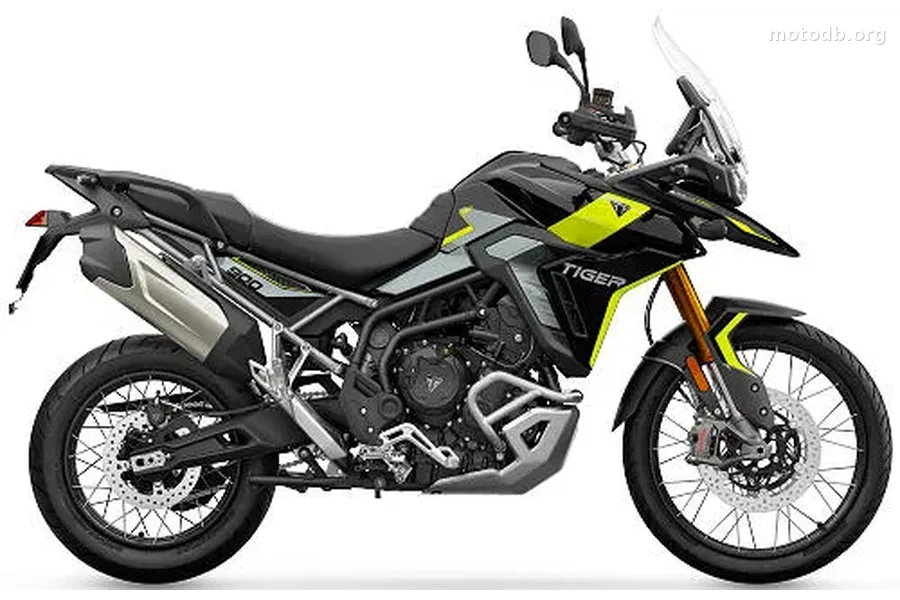
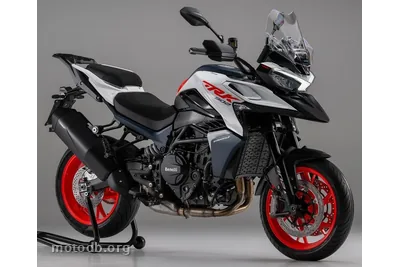
Here is one of the best ways (if not the best) to discover the world on a Triumph. The Tiger 900 Rally Pro, in its version Rally Pro, outperforms the entire family. This family has, in fact, been reduced to two models in the catalog: the GT Pro and this Rally Pro. They are there to cover all the desires of the public in this vigorous and very strategic mid-size trail category.
Mid-size is a way of speaking. From BMW to Ducati, from Japan to Europe, from the road to off-road, a displacement close to 1000 has become the norm – the 1200 and larger models benefit from this. Our intrepid tiger here is expressed and launched with the well-known 888 cm3 engine from the range since 2020. The manufacturer advances it further with an increased power output of 108 horsepower! A significant progress for this three-cylinder engine, which remained at the limit of 95 horsepower to leave a gateway for young license holders. But those times are gone, and it now wants to show its potential loud and clear.
Where have these 13% of power been found? By revisiting its internals. New, longer 15 mm intake trumpets send air into a cylinder head where the orifices are wider. Then, camshafts with higher lifts stir, while new pistons compress the gaseous mixture much more strongly – the compression ratio goes from 11.3:1 to 13:1. The T-plane remains as full as before but now delivers 13 extra horsepower, with a maximum at 9,500 rpm. The torque is not as well endowed but still benefits from 3 Nm of extra power. At 6,850 rpm, the peak reaches 9.2 mkg.
In terms of watts, the Tiger 900 is now almost as well-equipped as a 1050 V-Strom (separated by 1 mkg). Still with its specific character linked to its 270°-180°-270° offset firing order. The Rally Pro has exactly the same power and the same tubular steel trellis frame as the GT and GT Pro, but its peripherals are completely different to validate its passport for off-road use. There are slight differences in geometry, with a more closed steering angle (24°4 instead of 24°6 for the GT), a 5 mm shorter wheelbase, and a longer rake of 14.1 mm. Triumph favors maneuverability for this machine; logical given its appetite for dynamic terrain.
But it is in the suspension that the most significant changes are made. The GT models are equipped with Marzocchi suspension, while the Rally Pro prefers Showa, with much larger travel. 60 mm more, bringing the values to 240 mm for the 45 mm inverted fork and 230 mm for the mono-shock. Both are almost fully adjustable; only the rear rebound damping is missing. The connection to the ground, whatever it may be, is made with more specific tires: Bridg’ Adventure in 90/90-21 and 150/70-17. With this, the English bike can go far beyond mere decoration and offer a wide range of excursions without fearing the rough spots of the trails. Especially since its larger engine guard (more encompassing) and crash bars are there to protect most of the mechanics. The Tiger knows this well, as it is a carryover of its previous equipment.
The second-generation model improves with an isolated handlebar mount that better isolates from vibrations and moves 15 mm closer to the rider. The seat is flatter and slightly thicker, Triumph has added a USB-C port to the dashboard, installed the “My Triumph” connectivity module as standard (to play with the smartphone, its music, its calls and provide simplified navigation) and replaced the TFT screen. Still 7 inches, it significantly improves its ergonomics by adapting to that of the 1200. But it still feels a bit clunky in some procedures.
The riding modes are carried over, namely the six configurations that are Road, Sport, Rain and Off-Road of all 900 Tiger, plus the Rider customizable inherent to the Pro finish, plus the Off-Road Pro exclusive to the Rally Pro. With it, the rider can completely deactivate ABS and traction control, in order to fully exploit the machine… to the height of its technical baggage. It’s not because Ivan Cervantes jumps 3 meters high that everyone can do it.
For several years, the Hinckley brand has distinguished itself by offering high-end and sporty braking on its trails with excellent Brembo components: Stylema calipers and 320 mm discs. Respect! The Tiger 900 family wants to be even safer with the addition of an electronic brake force distribution between the front and rear. Consequently, more efficiency and stability during heavy braking. During these muscular phases, the warning lights come on to signal an “unexpected event.”
Around the 6 riding modes, a set of driving assistance systems are active, such as traction control and cornering ABS, the Up&Down shifter, the cruise control and tire pressure monitoring. Comfort is enhanced via a 50 mm adjustable bubble, a height-adjustable seat, seats and heated grips, two USB ports and a 12V socket, a center stand, handguards, a slipper clutch and enough to do good stages with 20 liters in the tank. Also included in this package is the DRL signature, all LED lighting, backlit switches, additional lights, Bluetooth and tubeless spoke wheels.
A quick summary? The Triumph 900 Tiger Rally Pro second generation is: - A more powerful engine - A slight design retouch - Electronic coupled braking - A TFT screen with new graphics - Connectivity as standard - An improved handlebar and a more comfortable seat - A larger engine guard - An extra USB port and smart turn signals.
At first glance, with its very timid facelift (just the flanks and cheeks), everything suggests that the 900 Tiger Pro evolves almost not at all. It nevertheless changes dimension with more power and a few refinements. The price inevitably rises, crossing the 17,000 euro mark. For a 900, that’s a hefty price. But nothing surprising given the level of equipment, the positioning of its big brother 1200 (at 5,000 euros more), the upward tariff leveling of the entire segment and the qualities of the machine. With the Tiger Rally Pro, forget the idea of a simple trail and an expedition with a blanket and a knife – welcome to business class!
M.B - Photos manufacturer
Standard equipment
- Assistance au freinage : ABS
- Nombre de mode de conduite : 6
- Taille de l'écran TFT couleur : 17,78 cm / 7 pouces
- ABS Cornering
- Jantes à rayon
- Shifter
- Béquille centrale
- Indicateur de vitesse engagée
- Régulateur de vitesse
- Bluetooth
- Prise USB
- Contrôle de traction
- Poignées chauffantes
- Pare brise réglable
- Suspensions réglables électroniquement
- ABS déconnectable
- Crash Bars / Top Blocks
- Embrayage anti-dribble
- Selle réglable
- Selle chauffante
- Centrale inertielle
- Commodes rétro-éclairés
- Surveillance de la pression des pneus
Practical info
- La moto est accessible aux permis : A
- Pays de fabrication : Thailande
Reviews & comments
No reviews yet. Be the first to share your opinion!