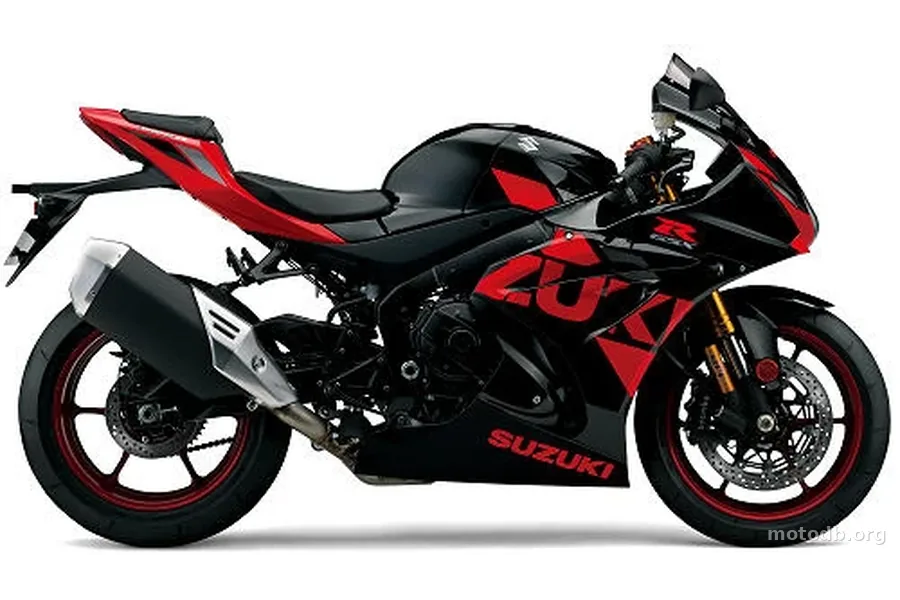
Key performance
Technical specifications
Engine
- Displacement
- 999 cc
- Power
- 202.0 ch @ 11500 tr/min (135.0 kW)
- Torque
- 117.0 Nm @ 10000 tr/min
- Engine type
- In-line four, four-stroke
- Cooling
- Liquid
- Compression ratio
- 13.2:1
- Bore × stroke
- 74.5 x 57.3 mm (2.9 x 2.3 inches)
- Valves/cylinder
- 4
- Camshafts
- 2 ACT
- Fuel system
- Injection
- Valve timing
- Double Overhead Cams/Twin Cam (DOHC)
- Lubrication
- Wet sump with oil cooler
- Starter
- Electric
Chassis
- Frame
- Twin-spar frame made of five cast sections
- Gearbox
- 6-speed
- Final drive
- Chain (final drive)
- Clutch
- Wet, multi-plate type
- Front suspension
- Inverted telescopic, coil spring, oil damped
- Rear suspension
- Link type, single shock, coil spring, oil damped
- Front wheel travel
- 120 mm (4.7 inches)
- Rear wheel travel
- 130 mm (5.1 inches)
Brakes
- Front brakes
- Double disc. Brembo 4-piston
- Rear brakes
- Single disc. Nissin-1 piston
- Front tyre
- 120/70-ZR17
- Front tyre pressure
- 2.50 bar
- Rear tyre
- 190/50-ZR17
- Rear tyre pressure
- 2.90 bar
Dimensions
- Seat height
- 825.00 mm
- Wheelbase
- 1485.00 mm
- Ground clearance
- 130.00 mm
- Length
- 2075.00 mm
- Width
- 705.00 mm
- Height
- 1145.00 mm
- Fuel capacity
- 16.00 L
- Weight
- 203.00 kg
- New price
- 19 399 €
Overview
Is it still possible, in 2024, to stir the emotions of purists with classic Japanese mechanics, against the onslaught of Italian V4s and overpowered four-cylinder engines? The Suzuki GSX-R1000R, in its 2018 version, provides a sharp, almost provocative answer. It proves that the “Gex” DNA doesn’t need a revolution to remain relevant, but a relentless evolution. With its 202 horsepower at 11,500 rpm and 117 Nm of torque, the 999 cm³ engine isn’t the most powerful in the segment, but it possesses that typically Suzuki ability to deliver its power in a linear and usable way. The real magic lies in the intake variable valve timing system, a technology that gives this engine the breathing of a wild cat across the entire rev range, avoiding the mid-range dip that hampered previous generations.
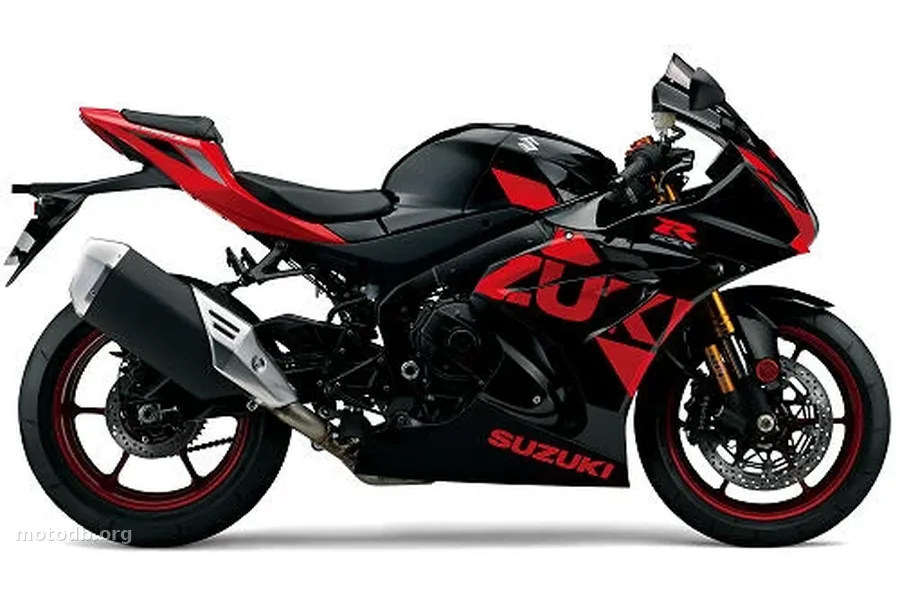
Where the 2018 GSX-R1000R truly makes a leap is in its electronic equipment. Finally, Suzuki was catching up, offering a complete package with 10-level traction control, ride-by-wire throttle, and active ABS, all managed by an inertial measurement unit. This array, now standard on a high-end sportbike, was at the time the key to competing with an Aprilia RSV4 or a BMW S1000RR. The “R” version was distinguished by an Up&Down shifter and a Launch Control, gadgets certainly, but which sounded like a commitment to track riders. The real gem, however, resided in its chassis: a Showa BFF cartridge fork and a BFRC Lite shock absorber, elements offering fine adjustment and pure sensations, far from the basic suspensions of the standard version.
With an announced weight of 203 kg fully fueled and a seat height of 825 mm, this Suzuki GSX-R1000R wasn’t the lightest nor the most welcoming for smaller riders. Its 16-liter tank also recalled that its kingdom was the track, or winding roads, much more than long journeys. Yet, it was in this definition of a pure sportbike that all its charm resided. At a price approaching 19,400 euros at the time, it positioned itself as a more affordable and mechanically more traditional alternative to the Italians, who were beginning to flirt with stratospheric prices.
Today, when we evoke the official characteristics of the future Suzuki GSX-R1000R 2026, with an engine probably reworked for Euro 5+, we can’t help but look at this 2018 generation with nostalgia. It represented the last breath of a Japanese sportbike before emission regulations came to complicate the equation. It wasn’t perfect, a bit heavy, sometimes spartan, but it exuded a mechanical honesty and remarkable efficiency that stuck in your mind. For the track rider seeking a reliable, predictable, and astonishingly efficient machine, rather than a demonstration of brute force, this GSX-R1000R remains a significant milestone. It poses a simple question: is the quest for pure power still the only path to emotion? Its answer, through its incredibly charming engine and precision chassis, was a resounding “no.”
Standard equipment
- Assistance au freinage : Carrera ABS
Practical info
- La moto est accessible aux permis : A
Reviews & comments
No reviews yet. Be the first to share your opinion!