Key performance
Technical specifications
Engine
- Displacement
- 999 cc
- Power
- 218.0 ch @ 14500 tr/min (160.3 kW)
- Torque
- 112.8 Nm @ 11000 tr/min
- Engine type
- 4 cylindres en ligne, 4 temps
- Cooling
- liquide
- Compression ratio
- 14.5 : 1
- Bore × stroke
- 80 x 49.7 mm
- Valves/cylinder
- 4
- Camshafts
- 2 ACT
- Fuel system
- Injection Ø 52mm
- Starter
- électrique
- Euro standard
- Euro 5+
Chassis
- Frame
- double poutre périmetrique en aluminium
- Gearbox
- boîte à 6 rapports
- Final drive
- Chaîne
- Front suspension
- Fourche téléhydraulique inversée Ø 45 mm, déb : 120 mm
- Rear suspension
- Mono-amortisseur, déb : 118 mm
Brakes
- Front brakes
- Freinage 2 disques Nissin Ø 320 mm, fixation radiale, étrier 4 pistons
- Rear brakes
- Freinage 1 disque Ø 220 mm, étrier simple piston
- Front tyre
- 120/70-17
- Front tyre pressure
- 2.50 bar
- Rear tyre
- 200/55-17
- Rear tyre pressure
- 2.90 bar
Dimensions
- Seat height
- 865.00 mm
- Fuel capacity
- 16.50 L
- Weight
- 194.00 kg
- New price
- 37 000 €
Overview
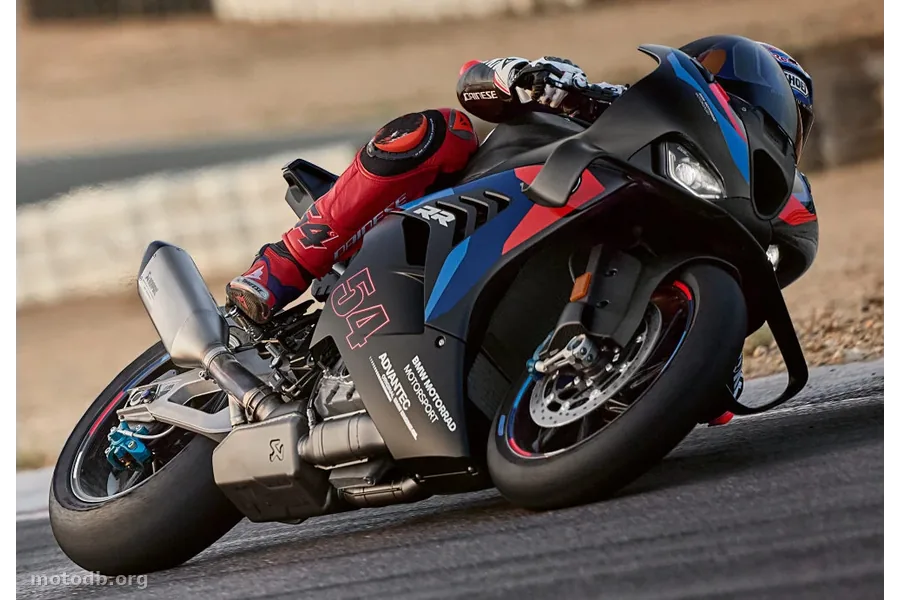
In 2025, after claiming a long-awaited first title in World Superbike, one might have thought BMW could have rested on its laurels, but that was not the case. The Germans, who undoubtedly intend to repeat their results, sought and improved every detail possible on the M 1000 RR. Thus, the new Missile gains performance thanks to increased power, improved aerodynamic downforce, and a lean-angle sensor technology.
Overall, the M 1000 RR retains the inline four-cylinder engine that made BMW’s reputation. However, the power gain is not insignificant, as it is an increase of 4 kW (6 hp) for a total of 160 kW (218 hp) at 14,500 rpm, compared to 156 kW (212 hp) at 14,500 rpm previously. The maximum engine speed remains at 15,100 rpm.
This increase in power was made possible thanks to the use of new titanium valves, an increase in the compression ratio to 14.5:1 (previously 13.5:1), new intake ducts, a new oval-shaped exhaust, an adapted airbox geometry, as well as a modified combustion chamber shape and larger throttle bodies. Wow! Just reading about these modifications and the small-batch production, this phenomenal engine alone is worth the price of the motorcycle. It would almost be banal, but having the privilege of riding on these race machines barely homologated for the road was, until recently, still an extremely rare pleasure, especially in the era of the Honda RC30 or 45.
The diameter of the throttle body is now 52 mm instead of the previous 48 mm, which corresponds to an increase in the cross-sectional area of approximately 17 percent. The piston design has been revised to withstand the additional thermal and mechanical stresses. For optimal flow conditions, the valve guides are trimmed flush with the surface of the orifices, and the exhaust valves have smoother transitions and a reduced seat angle from 45 to 40 degrees. To prevent backflow, the intake orifices have a pronounced edge at the valve disc level.
The titanium exhaust system has been adapted to the new, noticeably larger oval shape of the exhaust orifices. It features correspondingly designed connection flanges and oval-shaped collector inlets. The internal routing of the pre-silencer pipe has also been redesigned.
Power is controlled via a short-stroke throttle with a reduced angle of rotation. The new short-stroke throttle sees its angle of rotation reduced from 72 degrees to 58 degrees. It will then be necessary to be “fine” on the throttle, even though BMW announces having adjusted the settings to maintain total control. The throttle position sensor has been retained to attempt to offer a bit of “smoothness” in the way the motorcycle will react (especially in the action of all the assistance systems). All riding modes have been adapted to this new parameter.
As a cherry on top, despite the increase in performance, the engine meets the Euro5+ standard.
BMW has also made improvements to the control systems that assist the rider in chasing lap times. The Dynamic Traction Control (DTC) now features the new Slide Control thanks to the lean-angle sensor technology. This has led to a new subdivision of the DTC into Slip Control and Slide Control. The introduction of the lean-angle sensor technology has also led to the new Brake Slide Assist function of the BMW RaceABSPro.
In detail, the dynamic traction control (DTC) receives a new function to control slippage via the lean-angle sensor. The DTC is “divided” into two channels: wheel slip and drift/slide. This assistance is made possible by a 6-axis sensor group and a lean-angle sensor that intervene during acceleration. The Slide Control becomes an extension of the slip regulation (DTC). The central component of Slide Control is the lean-angle sensor. Using its signal, as well as the wheel speed and signals from the sensor box, the rear wheel slip angle ("drift angle") is determined.
Depending on the rear tire characteristics, the road surface, and the slip tolerated by the slip regulation, a slip angle is established. In a stable riding state, this angle is so small that it is not perceived by the rider. The Slide Control now associates the slip angle with a target value depending on the DTC setting. If this target value is likely to be exceeded, the Slide Control reduces the transmission slip.
For use on the track with slick tires, the rider is assisted in controlling rear-end drift depending on the selected riding mode (and its settings) combined with the DTC. The M RR has two different settings with different pre-defined drift angles: the DTC 3 and 2 settings. These allow very experienced riders to maximize the rear tire potential and influence the trajectory via the accelerator and thus the “drift angle.” Analogous to this new Slide Control function, the use of the lean-angle sensor also enables the new Brake Slide Control function.
The DTC still offers four fixed basic settings for the riding modes: “Rain,” “Road,” “Dynamic,” and “Race.” In the “Race Pro” riding modes, a fine adjustment is also available. In the special “Riding Modes Pro” equipment, the DTC Wheelie function is also adjustable. It allows to suppress or limit wheelies via the detection of the front wheel lift.
The BMW RaceABSPro technology adapts to the modern riding style that has emerged in recent years.
The aerodynamic qualities of the M 1000 RR have been optimized thanks to the redesigned front fairing. The purpose of this design is to offer more aerodynamic downforce thanks to the new M Winglets 3.0. In the redesign of the front fairing, the bubble has not escaped this quest for performance. Unlike fairings made of plastic, the M Winglets are made of carbon fiber (CFK), they now produce greater aerodynamic downforce, both in a straight line and in corners. This results in even greater confidence in the front end, both when placing it and at high speeds or during acceleration phases where the tendency to wheelie has been further reduced. Despite the increased aerodynamic load at 314 km/h, which has increased from 22.6 kg to 30 kg, the top speed remains unchanged, at 314 km/h.
BMW provides few details about the chassis. Just a few words about the “Flex-Frame” which receives a new engine mount. An upper mounting point on the left side of the engine has been moved from the cylinder head to the engine case. At the fork insertion point for the steering column, the frame has also been stiffened. For the record, Flex Frame technology has been introduced by BMW for about ten years. It allows, thanks to holes in the lateral elements of the frame, to obtain a more or less rigid chassis in certain places in order to obtain the perfect compromise between rigidity and steering / handling capacity of the motorcycle. The openings are not visible to the customer.
For the rest, the rider was already very well equipped on the previous version, there was no reason for that to change: carbon wheels (120 front / 200 rear tire), large Nissin braking system with 320 mm discs at the front and 220 mm at the rear bitten by four and two-piston calipers. The suspensions are equipped with a 45 mm fork adjustable in all directions, the rear shock absorber also (preload, compression and rebound). The stroke is unchanged at 120 mm at the front and 118 mm at the rear. Thus equipped (and well equipped!), the M 1000 RR weighs 183 kg dry and 194 kg in running order.
As an option, the motorcycle can be equipped with the M Competition pack which includes numerous M Performance parts with the aim of making it even more efficient on the track with for lap time hunters: the M GPS Laptrigger which allows to easily measure your lap times. The pack also includes aero carbon wheel covers M, M endurance chain, M brake and clutch levers, and M footrests. It also includes the passenger pack if a bag of sand wants to be shaken.
As before, the new M RR is offered in two versions: the base M 1000 RR in the base Lightwhite uni color and the M 1000 RR M Competition in the base Blackstorm metallic color. In addition, all the carbon parts of the M 1000 RR are finished in matte.
V2B - Manufacturer photos
Standard equipment
- Assistance au freinage : ABS Pro
- Nombre de mode de conduite : 7
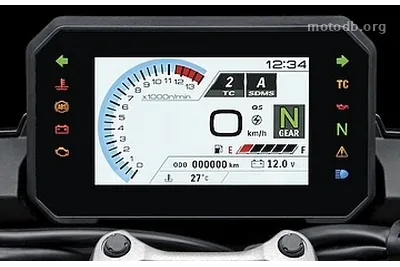
- Taille de l'écran TFT couleur : 16,51 cm / 6.5 pouces
- ABS Cornering
- Jantes Carbone
- Shifter
- Indicateur de vitesse engagée
- Régulateur de vitesse
- Prise USB
- Aide au démarrage en côte (Hill Hold Control)
- Aide au départ arrêté (Launch Control)
- Contrôle de traction
- Poignées chauffantes
- ABS déconnectable
- Contrôle anti wheeling
- Carénage carbone
- Contrôle de glisse
- Embrayage anti-dribble
- Centrale inertielle
- Contrôle du frein moteur
- Limitateur de vitesse dans les stands
Practical info
- La moto est accessible aux permis : A
Reviews & comments
No reviews yet. Be the first to share your opinion!