Key performance
Technical specifications
Engine
- Displacement
- 123 cc
- Power
- 10.0 ch (7.3 kW)
- Engine type
- Single cylinder, two-stroke
- Cooling
- Air
Chassis
- Gearbox
- 4-speed
- Final drive
- Chain (final drive)
Dimensions
- Dry weight
- 105.00 kg
Overview
In 1998, as the motorcycle world raced towards fuel injection and electronics, the Minsk 12 continued to forge its path, straight as an "i," in a blue cloud of castor oil. This machine is more than just a motorcycle; it's a living fossil, a relic of the Cold War that has survived the collapse of the bloc from which it originated. Its two-stroke single-cylinder engine with a displacement of 123 cm3, with its modest 10 horsepower, won't excite Yamaha TZR or Aprilia RS riders. Its mission lies elsewhere: to move forward, at all costs, with the robust simplicity of a tractor.
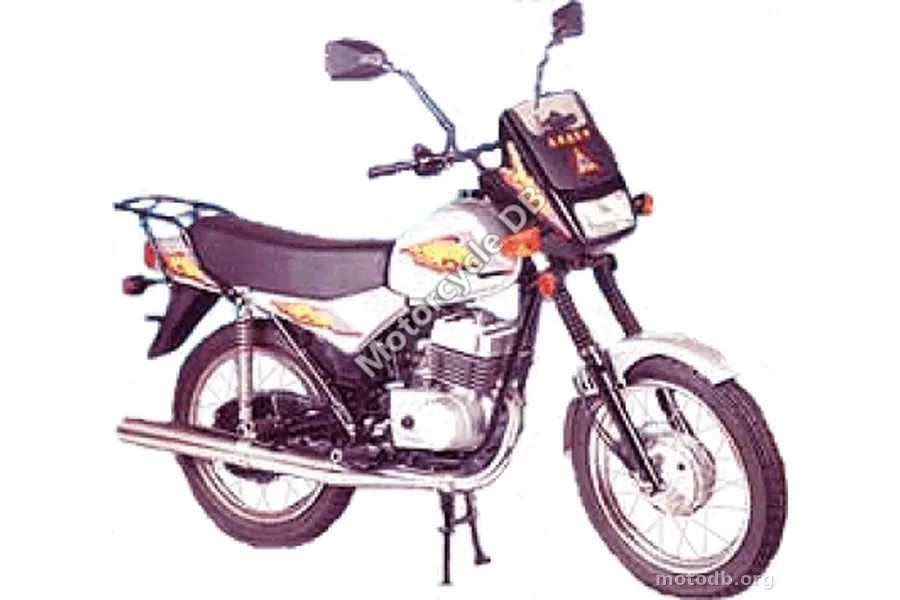
Its mechanics are of archaic beauty. A single piston, a carburetor, a spark plug, and that's it. The transmission has only four gears, sufficient to exploit the narrow and sonorous powerband typical of two-strokes. Air cooling and a chain final drive complete a picture where there's no point in looking for an onboard computer. The stated dry weight of 105 kg makes it a surprisingly lightweight machine, even if data is lacking on its wet weight. One can imagine a motorcycle that can be pushed with one hand, repaired with a wrench, and understood in an afternoon.
Riding a Minsk 12 is accepting a pact. In exchange for the total absence of sophistication, it offers a direct, almost raw, connection with the road. Each intervention on the clutch lever or gear selector is a tangible mechanical act. The fork and shock absorbers, of basic design, inform the rider of every imperfection in the road surface. Braking, presumably by drums, requires anticipation and firmness. It is a school of foresight and modesty, the opposite of the generalized assistance of modern naked bikes like the Suzuki SV650.
What attracts today, beyond its still derisory price, is its radical authenticity. It doesn't try to mimic Western or Japanese performance. It assumes its status as a basic mobility object, designed to last with the minimum of parts. For the collector of mechanical curiosities or the novice wishing to learn mechanics without complexity, it is an ideal subject of study. For the traveler seeking comfort or speed, it is a via crucis. The Minsk 12 doesn't flatter, it educates, it endures, and in its metallic bee buzz, it tells a story that most manufacturers have forgotten.
Reviews & comments
No reviews yet. Be the first to share your opinion!