Key performance
Technical specifications
Engine
- Displacement
- 738 cc
- Power
- 76.0 ch @ 9500 tr/min (54.8 kW)
- Torque
- 63.1 Nm @ 7500 tr/min
- Engine type
- In-line four, four-stroke
- Cooling
- par air
- Compression ratio
- 9.5 : 1
- Bore × stroke
- 66 x 54 mm
- Valves/cylinder
- 2
- Camshafts
- 2 ACT
- Valve timing
- Double Overhead Cams/Twin Cam (DOHC)
Chassis
- Frame
- Double berceau en tubes d’acier
- Gearbox
- boîte à 5 rapports
- Final drive
- Chaîne
- Front suspension
- Fourche téléhydraulique Ø 41 mm, déb : 130 mm
- Rear suspension
- Mono-amortisseur, déb : 130 mm
Brakes
- Front brakes
- Freinage 2 disques Ø 300 mm, étrier 2 pistons
- Rear brakes
- Freinage 1 disque Ø 240 mm, étrier 2 pistons
- Front tyre
- 120/70-17
- Front tyre pressure
- 2.50 bar
- Rear tyre
- 160/60-17
- Rear tyre pressure
- 2.50 bar
Dimensions
- Seat height
- 800.00 mm
- Wheelbase
- 1455.00 mm
- Fuel capacity
- 22.00 L
- Weight
- 220.00 kg
- Dry weight
- 202.00 kg
- New price
- 6 097 €
Overview
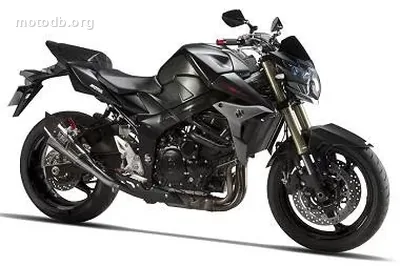
Does a motorcycle necessarily need to shout its power to exist? In 2003, as the roadster market heated up with the Hornet and Fazer, Kawasaki took a different path with the ZR-7. Far from the shrill cries of 16-valve four-cylinder engines, it offered an almost retro formula, based on proven mechanics and a philosophy of simplicity. This roadster, which succeeded the Zephyr, did not seek to impress with raw figures, but with a form of quiet efficiency. With a price tag of around €6000 at the time, it positioned itself as a sensible and accessible alternative, an honest proposition in a world that was beginning to overplay performance.
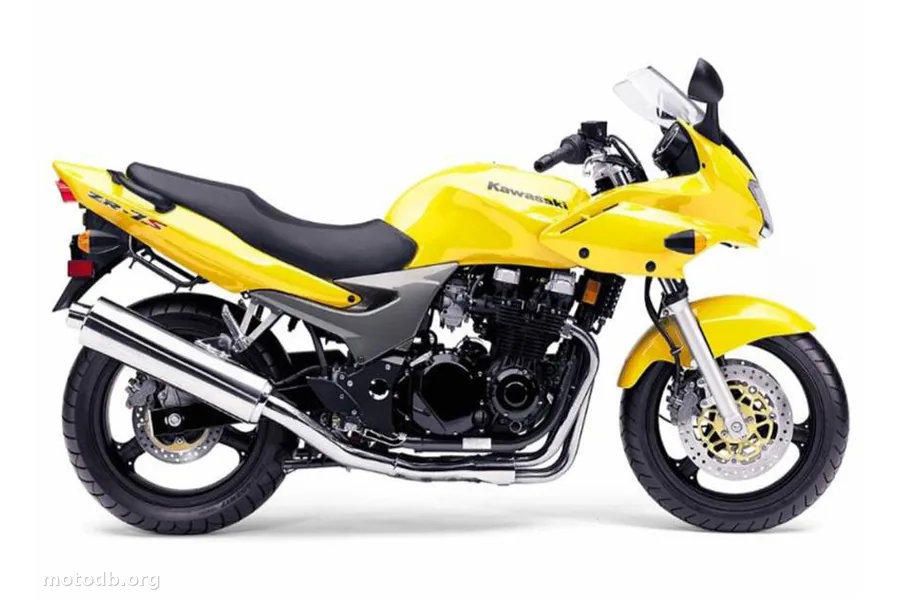
The heart of the beast is an inline four-cylinder engine with 738 cm3, an architecture that evokes the 1980s with its two valves per cylinder and finned block. This produces 76 horsepower at 9500 rpm, about twenty less than a contemporary 600 Hornet. But the magic lies elsewhere: at 7500 rpm, its torque of 63 Nm is already fully available, offering generous and linear thrust from the mid-range. That's the whole point of this Kawasaki ZR 7: it doesn't need to be tortured to move forward. The K-TRIC adaptive ignition system contributes to this exemplary smoothness, making it an ideal companion for the city or winding roads, where you spend more time playing with the torque than searching for the rev limiter. For an A2 license, with a simple restriction, it becomes a docile and sensory-rich platform.
This philosophy of simplicity is reflected in the chassis. The steel double cradle frame and 41mm telescopic fork are reliable values, not cutting-edge equipment. The result? A motorcycle with a significant weight, 220 kg fully fueled, which remains surprisingly agile once underway. The handling is healthy, the braking with its two front discs is progressive and sufficient, but do not ask it for track exploits. The footpegs touch early, reminding us that the ZR-7 is a road bike with a sporty spirit, not the other way around. On degraded roads, the rear may show some signs of nervousness, an invitation to adopt a smooth rather than aggressive riding style. It is precisely in this relaxed use that it excels, with a slightly forward-leaning but comfortable riding position, a 80 cm seat height, and a 22-liter tank promising autonomy.
Today, searching for a used Kawasaki ZR 7 is an excellent way to access a reliable and temperamental roadster without breaking the bank. It doesn’t have the flair of a transformed café racer, nor the aggressiveness of a sportbike, but it possesses mechanical integrity that appeals to riders seeking authenticity. The S versions, with their small fairing, are particularly popular with travelers. For those who want to download the Kawasaki ZR 7 technical manual, the diagrams reveal simple-to-maintain mechanics. It is ultimately the paradox of this machine: by being less flashy than the competition, it has built a reputation for robustness and straightforward pleasure. It doesn't make you dream on paper, but once in the saddle, it offers an essential motorcycle lesson, where pleasure is born of harmony and not excess.
Practical info
- La moto est accessible aux permis : A
Reviews & comments
No reviews yet. Be the first to share your opinion!