Key performance
Technical specifications
Engine
- Displacement
- 998 cc
- Power
- 200.0 ch @ 11000 tr/min (147.1 kW)
- Torque
- 137.3 Nm @ 8500 tr/min
- Engine type
- 4 cylindres en ligne, 4 temps
- Cooling
- liquide
- Compression ratio
- 11.2 : 1
- Bore × stroke
- 76 x 55 mm
- Valves/cylinder
- 4
- Camshafts
- 2 ACT
- Fuel system
- Injection Ø 40 mm + compresseur
- Starter
- électrique
Chassis
- Frame
- treillis tubulaire en tubes d'acier
- Gearbox
- boîte à 6 rapports
- Final drive
- Chaîne
- Front suspension
- Fourche téléhydraulique inversée Ø 43 mm, déb : 120 mm
- Rear suspension
- Mono-amortisseur et monobras, déb : 139 mm
Brakes
- Front brakes
- Freinage 2 disques Brembo Ø 320 mm, fixation radiale, étrier 4 pistons (M50 monobloc)
- Rear brakes
- Freinage 1 disque Ø 250 mm, étrier 2 pistons
- Front tyre
- 120/70-17
- Rear tyre
- 190/55-17
Dimensions
- Seat height
- 835.00 mm
- Seat type
- Selle biplaces
- Fuel capacity
- 19.00 L
- Weight
- 247.00 kg
- Dry weight
- 247.00 kg
- New price
- 29 000 €
Overview
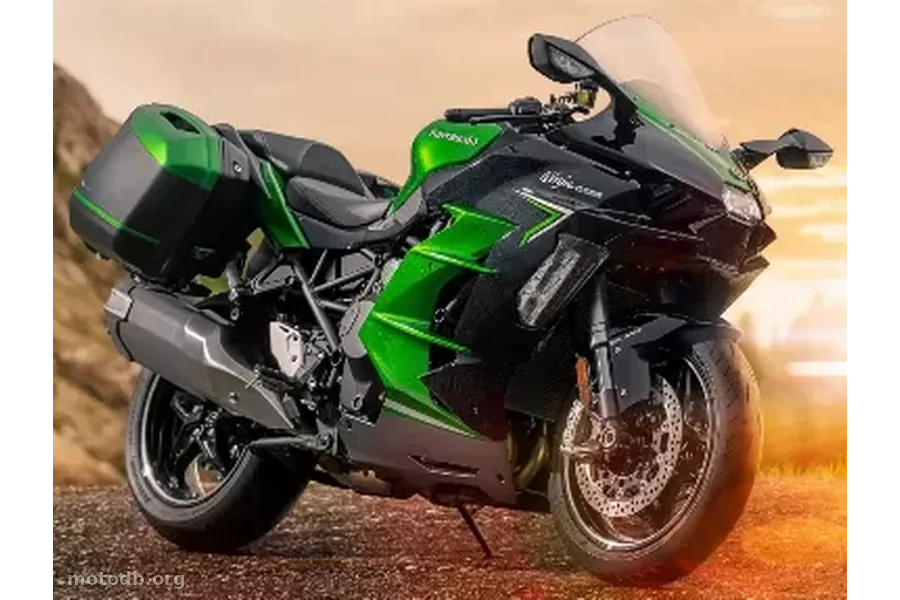
After adding electronics to the H2 SX in 2022, Kawasaki is back with a new system for lighting management. The AHB (Auto High Beam) system detects ambient light levels and the lights of vehicles ahead using a camera. From there, it can automatically turn the high beams on or off to avoid an unfortunate glare.
Previously, Kawasaki had taken control of the destiny of its super Sport-GT with a supercharger to solidify its technological climb and refine this road-going spearhead. Available in standard or SE versions with the electronic suspension system, the machine impresses with its onboard systems. "It's also the motorcycle with the most rider assistance systems that Kawasaki has ever offered," the manufacturer simply states.
But before diving into the details of the high-tech refinements offered by this model year, let's take a quick flashback to the birth of this missile like machine!
In 2018, the H2 SX arrived on our roads, a sort of touring missile derived from the H2 R (320 hp, not street legal) and H2 (200 hp, street legal but only available as a single-seater) which appeared three years earlier. Powered by a 1000 cm3 inline four-cylinder engine supercharged by a compressor that roars and ferociously delivers 200 hp (210 hp with the forced air intake system), it features a passenger seat and offers the possibility of installing rigid luggage.
The H2 SX quickly established itself as the most mind-blowing Sport-GT on the market! Upon its release, at Motoplanete, it was described as: "Transforming the H2 into a Sport-GT is a bit like putting a stick of dynamite in a family break. We know it will take us far and can blow our faces off on demand." The image couldn't have been more apt!
And our dear readers confirmed this in the comments: "This is my third H2 SX, 2018, 2019 and 2020. Of all the motorcycles I've owned, this one is exceptional," wrote Jenllau. "This motorcycle is the replica of a cheetah, gentle and monstrous at the same time depending on your mindset." Theo echoed this sentiment, literally charmed: "Happy owner of this motorcycle for a short time, I take great pleasure in riding it. It seems pointless to have such power available, but beyond that aspect, the motorcycle offers exceptional handling. It is what a Porsche is to a car. Why acquire this type of vehicle? For pleasure, sensations and certainly to give the finger to those who want to impose a way of life. Long live freedom."
That says it all! The power, the performance, the character, the bestiality, if not savagery, all created not to chase the stopwatch on a racetrack, but to travel far, very far, very fast and very long (if we don't get pulled over by the police). Demanding in many respects, the H2 SX is perhaps one of the last breaths of oxygen in a world where sensational mechanical pleasure is becoming increasingly anachronistic.
The H2 SX honors the sporty and rebellious image that has always accompanied the brand. A spirit born in the late 1960s, which settled firmly with the 500 H1 and then permanently anchored in 1971 with the birth of the first 750 H2! Since then, Kawasaki has never ceased to perpetuate this tradition with motorcycles with a strong character.
True to its DNA, the manufacturer does not neuter its Sport Tourer, but has offered new technological refinements on its H2 SX and H2 SX SE since 2022 to make exploiting this mile-eating monster even more… safe. Thus, the two models are not equipped with a radar sensor, but two! The first sensor, located at the front, is dedicated to the FCW (Front Collision Warning) and ACC (Adaptive Cruise Control), while the rear sensor manages the BSD (Blind Spot Detection) system.
The FCW assistance illuminates a light bar above the TFT dashboard to indicate proximity to the vehicle ahead, while the rider retains control of the actions to be taken. The ACC system intervenes when riding with the cruise control activated and automatically intervenes on the braking and engine speed to maintain the selected distance, among the three possibilities offered. The return to the programmed cruising speed then occurs gradually as the safety distance is re-established. If such systems may seem particularly useful in automobiles where concentration can sometimes relax, they seem less relevant on a motorcycle where involvement in riding the machine is clearly higher. Especially for the ACC system which reacts automatically in place of the rider: perhaps in the case of a car swerving at the last moment it may still be relevant. Nevertheless, concentration and anticipation are the best allies when riding a motorcycle. In any case, a warning is better than an accident. Conversely, the blind spot detection (BSD) system, which is displayed in the mirrors, is extremely relevant given how visibility to the rear on a motorcycle is something that can always be improved: mirrors are too small, vibrations, not far enough apart with half masked by the rider's arms, etc. …
For the rest, the H2 SX, especially in its high-end SE version, remains true to itself and still offers its Supercharger system, which provides the 998 cm3 inline four-cylinder engine with around 200 hp (210 hp at 11,000 rpm) and 137.3 Nm at 8,500 rpm. Weighing in at 267 kg (266 kg for the standard version) and a seat height of 835 mm, the beauty is clearly not a beginner’s motorcycle. Despite the plethora of electronic assistance systems and technological refinements it offers: semi-active electronic suspension equipped with the Skyhook system to adapt the operation of these to real-time riding conditions, cornering assistance, traction control, launch control, engine braking management, multiple riding modes, selectable power levels, up & down shifter, keyless start, LED turn signals, tire pressure monitoring system, hill start assist, emergency braking signal (the rear light flashes during sudden braking).
Onboard, the 6.5-inch TFT dashboard integrates an infotainment system that can connect to the rider's smartphone and display around twenty applications. However, one can legitimately ask: is it reasonable to entertain, and therefore distract, the rider when riding a 200 hp motorcycle? "Designed to be free" concludes the official internet presentation of the H2 SX SE. Freedom, isn’t it just disconnecting from your smartphone to fully enjoy the immense dynamic qualities of this fabulous motorcycle by concentrating on the road and the sensations it provides? Or when the best is not always the friend of the good...
Michael Levivier - Photos manufacturer
Standard equipment
- Assistance au freinage : ABS
- Nombre de mode de conduite : 3
- Taille de l'écran TFT couleur : 16,51 cm / 6.5 pouces
- ABS Cornering
- Jantes aluminium
- Shifter
- Béquille centrale
- Indicateur de vitesse engagée
- Régulateur de vitesse
- Prise USB
- Aide au démarrage en côte (Hill Hold Control)
- Aide au départ arrêté (Launch Control)
- Démarrage sans clé
- Contrôle de traction
- Poignées chauffantes
- Suspensions réglables électroniquement
- Système radar
- Embrayage anti-dribble
- Centrale inertielle
- Phares adaptatifs en virage
- Contrôle du frein moteur
- Surveillance de la pression des pneus
Practical info
- La moto est accessible aux permis : A
Indicators & positioning
Similar bikes
1000 GSX-R Edition Speciale Tourist Trophy
1000 Katana 7584
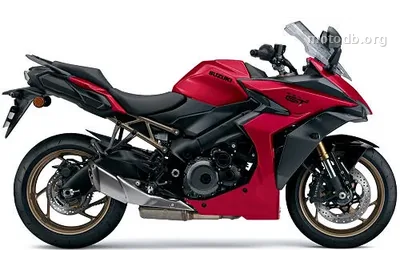
GSX-S1000GT
Reviews & comments
No reviews yet. Be the first to share your opinion!