Key performance
Technical specifications
Engine
- Displacement
- 999 cc
- Power
- 152.0 ch @ 11000 tr/min (111.8 kW)
- Torque
- 104.0 Nm @ 9250 tr/min
- Engine type
- 4 cylindres en ligne, 4 temps
- Cooling
- liquide
- Compression ratio
- 12.2 : 1
- Bore × stroke
- 73.4 x 59 mm
- Valves/cylinder
- 4
- Camshafts
- 2 ACT
- Fuel system
- Injection
- Starter
- électrique
Chassis
- Frame
- périmétrique en aluminium
- Gearbox
- boîte à 6 rapports
- Final drive
- Chaîne
- Front suspension
- Fourche téléhydraulique inversée Ø 43 mm
- Rear suspension
- Mono-amortisseur
Brakes
- Front brakes
- Freinage 2 disques Brembo Ø 310 mm, fixation radiale, étrier 4 pistons
- Rear brakes
- Freinage 1 disque Nissin Ø 220 mm, étrier simple piston
- Front tyre
- 120/70-17
- Front tyre pressure
- 2.50 bar
- Rear tyre
- 190/50-17
- Rear tyre pressure
- 2.90 bar
Dimensions
- Seat height
- 810.00 mm
- Seat type
- Selle biplaces
- Fuel capacity
- 19.00 L
- Weight
- 226.00 kg
- New price
- 13 999 €
Overview
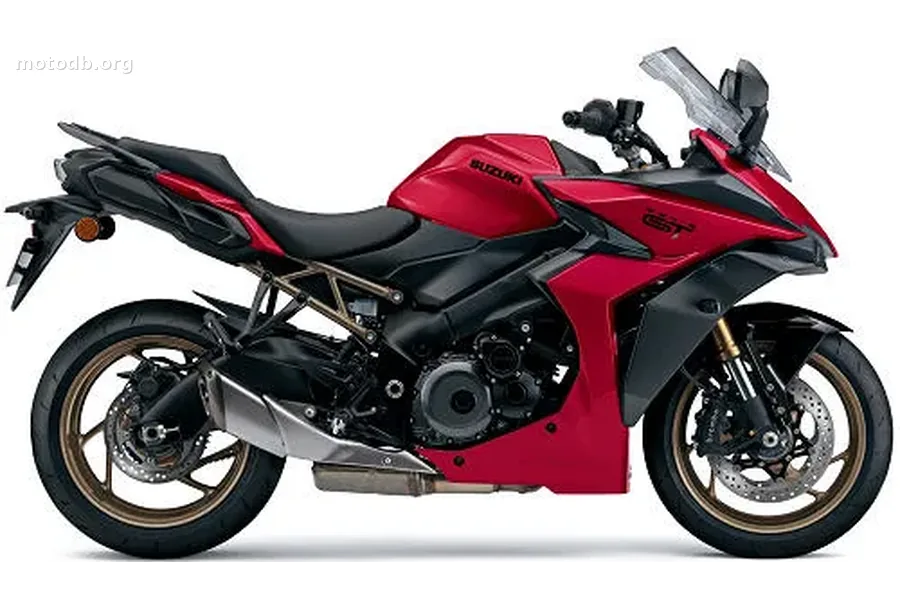
The idea could have come from Kawasaki, a customizer, Erik Buell, or Christopher Nolan. But no, it was Suzuki that created this motorcycle with a striking style. The GSX-S1000GT could be, without complex, Batman’s touring bike.
The firm from Hamamatsu needed to rebound, to be seen, to express a nervousness it had let slip. A streetfighter took the gamble of a skewed appearance; this "Sport Touring" variant pushes the idea between a shock and a stealth fighter.
Taking over from the GSX-S1000F is no easy task. With its scooter-like appearance, the machine had a bit of trouble attracting buyers and positioning itself against a more established Ninja 1000 SX. The GT experience is much more exposed on this model. The fairing imposes a strong presence, with a prow seeming to shatter rocks. Facing the air seems a mission, crushing kilometers its profession (of faith?), intimidating the girls an obligation.
One thing is certain: the threat is omnipresent. The face of this machine returns to us a Muto from the Godzilla universe, to which we would have grafted R1 eyes. Its bodybuilder bat-like shoulders forbid a smile. It is clear that the designers took some serious acids to define this identity – with a totally successful objective: a GSX-S, it’s noticeable. A little heavy, the GT weighing 12 kilograms more. Admit that you would have given much more.
Its engine being that of the recently updated roadster, we find the same improvements. This translates to increased efficiency compared to the F. Two more horsepower at 11,000 rpm, better acceleration, but a slight decrease in torque. We go from a little more than 11 mkg to a little less. Its curve is smoother for more roundness in use. The original GSX-R 1000 cylinder engine was revised for the new generation of GSX-S, with modifications to the camshafts, valve springs, injectors, clutch, and gear selection system. The airbox also changed to better breathe the engine.
The rider will be in a new ambiance. Perhaps due to the fact that the riding position has evolved. The handlebar is 23 mm wider and 14 mm closer to the rider compared to the previous sport-GT. This should be more relaxed on board but... That’s not what will be noticed right away. The surprise is in the gaze. A domain where Suzuki catches up with the competition is in instrumentation. The GSX-S1000GT is the first from the manufacturer to adopt full digital with a 6.5-inch color TFT screen. The Hayabusa is also equipped with this technology but only with a small screen wedged between the needles. For the roadster-GT, it’s an opening to a multimedia world. Connect it to a smartphone via a USB cable or Bluetooth and the mySPIN system allows you to pilot your contact list to make a call, manage your appointment calendar, select music and playlists, or use a GPS navigator.
That’s what is originally in place. This interface is designed to receive third-party applications. Which will allow to add more functionalities later. Weather, additional navigation functions, unprecedented interactions... The beginning of the Suzuki Store?
mySPIN is compatible with Android and iOS. Everything is controlled from the new switches on the left handlebar control. Now that Suz has joined the party, it is highly likely that this 10.65 cm screen will invade the large models of the range in the short term. Fortunately, it doesn’t just display entertainment. The tachometer normally occupies a good half of the screen. Practical information uses a discreet space (trips, temperatures, clock, fuel gauge) while a graphic section informs about the electronic assists engaged: the level of traction control, the engine mapping, the upshift activation, and the gear engaged. Do you prefer white or black background? Multiple menus allow you to parameterize this kind of preference.
The GSX-S1000GT inherits the riding aids equipping the roadster, such as the SDMS containing 3 riding modes (A / sport - B / dynamic - C / tranquil), the up & down shifter, traction control at 5 levels + off, Easy Start to launch the engine with a simple press, and Low RPM Assist to facilitate maneuvers at low speeds. Suz thought that adding a fairing was not enough. Hence the additional presence of active cornering braking and cruise control (active between 30 and 180 km/h). In 2025, an update allows it not to be deactivated when using the upshift. The GSX-S 1000F didn’t even have half of this electronics.
It’s on the chassis that the GT suffers no modifications (well, almost). Why would it? Such a cycle could handle 30 more horsepower before starting to twist. The swingarm comes from an old GSX-R 1000, the frame is very similar to that of the hypersport, the KYB inverted fork is fully adjustable, and the shock absorber can be adjusted in rebound and preload. Touring or sport riding, it won’t cause it any problems. Where the spine differs is regarding the rear frame. It is modified and reinforced to support the crew and the cases (optional), and also lowered to install a thicker passenger seat.
The 1000 GT justifies its name by a notion of comfort that the roadster does not envisage. To begin with, the seats are different and more welcoming. The passenger benefits from grab handles. The footpegs and handlebar are isolated by rubber. The bubble (non-adjustable) and the fairing have spent a lot of time in a wind tunnel to optimize the aerodynamic efficiency / protection ratio. Finally, the suspensions are tuned for a more touring use than the GSX-S 1000.
The manufacturer has obviously planned a whole range of accessories to make this GSX-S1000 truly GT. On the menu, 36-liter cases capable of accommodating an integral helmet, a high bubble, heated grips, comfort seats, soft luggage, all kinds of protections... and decorative accessories. Enough to inflate the bill quickly, set originally at more than 15,000 euros. A price calibrated extremely close to the competition.
M.B - Photos manufacturer
Standard equipment
- Assistance au freinage : ABS
- Nombre de mode de conduite : 3
- Taille de l'écran TFT couleur : 16,51 cm / 6.5 pouces
- ABS Cornering
- Jantes aluminium
- Shifter
- Indicateur de vitesse engagée
- Régulateur de vitesse
- Bluetooth
- Prise USB
- Aide au démarrage
- Aide à la manoeuvre
- Contrôle de traction
Practical info
- La moto est accessible aux permis : A
- Pays de fabrication : Japon
Indicators & positioning
Similar bikes
M 1000 XR prototype
CBR 1000 RR Endurance TT Legends
Reviews & comments
No reviews yet. Be the first to share your opinion!