Key performance
Technical specifications
Engine
- Displacement
- 471 cc
- Power
- 46.6 ch @ 8500 tr/min (34.3 kW)
- Torque
- 43.4 Nm @ 6250 tr/min
- Engine type
- Bicylindre en ligne, 4 temps, calé à 180°
- Cooling
- liquide
- Compression ratio
- 10.7 : 1
- Bore × stroke
- 67 x 66.8 mm
- Valves/cylinder
- 4
- Camshafts
- 2 ACT
- Fuel system
- Injection
- Starter
- électrique
- Euro standard
- Euro 5+
Chassis
- Frame
- Cadre tubulaire en acier
- Gearbox
- boîte à 6 rapports
- Final drive
- Chaîne
- Front suspension
- Fourche téléscopique Ø 41 mm, déb : 150 mm
- Rear suspension
- 2 amortisseurs latéraux, déb : 145 mm
Brakes
- Front brakes
- Freinage 1 disque Nissin Ø 310 mm, étrier 2 pistons
- Rear brakes
- Freinage 1 disque Nissin Ø 240 mm, étrier simple piston
- Front tyre
- 110/80-19
- Front tyre pressure
- 2.00 bar
- Rear tyre
- 150/70-17
- Rear tyre pressure
- 2.00 bar
Dimensions
- Seat height
- 790.00 mm
- Seat type
- Selle biplaces
- Fuel capacity
- 12.00 L
- Weight
- 192.00 kg
- New price
- 6 199 €
Overview
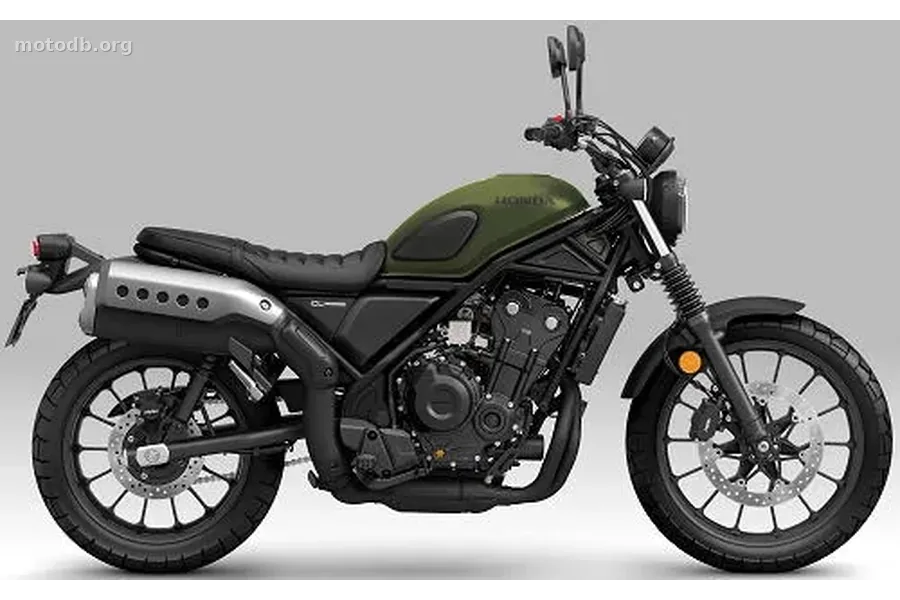
The CL 500 is one of those fun, seemingly immutable machines. Yet, 2025 subtly introduces a few modifications to this roadster-custom-scrambler. Of course, to meet Euro5+ regulations, accompanied by a more readable screen, readjusted footrests, and a new urethane seat.
When you think scrambler, Honda isn’t necessarily the first name that comes to mind. Not even close. Wrongly, because the brand has mastered the exercise in the 60s and 70s – especially in the States. Notably with the beautiful CL77 Scrambler 305. However, the new CL 500 draws its inspiration from the 1962 CL 250. Not in form, but in essence: “simple, raw and rustic,” as the manufacturer points out.
This CL 500 is based on the CMX 500 custom, primarily for the engine and a good portion of the frame. But Honda has worked hard all around to offer a truly different motorcycle. Some brands would have been content to change the headlight and add a few stickers. That’s not the case here. The machine offers a real identity, much more fun than the custom. As if it were transforming into a roadster, with the desire and effort to escape the sector, expelling a taste of scrambler...
Approaching this destiny without going all the way. First a look for everyday use, then capabilities for off-road riding. More engaged off-road use is not recommended. That makes sense. Honda already has equipment in its range for that. With its 750 Transalp, 1100 Africa Twin and CRF 300 L, everyone can experience adventure in their own way, at different levels.
This one’s allure is its destiny. It’s not lacking in charm. The choice of colors brings a real gaiety, something that has become too rare in production. The raised exhaust with its perforated heat shield adds a lot of character. Compared to the custom, Honda has modified the rear of the frame to offer a completely different seat and rear subframe. Between the long, flat seat, its height, the different handlebar and its more rearward footrests, the CL induces a more natural, more comfortable and more versatile riding position. The fuel tank has undergone a small cut at the lower level, which suits it rather well; even more so with its knee grips.
Arg, it’s a shame to have kept the small all-digital instrument panel. A good old-fashioned analog gauge would perfectly fit here, with a touch of chrome. Some accessories seem to us almost “indissociable” to fully express the scrambler look, such as the high front fender, the fork head and the handguards.
It also stands out with its fork boots, a specific rear light and different wheels. The tires are less “imposing” and the rim dimensions are more suited for urban riding: we go from 130/90-16 to 110/80-19, which will noticeably enhance the front-end dynamics. For the rear, the 150/80-16 biases the mix for 150/70-17. If the rim design reminds you of something, click on the CB 500 X;-). The headlight remains the strange block of lights from the Rebel – intriguing and instantly recognizable.
Since it is targeted for A2 license holders, the CL 500 doesn’t overcomplicate things. It gets the 471 cm3 twin-cylinder engine found in many models (CB 500 F, CB 500 X, CBR 500 R, 500 Rebel) and copied by a multitude of Chinese brands. Then it ponders and says that a small adaptation would be a good idea to have its own character. So, the engineers change the airbox, the mapping is revised, and the timing is also modified. This gives a power of 46.6 horsepower at 8,500 rpm, between those of the CB 500 and the CMX. The 43 Nm of torque is almost identical. But it is mainly the shorter final ratio that will give the CL extra pep.
That’s what we’re looking for. With added ease. That’s what the CL 500 conceives, with a seat height of 790 mm. Enough to allow the vast majority of users to place both feet flat. Yes, it’s 10 cm more than the 500 Rebel, but the scrambler offers a much more important suspension travel, a guarantee of better comfort, more efficient and progressive work, and it’s better on the ordinance when you want to crawl through the paths. The 41 mm fork moves 150 mm, the shock absorbers 145 mm. Only the latter can be adjusted, on preload. That said, the suspensions chosen by Honda, here from Showa, very often demonstrate remarkable homogeneity.
The inherent simplicity of the philosophy of this model is also reflected in the brakes. A single disc at the front, 310 mm. The action of the 2-piston caliper will calm 192 kg of motorcycle + the rider and eventually a passenger (not partying on the little-inclined rear seat). The rear receives a 240 mm disc bitten by a single piston. Yes, simple, but sufficient. The CL 500 is not meant to do WorldSSP300.
The Honda CL 500 has an unexpected asset: its price. Almost 7,000 euros, which places it at the level of a CB 500 – ndlr: the latter has a higher level of equipment and peripherals of quality. So we can have a (almost) scrambler for the same price as a roadster, when this kind of machine is sold much more dearly with the competition. 4,000 more minimum for a 900 Scrambler Triumph or an 800 Icon from Ducati; another notch above for R NineT Scr from BMW. Of course, their engines and their performances are more valuable. But if it’s just the style that matters to you, there’s no comparison. Eventually, the Fantic Caballero 500 can taunt it. Unless between the Honda badge and a sino-Italian cocktail, your reason can quickly falter.
Last nostalgic point: it’s the first time a scrambler CL puts its wheels in France. All series of their beautiful era have never been imported into the hexagon.
M.B - Photos manufacturer
Standard equipment
- Assistance au freinage : ABS
- Jantes aluminium
- Indicateur de vitesse engagée
- Embrayage anti-dribble
Practical info
- La moto est accessible aux permis : A, A2
Reviews & comments
No reviews yet. Be the first to share your opinion!