Key performance
Technical specifications
Engine
- Displacement
- 451 cc
- Power
- 59.2 ch (43.5 kW)
- Torque
- 59.8 Nm @ 2800 tr/min
- Engine type
- Bicylindre en ligne, 4 temps
- Cooling
- liquide
- Compression ratio
- 11.7 : 1
- Bore × stroke
- 70 x 58,6 mm
- Valves/cylinder
- 4
- Camshafts
- 2 ACT
- Fuel system
- Injection Ø 36 mm + Batterie Li-ion 48V
Chassis
- Frame
- Treillis tubulaire en acier
- Gearbox
- boîte à 6 rapports
- Final drive
- Chaîne
- Front suspension
- Fourche téléscopique Ø 41 mm, déb : 120 mm
- Rear suspension
- Mono-amortisseur, déb : 114 mm
Brakes
- Front brakes
- Freinage 2 disques Ø 300 mm, étrier 2 pistons
- Rear brakes
- Freinage 1 disque Ø 250 mm, étrier simple piston
- Front tyre
- 120/70-17
- Rear tyre
- 160/60-17
Dimensions
- Seat height
- 795.00 mm
- Dry weight
- 227.00 kg
- New price
- 13 159 €
Overview
The history books will record that 2024 is the year a motorcycle attempted one of the most important evolutions in its journey since the late 19th century. Kawasaki intends to shake up the sector by being the first manufacturer to market a hybrid motorcycle. Yes, like in a car: a combination of a thermal engine and an electric motor. The new Ninja 7 Hybrid innovates by offering this cocktail of technology.
Kawasaki had promised us this at the EICMA 2022 show. It wasn’t a false promise! The hybrid motorcycle is ready, eager to show us the alliance of gasoline and electrons. Underneath its sporty looks, it carries a 451 cm3 engine capable of developing 45 horsepower. A flagship engine of 2024 because it arrives simultaneously on the sporty and roadster 7 Hybrid but also the 500 Eliminator, Z 500 and 500 Ninja.
Behind its cylinder bank is grafted a 9 kW electric unit. Once the two add their forces, the power reaches 59 horsepower. And can climb to 69 horsepower thanks to the “e-boost” mode. A little shot limited in time but practical for overtaking. The Ninja 7 Hybrid therefore presents the native strength of a 500, can bring its power up to the equivalent of a 650 but… “would consume like a 250 and would compete with 1000 Supersports from a standstill,” according to the manufacturer. It’s true that electric motors produce a considerable surge of power instantly. We doubt that the twin-motor Ninja will surprise at the start, but for how many tens of meters…?!
With its Ninja 7 Hybrid, Kawasaki is not only an agitator of motorization but also takes the opportunity to implement new solutions. This motorcycle is the first large-displacement Kawasaki to receive an automatic gearbox (let’s forget the Z 125 Pro with an automatic gearbox, not marketed in Europe). No more selector! To change gears, two paddles on the left handlebar allow you to switch gears. Or you can switch to AT and the system manages the gearbox itself.
The color TFT screen reflects only part of the electronics of this Ninja. For the first time, there are two fuel gauges. One for gasoline, the other for the 48-volt battery. Some pictograms and the commands of the handlebar controls will allow the rider to combine the multiple characteristics of the Ninja hybrid. With the driving Modes: Sport-Hybrid, Eco-Hybrid or EV - in all-electric mode, the range reaches 12 km while the engine produces 7 kW, or just under 10 horsepower. There is also a Walk function to move the motorcycle at a very low speed (like electric bicycles), an APLF (Automatic Launch Position Finder) system to automatically shift into first gear at a standstill, a Stop & Start and a reverse gear (in Walk mode). Kawasaki has also integrated a regenerative braking system.
The concept promises several advantages: smooth riding, quiet operation in the city (with the EV mode), controlled pollution and consumption, more autonomy as long as you find gasoline. A lovely picture; not from an important data point: the price. Its influence will be more than decisive for a Sport-GT less powerful than an MT-07. Displayed at the price of a Z 900 RS SE… The weight could also deter more than one. An electric vehicle is not light, and the Kawasaki does not escape: 227 kilograms dry weight. Once the tank is full, it is not far from the weight of an R 1300 GS.
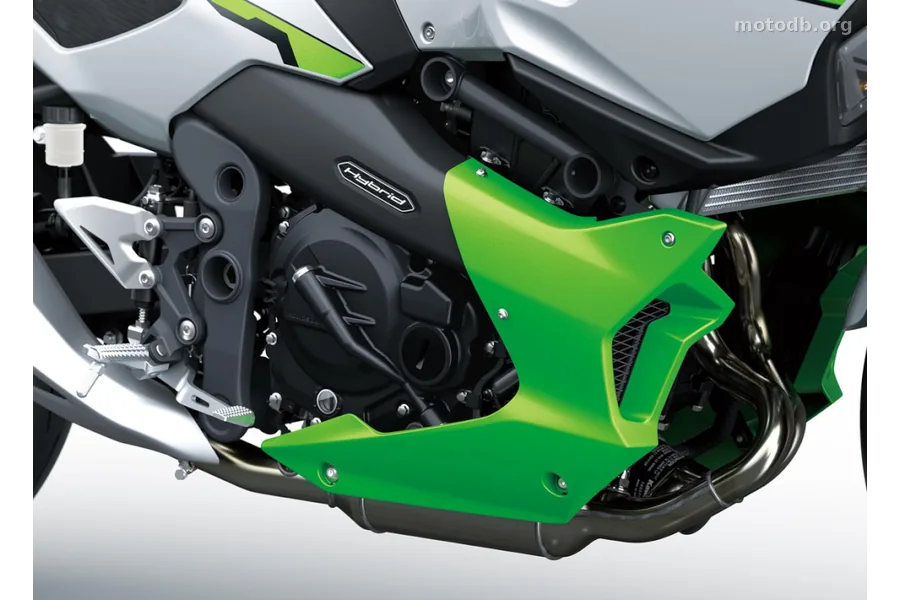
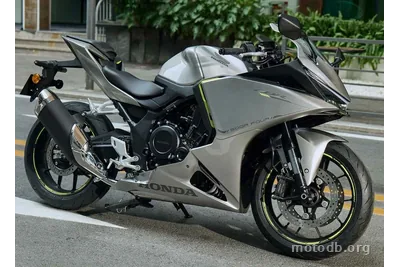
Due to its name, the hybrid has immediately chosen a sporty doctrine to present its assets. The fairing clearly goes in this direction, with however heavy forms due to the carrying of technologies. The rear part is dressed more than usual, in order to hide the battery… but which remains visible from near thanks to translucent sections. The independent skid plate is responsible for cooling missions. A left duct brings air to the gearbox casing, the right one ventilates the battery.
However, the high-rise demi-handlebars imply a raised riding position and not at all made for attack. This Ninja wants to ride, not cut up the road. Its cycle part also defends this doctrine, with a classic fork without adjustment, a basic swingarm and 2-piston brake calipers. The frame is made of steel tubes. Nothing to report at the level of the two brake discs or the dimensions of the tires, similar to those of the 650 Ninja. However, the wheelbase is announced as very long for a machine of this size. It is 1535 mm - it is even more than that of a Triumph 1200 Speedmaster. Note that the 6.5’s is only 1410 mm.
We have seen projects, prototypes, simulations… chimeras especially, praised by ephemeral start-ups. This time, the matter is very serious. Not only will the motorcycle arrive in reality (not in crowdfunding) in 2024 but also, it is one of the main brands on the market that is getting involved. Kawasaki is seriously thinking about a different future. The idea is more than salutary but the price is not as intrepid as the concept.
The Ninja 7 must come to terms with the weak enthusiasm of the public (very conservative of the thermal) and liquidate its precursors. Its price plummets by almost 1/3 to reach 8,999 euros during the months of March and April 2025.
M.B - Photos manufacturer
Standard equipment
- Assistance au freinage : ABS
- Nombre de mode de conduite : 3
- Taille de l'écran TFT couleur : 10,92 cm / 4.3 pouces
- Jantes aluminium
- Indicateur de vitesse engagée
- Boîte automatique
- Bluetooth
- Marche arrière
Practical info
- Véhicule accessible au permis A2 ou bridable à 47.5ch / 35 Kw
- La moto est accessible aux permis : A, A2
Reviews & comments
No reviews yet. Be the first to share your opinion!