Key performance
Technical specifications
Engine
- Displacement
- 451 cc
- Power
- 45.4 ch @ 9000 tr/min (33.4 kW)
- Torque
- 42.2 Nm @ 6000 tr/min
- Engine type
- Bicylindre parallèle, 4 temps
- Cooling
- liquide
- Compression ratio
- 11.3 : 1
- Bore × stroke
- 70 x 58,6 mm
- Valves/cylinder
- 4
- Camshafts
- 2 ACT
- Fuel system
- Injection Ø 32 mm
- Starter
- électrique
Chassis
- Frame
- Structure en tubes d'acier
- Gearbox
- boîte à 6 rapports
- Final drive
- Chaîne
- Front suspension
- Fourche telescopique Ø 41 mm, déb : 120 mm
- Rear suspension
- Mono-amortisseur, déb : 130 mm
Brakes
- Front brakes
- Freinage 1 disque Ø 310 mm, étrier 2 pistons
- Rear brakes
- Freinage 1 disque Ø 220 mm, étrier 2 pistons
- Front tyre
- 110/70-17
- Front tyre pressure
- 2.00 bar
- Rear tyre
- 150/60-17
- Rear tyre pressure
- 2.25 bar
Dimensions
- Seat height
- 785.00 mm
- Seat type
- Selle biplaces
- Fuel capacity
- 14.00 L
- Weight
- 157.00 kg
- Dry weight
- 157.00 kg
- New price
- 6 090 €
Overview
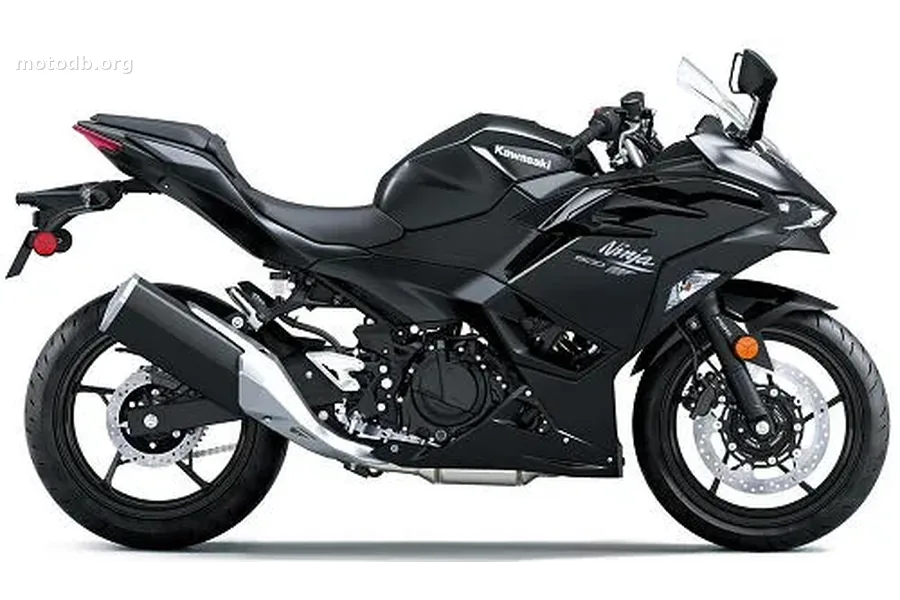
The Ninja family has become the one with the most iterations on the market. Catering to desires and budgets, enthusiasts can discover the 125, experience the SuperSport with the ZX-6R, propel themselves into space with the H2R and its supercharging, dare the hybrid with the Ninja 7, shatter the chrono with the ZX-10R – there’s something for everyone, and even a little more for A2 license holders with the arrival of the 500 Ninja.
Let’s go straight to one of the essential points: the engine. Because you’d expect a significant gap from the 400. It is, but it’s not obvious at first glance. Let’s start with the bitter truth. The Ninja hasn’t grown by a hundred cc as its name suggests, but by 52 cc. Not a big deal, you might say; the 451 twin should be spitting out a series of extra horsepower. But in reality, nothing! There are still 45 ponies at the engine output. So, where’s the interest? Everywhere else.
The first is the gain in torque, of about 1/2 mkg. Then, it’s a better availability of muscle from the mechanics. Power and torque are available much earlier. Regardless of the RPM, the rider will systematically have more horsepower and torque than with the 400. The engine will feel more robust, more full, more enthusiastic. To achieve this result, Kawasaki revised the compression ratio, piston stroke, pistons themselves, connecting rods, airbox and crankshaft.
Conversely, the chassis hasn’t been given an update. No desire or no need? Let’s not forget that we are in an entry-level category. Like the Ninja 400 and the Z cousin roadster, the 500 starts with a 41 mm inverted fork, followed by a minimalist steel tube trellis frame, a adjustable shock absorber in preload only, 17-inch wheels with their respective brake discs. 310 mm at the front and 220 mm at the rear, both being pinched by 2-piston calipers.
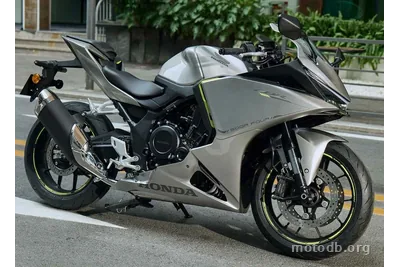
But this technical reproduction doesn’t give a sense of déjà-vu because the retouched design allows you to feel this freshness of the newness. A little more aggression with two more prominent fangs and a scowling look in the style of the ZX-6R 636, redesigned flanks, a more tapered rear light, a flatter seat – The Ninja 500 doesn’t transcend the style but makes it evolve.
It’s at the level of the cockpit that the change marks the most point. The instrumentation offers a truly more serious appearance than that of the 400. More modern? Not quite. You would think of a TFT screen to be on trend but Kawa reserves it for the SE version. The speedometer of the half-liter Ninja operates with liquid crystals, in a rather nice arrangement and very tech’ angular shapes. And as with the SE, it allows Smartphone pairing via Bluetooth and the Rideology app – enough to have information on internal machine data, traceability of your rides, interaction with telephone calls and messages, maintenance information and a few other goodies.
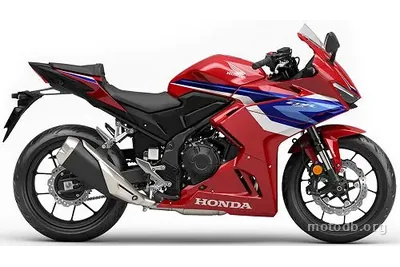
How far away is the time when the little Ninja appeared, with only 250 cc in its belly. Frail, almost fragile, it has gradually gained confidence and style, from the 300 generation to the 400 generation, until this climax in 500. The proposition is now more convincing, facing a well-established Honda CBR 500 R and a competition that is strengthening discreetly.
M.B - Photos constructeur
Standard equipment
- Assistance au freinage : ABS
- Jantes aluminium
- Indicateur de vitesse engagée
- Bluetooth
- Embrayage anti-dribble
Practical info
- La moto est accessible aux permis : A, A2
- Pays de fabrication : Thailande
Reviews & comments
No reviews yet. Be the first to share your opinion!