Key performance
Technical specifications
Engine
- Displacement
- 499 cc
- Power
- 135.0 ch @ 10500 tr/min (99.3 kW)
- Torque
- 88.3 Nm @ 8000 tr/min
- Engine type
- Bicylindre en L à 90°, 4 temps
- Cooling
- liquide
- Bore × stroke
- 72 x 61,25 mm
Chassis
- Frame
- Périmétrique double poutre en aluminium
- Gearbox
- boîte à 6 rapports
- Final drive
- Chaîne
- Front suspension
- Fourche télescopique inversée Ø 46 mm, déb : 120 mm
- Rear suspension
- Mono-amortisseur Öhlins, déb : 130 mm
Brakes
- Front brakes
- Freinage
- Rear brakes
- Freinage 1 disque
- Front tyre
- 120/70-17
- Rear tyre
- 180/55-17
Dimensions
- Fuel capacity
- 16.00 L
- Dry weight
- 164.00 kg
- New price
- 16 770 €
Overview
There are machines that tell a period of time better than a history book. The Bimota 500 V-Due Corsa Evoluzion is one of those. It appeared in 2001, at the exact moment when MotoGP was about to definitively bury two-stroke engines in Grand Prix racing, and it carries this mourning with a certain insolence. In a market that offered little more than the Aprilia 250 RS to hear cylinders singing, the L-twin from Rimini represented an assumed anachronism, a last cry before the victorious four-strokes’ silence.
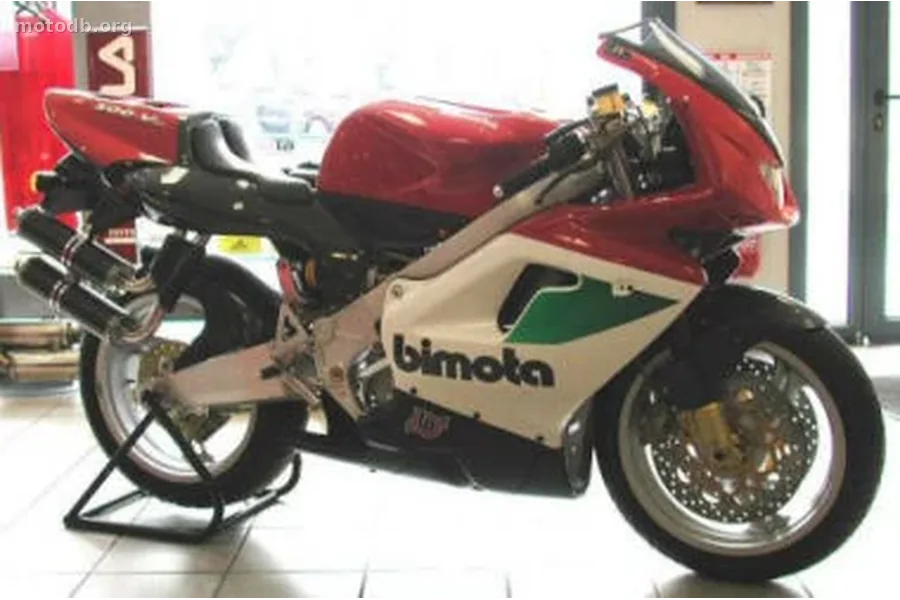
The story of the V-Due had not, however, begun under the best auspices. Early versions featured electronic injection that was too slow to follow the demands of a two-stroke engine at this level of use, and the machine had accumulated criticism before even having convinced. The Evoluzion draws a line over these missteps and returns to traditional carburetion, which profoundly changes the character of the machine. The Strada returns to the asphalt, the Trofeo is directly sized for the racetrack. It is the latter that truly reveals what this mechanics has in its belly.
135 horsepower at 10,500 rpm for 164 kilograms dry weight, the calculation is brutal. This power-to-weight ratio places the machine in a category where few production motorcycles dared to venture at the time. The perimeter double beam aluminum frame surrounds the whole with the rigor expected of a manufacturer who has always made the cycle its main argument. The 46 mm inverted fork and the Öhlins monoshock at the rear compose a healthy, adjustable base, tailored for serious track work. Below 8,000 rpm, the engine shows itself to be almost docile, almost usable for everyday use if one forces a little its definition of everyday. Past this regime, the character changes completely, as if a valve suddenly opened and released an energy that the 499 cc had previously contained out of politeness.
The target audience is clearly not the novice seeking his first motorcycle, nor even the globetrotter who seeks to cross Europe comfortably with its 16 liters of tank. It is the experienced track rider, the one who understands what it means to drive a machine sharpened to the bone, who knows how to manage the characteristic power delivery of a two-stroke at full load, and who accepts the compromises inherent in this type of machine. On the track, the whole keeps its promises: balanced, precise, with a sound that resembles nothing else in motorcycle production of the time.
At 16,770 euros, the bill is salty for 2001. The Italian, Japanese and even Aprilia’s 250 RS, a benchmark in its category, cost significantly less. But the V-Due Corsa Evoluzion does not really play in the same register as its contemporaries. It is more a collector's item sold new than a mass-market motorcycle seeking to seduce the maximum number of buyers. Its programmed rarity, its positioning at the extreme border of a regulation about to change, its exceptional mechanics make it something unique, with everything that word implies of fascinating and demanding at the same time. One does not buy it to feel comfortable immediately. One buys it because one knows what it represents.
Practical info
- La moto est accessible aux permis : A
Reviews & comments
No reviews yet. Be the first to share your opinion!