Key performance
Technical specifications
Engine
- Displacement
- 499 cc
- Power
- 58.0 ch @ 9500 tr/min (42.0 kW)
- Torque
- 46.0 Nm @ 8000 tr/min
- Engine type
- Twin, four-stroke
- Cooling
- liquide
- Compression ratio
- 10.5:1
- Bore × stroke
- 73.0 x 59.6 mm (2.9 x 2.3 inches)
- Valves/cylinder
- 4
- Camshafts
- 2 ACT
- Fuel system
- Carburettor
Chassis
- Frame
- double berceau acier
- Gearbox
- 6-speed
- Final drive
- Chain (final drive)
- Front suspension
- Fourche téléhydraulique Ø 37 mm, déb : 120 mm
- Rear suspension
- 2 amortisseurs latéraux, déb : 125 mm
- Front wheel travel
- 115 mm (4.5 inches)
- Rear wheel travel
- 117 mm (4.6 inches)
Brakes
- Front brakes
- Single disc
- Rear brakes
- Single disc
- Front tyre
- 110/80-17 57H
- Front tyre pressure
- 2.00 bar
- Rear tyre
- 130/80-17 65H
- Rear tyre pressure
- 2.25 bar
Dimensions
- Seat height
- 775.00 mm
- Wheelbase
- 1430.00 mm
- Ground clearance
- 145.00 mm
- Length
- 2090.00 mm
- Width
- 720.00 mm
- Height
- 1050.00 mm
- Fuel capacity
- 18.00 L
- Weight
- 198.00 kg
- Dry weight
- 173.00 kg
- New price
- 5 483 €
Overview
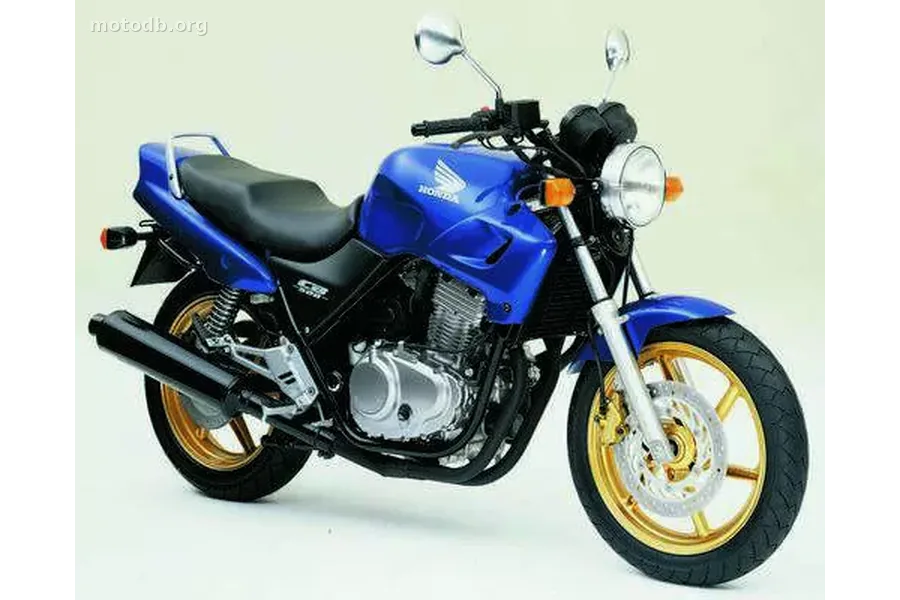
When looking for a motorcycle to learn on without breaking the bank or scaring yourself, you inevitably come across the CB 500. Not by accident. Honda built a reputation around this 499 cc twin that far exceeds the simple beginner's license category, and the 2002 version embodies this philosophy better than any marketing speech could.
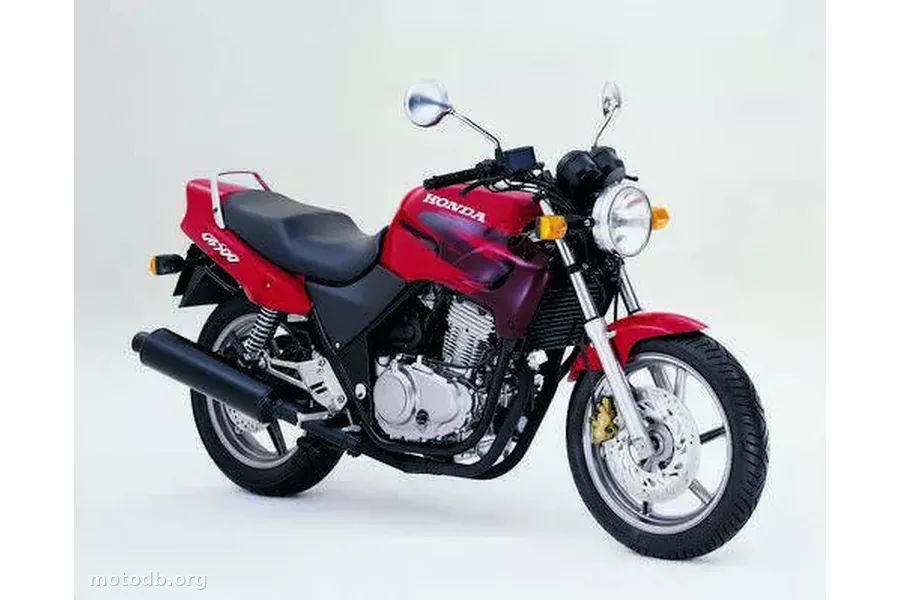
The engine is the heart of the matter. Eight valves, two cylinders, 58 horsepower at 9,500 rpm. On paper, it doesn't inspire dreams compared to some competitors playing the numbers game with more flattering figures. But in practice, this parallel twin delivers 46 Nm of torque from 8,000 rpm, and above all it puts out its power in a straightforward, honest way. It doesn't have the tractability of a large single-cylinder or the linearity of a well-bred four-cylinder, but it has character: aggressive when you wind it up through the rev range, it pushes consistently where direct rivals fall flat in the mid-range. Honda claims exceptional durability for this engine, and the Honda CB 500's reputation on the used market confirms what the manufacturer states: these engines last, for a long time, with minimal maintenance.
The steel double-cradle frame does its job without trying to impress. At 198 kg fully fuelled with a seat height of 775 mm, it's accessible, balanced, and easy to handle in the city and on the road alike. The 37 mm telescopic fork handles everyday riding adequately, and the overall rigidity even allows for some committed cornering without the bike protesting. The braking — a single disc at each end — is proportionate to the available power and the 190 km/h top speed. It doesn't surprise you; it reassures you. The only structural drawback comes from the rear shock absorbers, too soft for demanding riders, which compromise comfort on rough surfaces without jeopardising safety. It's the typical trade-off of a motorcycle designed for a broad audience.
What makes the Honda CB 500's spec sheet particularly relevant for the rational buyer is the consistency of the whole package. An 18-litre tank paired with moderate fuel consumption, a new price of 5,483 euros at the time, and an S variant available since 1998 for those wanting a more touring-oriented riding position. The CB 500 Cup, Honda's own competition formula, proves you can even use it to develop your track skills in a structured environment. Visually, nobody will turn their head at this motorcycle. Functional aesthetics, lines with no particular stylistic ambition — that's the trade-off for a machine designed to last and win you over through use rather than showroom appeal.
For anyone looking at a used Honda CB 500 today, this 2002 generation remains a solid foundation: proven mechanics, available parts, stable resale value. It speaks to the beginner who doesn't want to throw their money away, the urban commuter prioritising reliability over image, and the rider returning to motorcycling after a long break. Nothing spectacular, everything sensible. And sometimes, that's exactly what you need.
Practical info
- Moto bridable à 34 ch pour l'ancien permis A MTT1 - pas garanti pour le permis A2
- La moto est accessible aux permis : A, A (MTT1)
Reviews & comments
No reviews yet. Be the first to share your opinion!