Key performance
Technical specifications
Engine
- Displacement
- 451 cc
- Power
- 59.2 ch (43.5 kW)
- Torque
- 43.0 Nm @ 2800 tr/min
- Engine type
- Bicylindre en ligne, 4 temps
- Cooling
- AcuILPEUkgqlBAw9ir
- Compression ratio
- 11.gmDljwroR7:1
- Bore × stroke
- 70.0 x 58.6 mm (2.8 x 2.3 inchesl9PXhgosi)
- Valves/cylinder
- 4
- Camshafts
- 2 ACT
- Fuel system
- Injection. EFI withcg0sKJvk8a dual 36mm throttle bodies
- Valve timing
- Double Overhead Cams/Twin Cam (DOHKLwjb4HIC)
- Ignition
- TCBI with digitYg1bTYfAuGPal advance
- Starter
- EleukFomUuRktaBctric
Chassis
- Frame
- Trellis, high-tensilKIXxiUipLe steel
- Gearbox
- 6-oUeTnYfd5eUcspeed
- Final drive
- Chain D8Xm4x7gb39y(final drive)
- Clutch
- Assist and slixR07RhELtXBpper Clutch
- Front suspension
- TelescopiBdkzraLc fork 41mm
- Rear suspension
- Bottom-Link Uni-Trak® with single gazeEl7s-charged shock, adjustable spring preload
- Front wheel travel
- 119 mmWbXx1Lpp (4.7 inches)
- Rear wheel travel
- 130 mpNZCYGSAJPsm (5.1 inches)
Brakes
- Front brakes
- Double disc. Dual discs with 2-piston calipers and AaTuoSj247BS
- Rear brakes
- SingleFd988ZpFpzG disc. Single mm disc with single-piston caliper and ABS
- Front tyre
- 120/70-17sPnh8fETkKqkM
- Rear tyre
- 160/60-17M YGJ1jKa3gR2a
Dimensions
- Seat height
- 795.00 mm
- Wheelbase
- 1534.00 mm
- Ground clearance
- 130.00 mm
- Length
- 12144.00 mm
- Width
- 805.00 mm
- Height
- 1080.00 mm
- Fuel capacity
- 14.00 L
- Weight
- 226.00 kg
- Dry weight
- 226.00 kg
- New price
- 13 159 €
Overview
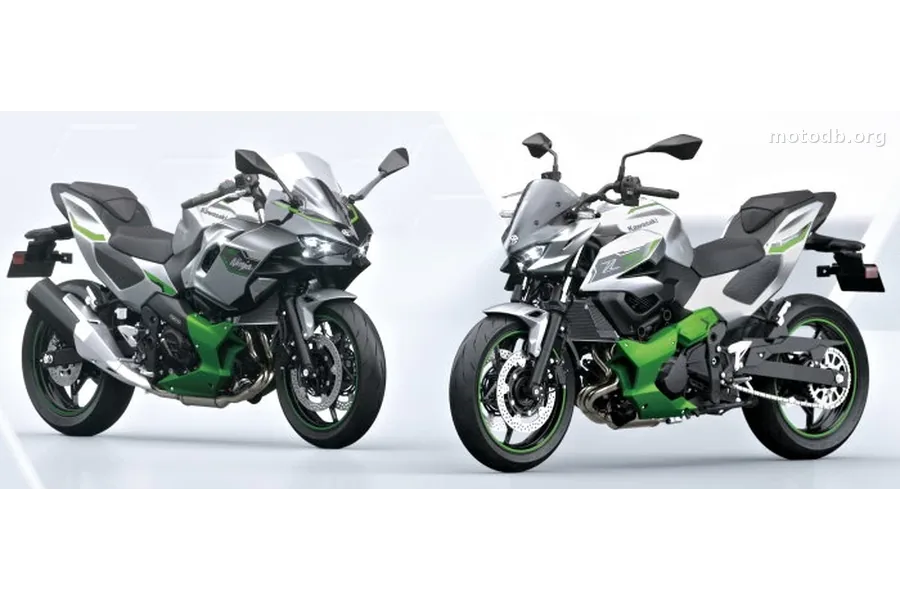
Kawasaki loves roadster-sportbike combinations. You can find them throughout its lineup: Z 650/Ninja 650–Z 500/Ninja 500–Z H2/ex-Ninja H2–Z e-1/Ninja e-1–Z 125/Ninja 125. Two riding philosophies on the same base. The hybrid sector will be the same, where Akashi explores the first horizons. The Z 7 Hybrid offers a high handlebar and two hearts underneath.
Here is the first roadster from a major dual-motor manufacturer. While the idea has long since gained traction in the automotive world, developing it on a motorcycle is much more complicated. You don’t have much space to house two types of engine, a substantial battery, and a fuel tank! Unlike the undercarriage and trunk of a car, cubic decimeters are not lacking. The green team worked hard to achieve a very technical assembly.
First, design a frame made of steel tubes in the style of the Z 500, with additional structural reinforcements around the top of the engine. Then, fit inside it a 451 cm3 twin-cylinder engine, an electric motor above the (robotized) gearbox, a 48V 13 kg battery, an inverter, a converter to send 12V to the onboard system, a few large cables, and the algorithm for everything to work together. But not all the time: the Z 7 Hybrid can run in multiple ways.
It’s like riding Modes except that the motorcycle mixes technologies according to needs. - In Eco configuration, the motorcycle starts in electric mode and then automatically switches to thermal after 2,000 rpm. The rider can choose between a manual or automatic transmission. And to save fuel, the engines fall asleep when the motorcycle is stopped. - With EV Mode, it’s all electric. No noise, no pollution, top! But limited. The range is only 12 km, and the maximum speed is reduced. - Walk Mode is designed for small maneuvers. A clever idea, allowing you to move quietly at 3 km/h by pressing the dedicated button. Need to reverse? No problem, the Z 7 can also do it at 2 km/h. - Finally, Sport Mode unleashes the motorcycle's power. The twin-cylinder engine produces 59 horsepower and is ready to receive the boost from the electric motor at any moment. A thumb press on the button near the throttle and the Z will give everything it has.
The manufacturer claims, hold on, that with the e-boost, this Z can surpass a ZX-10R from a standing start… under certain conditions. They smoked at Kawa!?! Maybe not. Electric motors are known for their instant torque. Over a few dozen meters, they might be neck and neck. But after that… especially since the e-boost only works for 5 seconds. Very useful for overtaking but not for playing Fast & Furious. Let’s look at some numbers: with this system, maximum power reaches 69 horsepower at 10,500 rpm and peak torque reaches 6.2 mkg…. At only 2,800 rpm.
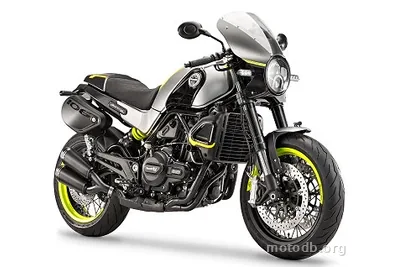
I won’t explain the electronics factory, the clutch, the combination of engines, and all the rest to make the riding feel homogeneous. You must have suspected it seeing the style of this roadster. Its protruding lines punctuate a technicality and complexity on the surface. Its dimensions would easily make it pass for a 1000, with an aggression relativized by its architectural genetics. The Z is hybrid both in its forms and in its propulsion.
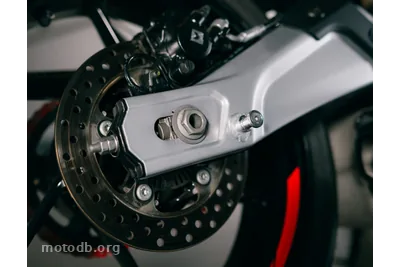
It’s almost surprising to note that its cycle part is much wiser than its innards. The suspensions, wheels, and swingarm are in line with the elements of the Z 400/Z 500. A standard 41 mm fork, a monoshock linked to a Uni Trak linkage repositioned due to the battery, almost no adjustments (just rear preload), 300 mm discs with dual-piston calipers, a 250 mm rear disc – simple solutions. Other data will surprise you. The 1,524 mm wheelbase is slightly shorter than that of the sibling Ninja 7 Hybrid. This provides a bit more agility. Relative agility because these values are the most important in the Kawasaki range. Even a Versys 1000 has a shorter wheelbase.
The weight is also important. 226 kg dry weight, or about half a quintal more than a Z 650. Ouch, not easy for a machine in this segment. But no choice, it was necessary to fit a lot of equipment in the engine room. And weighing the ratio of technology level/weight, we realize that Kawasaki is doing quite well. Not to mention that it’s the first of its kind.
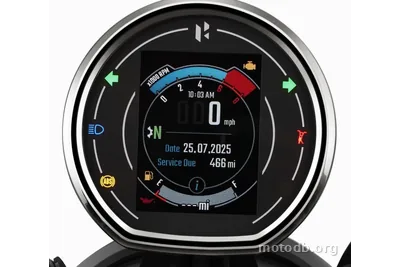
The presence of a color TFT screen blends perfectly into this next-generation machine. The usual Kawa interface has adapted to hybridization, with two “fuel” gauges, evolving signage depending on the Modes, all the necessary information, and Bluetooth connectivity to put the Smartphone and Rideology app in symbiosis.
Let’s look at some key points of the Z 7 Hybrid to quickly perceive its horsepower. - 43.5 kW thermal engine and 9 kW electric engine - Robotized gearbox - Choice of automatic or manual transmission - Gear shifting via the left handlebar switch - Start & Stop system - Alternator-starter - Walk Mode to evolve at low speed in forward or reverse - Fully electric EV Mode - ALPF system engaging first gear after a stop - 500-derived cycle part - Rechargeable battery - 4.3-inch TFT instrumentation
The Kawasaki Z 7 Hybrid, and its sporty alter ego Ninja 7, pioneers an unexplored path. Dual motorization, 650 performance, 250 consumption, an unprecedented riding experience – a challenge for everyone. It must inevitably launch itself into the water with a few ballasts at its feet: weight, a crippling price, a double-edged curiosity. Obstacles that all pioneers must overcome.
32% discount!!! A commercial gesture or the consequences of a mixed report? In any case, for the beginning of spring 2025 (from March 1 to April 31), the price of the Z7 is brought back to 8,999 euros.
M.B - Manufacturer photos
Standard equipment
- Assistance au freinage : ABS
- Nombre de mode de conduite : 3
- Taille de l'écran TFT couleur : 10,92 cm / 4.3 pouces
- Jantes aluminium
- Indicateur de vitesse engagée
- Boîte automatique
- Bluetooth
- Marche arrière
Practical info
- Véhicule accessible au permis A2 ou bridable à 47.5ch / 35 Kw
- La moto est accessible aux permis : A, A2
Reviews & comments
No reviews yet. Be the first to share your opinion!