Key performance
Technical specifications
- Fuel system
- — → Carburettor
- Ignition
- — → CDI
- Starter
- — → Electric
- Front wheel travel
- — → 115 mm (4.5 inches)
- Rear wheel travel
- — → 117 mm (4.6 inches)
- Front tyre
- 110/80-17 → 110/80-H17
- Rear tyre
- 130/80-17 → 130/80-H17
- Wheelbase
- — → 1435.00 mm
- Length
- 2090.00 mm → —
- Width
- 720.00 mm → —
Engine
- Displacement
- 499 cc
- Power
- 58.0 ch @ 9500 tr/min (41.6 kW)
- Torque
- 46.0 Nm @ 8000 tr/min
- Engine type
- Twin, four-stroke
- Cooling
- liquide
- Compression ratio
- 10.5:1
- Bore × stroke
- 73.0 x 59.6 mm (2.9 x 2.3 inches)
- Valves/cylinder
- 4
- Camshafts
- 2 ACT
- Fuel system
- Carburettor
- Ignition
- CDI
- Starter
- Electric
Chassis
- Frame
- double berceau acier
- Gearbox
- 6-speed
- Final drive
- Chain (final drive)
- Front suspension
- Fourche téléhydraulique Ø 37 mm, déb : 120 mm
- Rear suspension
- 2 amortisseurs latéraux, déb : 125 mm
- Front wheel travel
- 115 mm (4.5 inches)
- Rear wheel travel
- 117 mm (4.6 inches)
Brakes
- Front brakes
- Single disc
- Rear brakes
- Single disc
- Front tyre
- 110/80-H17
- Front tyre pressure
- 2.00 bar
- Rear tyre
- 130/80-H17
- Rear tyre pressure
- 2.25 bar
Dimensions
- Seat height
- 775.00 mm
- Wheelbase
- 1435.00 mm
- Fuel capacity
- 18.00 L
- Weight
- 198.00 kg
- Dry weight
- 173.00 kg
- New price
- 5 483 €
Overview
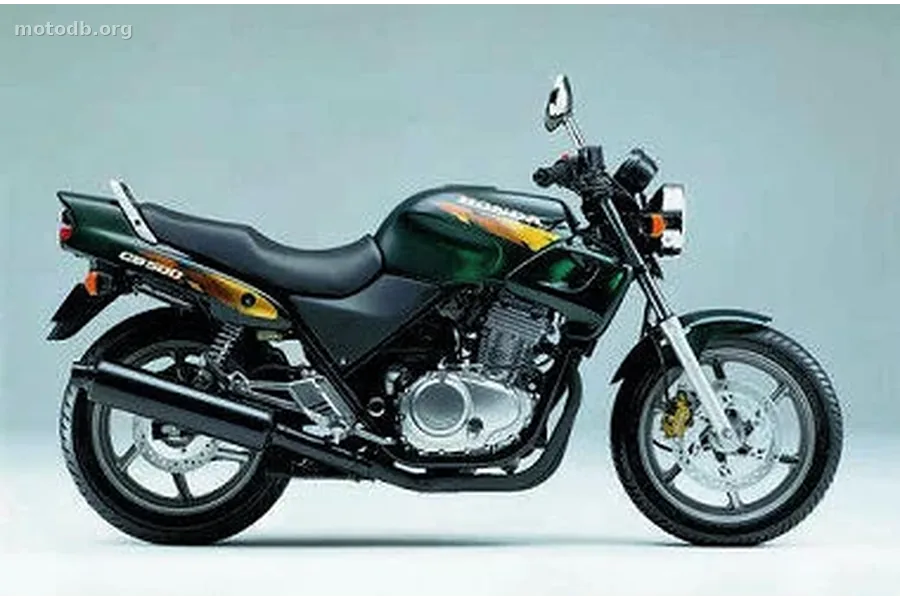
Some motorcycles are born with a predetermined destiny. Not to shine under showroom spotlights, not to adorn teenagers' posters, but to get the job done, year after year, without complaint. The Honda CB 500 belongs to that breed — the honest tools you end up respecting through sheer familiarity.
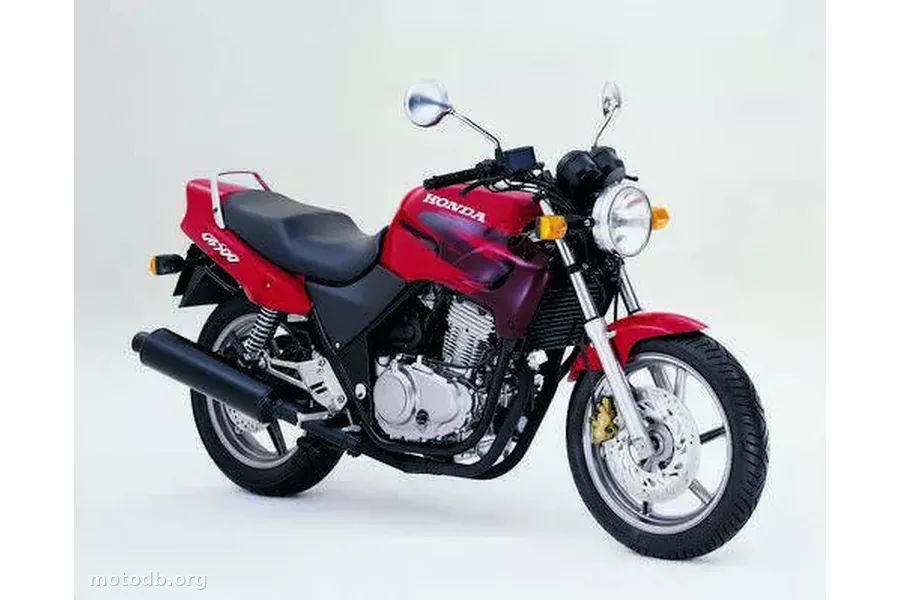
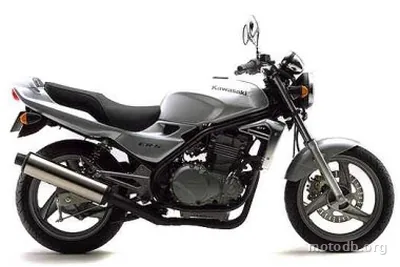
Beneath the 18-liter tank hides a parallel twin 499 cc 8-valve engine producing 58 horsepower at 9,500 rpm. These figures don't frighten a Kawasaki ER-5 or a Suzuki GS 500, its direct rivals in the segment. But the Honda twin has an advantage that raw data doesn't quite capture: 46 Nm of torque available from mid-range revs, making the machine usable without having to work the 6-speed gearbox relentlessly. The engine revs with a certain sharpness, a way of jolting the rider out of any routine complacency. Tractability isn't its strong suit, admittedly, but the enthusiasm more than compensates.
What truly sets this Honda CB 500 apart from the competition is a reliability reputation built on years of intensive service, from riding schools to private owners racking up the miles without a murmur. The steel double cradle absorbs, the 37 mm telehydraulic fork dampens, and the handling remains sound even when pushing the chassis to its reasonable limits. At 198 kg fully fuelled with a seat height of 775 mm, it remains accessible to new license holders without being unforgiving to more experienced riders. The claimed top speed of 179 km/h sits squarely within the segment's range, sufficient for mixed urban and road use.
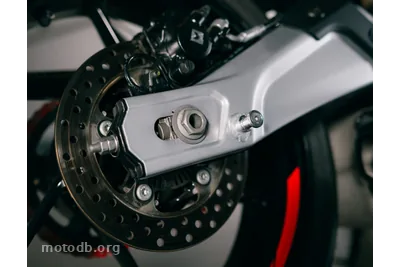
The single disc brakes on each wheel do their job without generating any particular excitement, which is ultimately what you'd expect from a motorcycle of this class. The rear shock absorbers, however, represent the genuine weak point of the Honda CB 500's spec sheet: their overly stiff setting penalises comfort on deteriorated surfaces without delivering any measurable dynamic gain. It's an awkward compromise, and Honda could have done better here. On a long motorway stretch, your back remembers it.
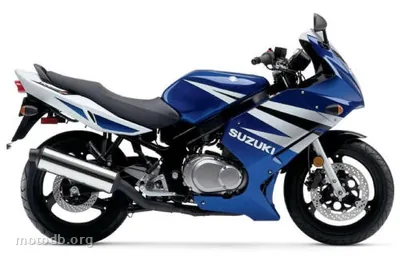
For under 5,500 euros on the 2001 price list, it's hard to argue with the value proposition. Maintenance costs remain reasonable, fuel consumption too, and parts availability has never been an issue. The Honda CB 500 makes no attempt to seduce through aesthetics — that much is clear. Its generic styling could belong to ten different models. But for a first-time rider looking to progress on a solid foundation, or an urban commuter wanting reliable transport without headaches, it remains a safe bet. Honda has offered an S version more oriented toward touring since 1998, a sign that the chassis had the potential to evolve. Current variants like the Honda CB 500 F and Honda CB 500 X confirm that this mechanical platform still had plenty to say.
Practical info
- Moto bridable à 34 ch pour l'ancien permis A MTT1 - pas garanti pour le permis A2
- La moto est accessible aux permis : A, A (MTT1)
Reviews & comments
No reviews yet. Be the first to share your opinion!