Key performance
Technical specifications
- Power
- 58.0 ch @ 9500 tr/min (42.0 kW) → 58.0 ch @ 9500 tr/min (42.3 kW)
- Torque
- 46.0 Nm @ 8000 tr/min → 48.0 Nm @ 8000 tr/min
- Cooling
- liquide → Liquid
- Bore × stroke
- 73.0 x 59.6 mm (2.9 x 2.3 inches) → 73 x 59.6 mm
- Fuel system
- Carburettor → —
- Front wheel travel
- 115 mm (4.5 inches) → —
- Rear wheel travel
- 117 mm (4.6 inches) → —
- Front tyre
- 110/80-17 57H → 110/80-17
- Rear tyre
- 130/80-17 65H → 130/80-17
- Wheelbase
- 1430.00 mm → 1435.00 mm
- Ground clearance
- 145.00 mm → —
- Length
- 2090.00 mm → —
- Width
- 720.00 mm → —
- Height
- 1050.00 mm → —
Engine
- Displacement
- 499 cc
- Power
- 58.0 ch @ 9500 tr/min (42.3 kW)
- Torque
- 48.0 Nm @ 8000 tr/min
- Engine type
- Twin, four-stroke
- Cooling
- Liquid
- Compression ratio
- 10.5:1
- Bore × stroke
- 73 x 59.6 mm
- Valves/cylinder
- 4
- Camshafts
- 2 ACT
Chassis
- Frame
- double berceau acier
- Gearbox
- 6-speed
- Final drive
- Chain (final drive)
- Front suspension
- Fourche téléhydraulique Ø 37 mm, déb : 120 mm
- Rear suspension
- 2 amortisseurs latéraux, déb : 125 mm
Brakes
- Front brakes
- Single disc
- Rear brakes
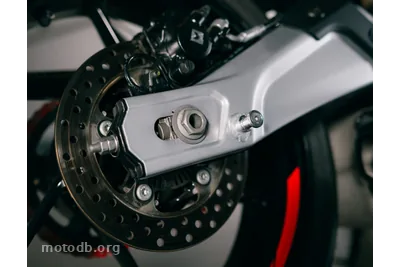
- Single disc
- Front tyre
- 110/80-17
- Front tyre pressure
- 2.00 bar
- Rear tyre
- 130/80-17
- Rear tyre pressure
- 2.25 bar
Dimensions
- Seat height
- 775.00 mm
- Wheelbase
- 1435.00 mm
- Fuel capacity
- 18.00 L
- Weight
- 198.00 kg
- Dry weight
- 173.00 kg
- New price
- 5 483 €
Overview
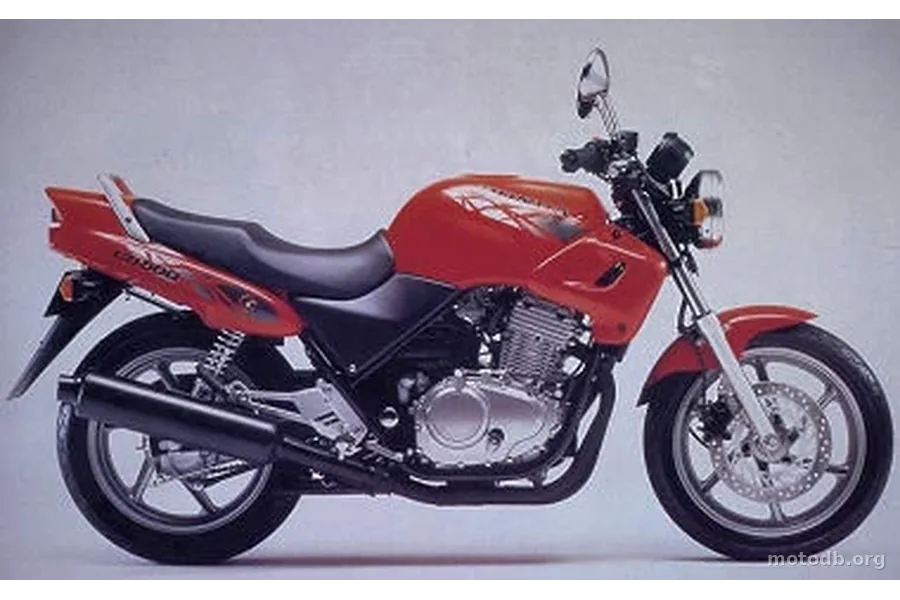
When Honda put the CB 500 back on the roads in 1994, nobody was looking to revolutionize the genre. The objective was simple, almost surgical: build a reliable, accessible machine capable of training an entire generation of riders without bankrupting or discouraging them. On that precise point, the brief is fulfilled beyond all reasonable expectations.
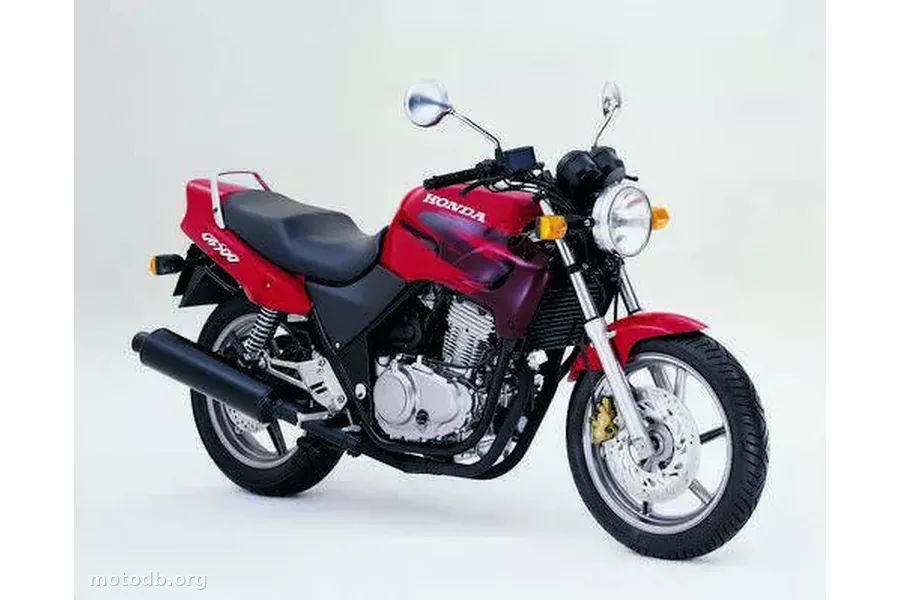
The 499 cc parallel twin has neither the smoothness of a Japanese four-cylinder nor the rough character of a British twin. Its 58 horsepower arrives at 9,500 rpm, which means you need to work through the rev range to get something out of it. But it's below the redline that things get positively interesting: 48 Nm of torque available from 8,000 rpm, early enough in the powerband to hustle the 198 kg wet weight along without the rider needing to work the clutch like a surgeon. The six-speed gearbox absorbs transitions without a hitch, and the 18-liter tank allows decent stretches between fuel stops. Honda quotes engine longevity figures that border on indecent for the segment — 300,000 kilometers under certain operating conditions. At that level, you're no longer talking about a motorcycle, you're talking about infrastructure.
The steel double-cradle frame makes no attempt to impress. It does its job, absorbs the mistakes of beginners as well as the more committed cornering of experienced riders, and never surprises in the wrong way. The 37 mm telescopic fork with 120 mm of travel is honest, but it's the twin rear shock absorbers that deserve a yellow card: their calibration prioritizes handling over comfort, and daily speed bumps make their presence felt in your vertebrae. It's not a dealbreaker, but it's noticeable. The single disc brakes at each end are adequate for the job, without generating any particular enthusiasm. The claimed top speed of 190 km/h will only be reached lying flat on the tank, but for the honda cb 500 and its real-world purpose, the question barely arises.
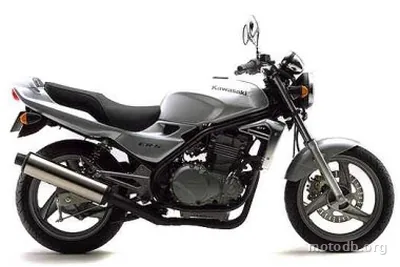
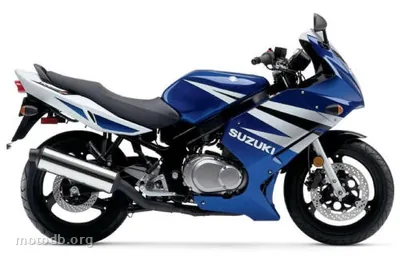
That's where the real story lies. The honda cb 500 technical specifications make it clear through its dimensions: a 775 mm seat height, 1,435 mm wheelbase — a contained package that makes it immediately manageable in urban environments. The commuter using it five days a week doesn't suffer, the newcomer getting their bearings doesn't find themselves in trouble, and the rider looking to have fun on a winding Sunday morning road won't be too heavily penalized either. Its launch price of around €5,483 placed the honda cb 500 prix in a defensible bracket against the Kawasaki ER-5 and Suzuki GS500 of the era. On the honda cb 500 occasion market today, its reputation for reliability still commands a solid resale value.
The design won't draw a crowd in a car park. It's a motorcycle that looks like a motorcycle — functional and without frills. But that stripped-back approach is almost a quality in itself: nothing fragile to worry about, nothing unnecessary to break. For those discovering motorcycling or looking for a no-nonsense daily tool, the honda cb 500 is a coherent, durable answer — and ultimately more endearing than it appears at first glance.
Practical info
- Moto bridable à 34 ch pour l'ancien permis A MTT1 - pas garanti pour le permis A2
- La moto est accessible aux permis : A, A (MTT1)
Reviews & comments
No reviews yet. Be the first to share your opinion!