Key performance
Technical specifications
Engine
- Displacement
- 955 cc
- Power
- 149.0 ch @ 10700 tr/min (108.8 kW)
- Torque
- 100.0 Nm @ 8200 tr/min
- Engine type
- In-line three, four-stroke
- Cooling
- Liquid
- Compression ratio
- 12.0:1
- Bore × stroke
- 79.0 x 65.0 mm (3.1 x 2.6 inches)
- Valves/cylinder
- 4
- Camshafts
- 2 ACT
- Fuel system
- Injection
- Valve timing
- Double Overhead Cams/Twin Cam (DOHC)
Chassis
- Frame
- multitubulaire en alu
- Gearbox
- 6-speed
- Final drive
- Chain (final drive)
- Front suspension
- Fourche téléhydraulique Ø 45 mm, déb : 120 mm
- Rear suspension
- Mono-amortisseur, déb : 140 mm
Brakes
- Front brakes
- Dual disc
- Rear brakes
- Single disc
- Front tyre
- 120/70-17
- Front tyre pressure
- 2.50 bar
- Rear tyre
- 190/50-17
- Rear tyre pressure
- 2.90 bar
Dimensions
- Seat height
- 815.00 mm
- Wheelbase
- 1426.00 mm
- Length
- 2072.00 mm
- Width
- 725.00 mm
- Height
- 1165.00 mm
- Fuel capacity
- 21.00 L
- Weight
- 219.00 kg
- Dry weight
- 191.00 kg
- New price
- 13 500 €
Overview
Do you remember 2002? Japanese sportbikes reigned supreme on the circuits, their four-cylinder engines screaming at 15,000 rpm. In that landscape, Triumph, with its century of existence on the odometer, released a secret weapon for its anniversary. Not a revolution, but a statement of intent: the Daytona 955i Centennial Edition. At the time, delivering 149 horsepower from an inline three-cylinder engine was a gamble. A typically British gamble, elegant and a little rebellious.
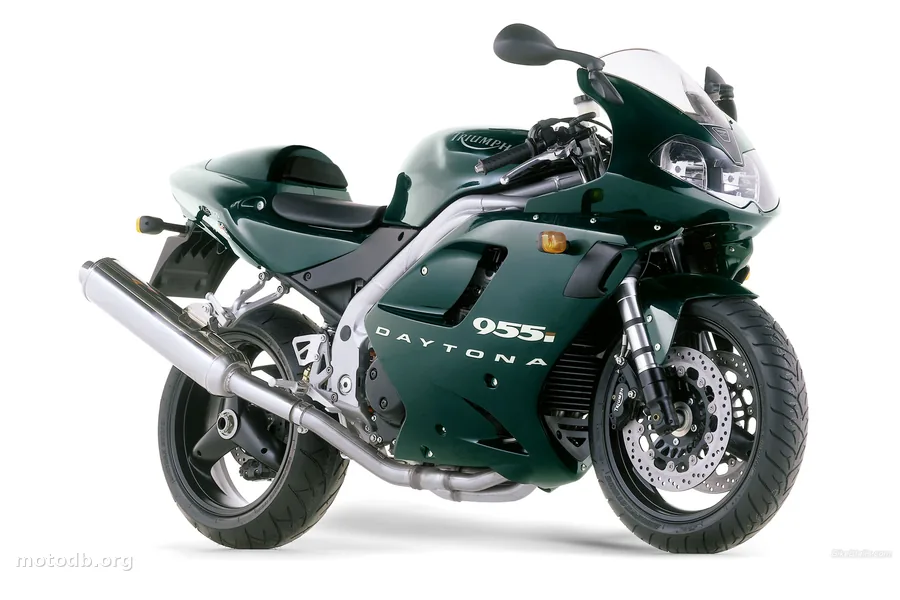
It doesn’t go unnoticed, that’s the least one can say. Clad in a deep English green, the “Aston Green,” it displays a presence that the garish plastics of the time didn’t know. The return of the single-sided rear swingarm, an aesthetic and technical signature that purists had regretted, gives it a distinctive silhouette. Adding a few discreet touches of carbon fiber on the mudguard and flanks, and you get a sportbike that focuses on refinement rather than aggression. An approach befitting its status as a limited series of only 200 units.
But don't be fooled, beneath this distinguished attire beats the wild heart of the famous 955 cm³ triple. This engine is the soul of the bike. It delivers its 149 hp at 10,700 rpm, with a torque of 100 Nm available much earlier, around 8,200 rpm. This is where its genius lies compared to Japanese four-cylinder engines: a force available in the mid-range, a meaty push that propels you without needing to twist the throttle to the rev limiter. Admittedly, compared to the original T595, it is sometimes criticized for having lost a little of its mid-range punch to gain maximum power, but the character remains unique. Its deep, full rumble is an unforgettable sound signature.
With a multi-tubular aluminum frame and a wet weight of 219 kg, it’s not the lightest in its class. The seat height of 815 mm may intimidate those of smaller stature. Yet, once in motion, it proves surprisingly agile and predictable. The 45 mm fork and single shock offer a more supple road-going compromise than on a pure track bike, making it a sportbike for winding roads, capable of devouring kilometers with a certain serenity, aided by a 21-liter tank. The brakes, two front discs, do the job without being the sharpest on the market.
Who is it for? The enthusiast seeking a sportbike with a distinctive character, who prefers discreet elegance and torque richness to the strident cries of a four-cylinder engine. It's a machine for those who want a Daytona 955i, but with the small historical and exclusive bonus of the centennial series. At 13,500 euros new, it was clearly positioned in the high-end segment. Today, it is a collector's item, a piece of Triumph history that recalls that at the dawn of the 2000s, the English still knew how to shake up the established order with panache and an unmatched three-cylinder engine.
Practical info
- La moto est accessible aux permis : A
Indicators & positioning
Similar bikes
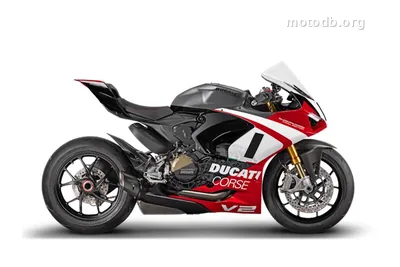
Panigale V2 Bayliss
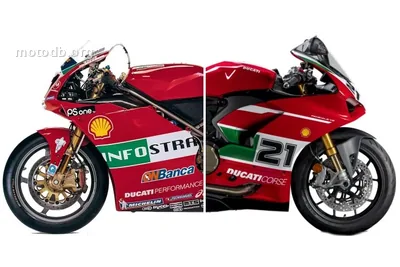
Panigale V2 Bayliss 1st Championship 20th Anniversary
Reviews & comments
No reviews yet. Be the first to share your opinion!