Key performance
Technical specifications
Engine
- Displacement
- 1199 cc
- Power
- 95.0 ch @ 6200 tr/min (69.9 kW)
- Torque
- 107.9 Nm @ 6500 tr/min
- Engine type
- Bicylindre en V, 4 temps
- Cooling
- par air
- Compression ratio
- 10:1
- Bore × stroke
- 88.8 x 96.8 mm
- Valves/cylinder
- 2
- Fuel system
- Injection
Chassis
- Frame
- structure en tubes d\'acier
- Gearbox
- boîte à 5 rapports
- Final drive
- Courroie
- Front suspension
- Fourche téléhydraulique Ø 41mm, déb : 120 mm
- Rear suspension
- Mono-amortisseur, déb : 117 mm
Brakes
- Front brakes
- Freinage
- Rear brakes
- Freinage 1 disque
- Front tyre
- 120/70-17
- Front tyre pressure
- 2.20 bar
- Rear tyre
- 170/60-16
- Rear tyre pressure
- 2.48 bar
Dimensions
- Fuel capacity
- 16.30 L
- Weight
- 221.00 kg
- Dry weight
- 200.00 kg
- New price
- 10 365 €
Overview
Some motorcycles are ridden. This one, you endure it, in the best sense of the term. The 2002 X1 Lightning belongs to that rare category of machines that don’s seek to please, that make no effort of seduction, and yet captivate from the first twist of the throttle. Erik Buell had an obsession: to take the internals of a Harley-Davidson V-twin and make something sharp, nervous, radically different from the Milwaukee cradle from which it originated.
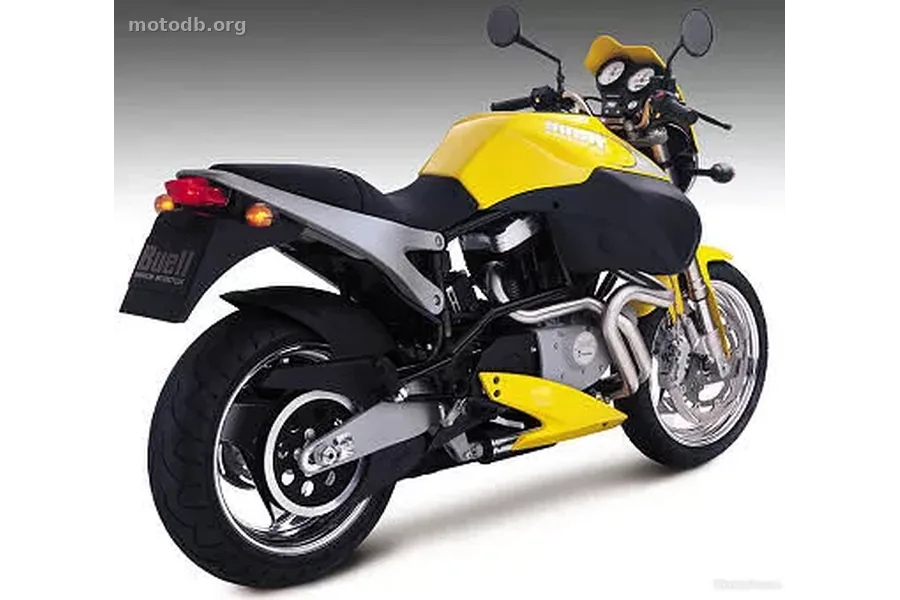
The result is this 1199 cc V-twin, pushrod, producing 95 horsepower at 6200 rpm and 107.9 Nm of torque. On paper, these figures seem modest compared to a Yamaha XJR 1300 or a Suzuki GSX 1400. But comparing the Lightning to these machines is like confusing a jackhammer with a chainsaw. The twin’s torque expresses itself in the mid-range with a frankness that jostles the rider in the saddle. No progressive and polished power delivery, no four-cylinder that purrs while waiting for high revs. Here, the mechanics speak loudly and without detour.
The drawback comes from the final gearing, restricted by European homologation constraints. The belt transmission and five-speed gearbox do their job, but the strangled final drive ratio prevents the machine from expressing everything it has in its belly. The limits of fifth gear are regularly reached on open roads, frustrating when you know that the announced top speed reaches 216 km/h. This is the compromise that Buell was unable to, or did not, escape. The braking, however, suffers from no restraint: the single, large-diameter disc positioned on the periphery of the front wheel, a house signature, generates a sharp stopping power. The 41 mm telescopic fork handles well on smooth roads, but reveals its limits on degraded surfaces, where the single rear shock absorber does the same. For 221 kg fully fueled, one would have hoped for a little more care in the calibration of the suspension.
The design deserves attention. The exhaust and shock absorber are hidden under the engine, the line is compact, stocky, almost aggressively compact in its density. The passenger seat is symbolic, the 16.3-liter tank provides reasonable range, but the overall ergonomics send a clear message: this motorcycle is not designed for family rides. It is aimed at the solo rider who seeks a physical, direct experience, without filters. At 10,365 euros in 2002, it targeted an informed buyer, capable of accepting the compromises of a machine with character in exchange for sensations that the smooth and wise Japanese bikes of the time could not offer.
The Buell X1 Lightning is a motorcycle of conviction. It demands that the rider be in the same mindset as the machine, engaged, focused, ready to absorb the twin’s vibrations and the imprecision of the suspension as raw signals from a living mechanical system. It is not a perfect motorcycle, far from it. It is an honest motorcycle, almost brutally honest, and that quality, in a market saturated with polished machines, is worth a few flaws.
Practical info
- La moto est accessible aux permis : A
Reviews & comments
No reviews yet. Be the first to share your opinion!