Key performance
Technical specifications
Engine
- Displacement
- 1199 cc
- Power
- 95.0 ch @ 6200 tr/min (69.9 kW)
- Torque
- 107.9 Nm @ 6500 tr/min
- Engine type
- Bicylindre en V, 4 temps
- Cooling
- par air
- Compression ratio
- 10:1
- Bore × stroke
- 88.8 x 96.8 mm
- Valves/cylinder
- 2
- Fuel system
- Injection
Chassis
- Frame
- structure en tubes d\'acier
- Gearbox
- boîte à 5 rapports
- Final drive
- Courroie
- Front suspension
- Fourche téléhydraulique Ø 41mm, déb : 120 mm
- Rear suspension
- Mono-amortisseur, déb : 117 mm
Brakes
- Front brakes
- Freinage
- Rear brakes
- Freinage 1 disque
- Front tyre
- 120/70-17
- Front tyre pressure
- 2.20 bar
- Rear tyre
- 170/60-16
- Rear tyre pressure
- 2.48 bar
Dimensions
- Fuel capacity
- 16.30 L
- Weight
- 221.00 kg
- Dry weight
- 200.00 kg
- New price
- 10 365 €
Overview
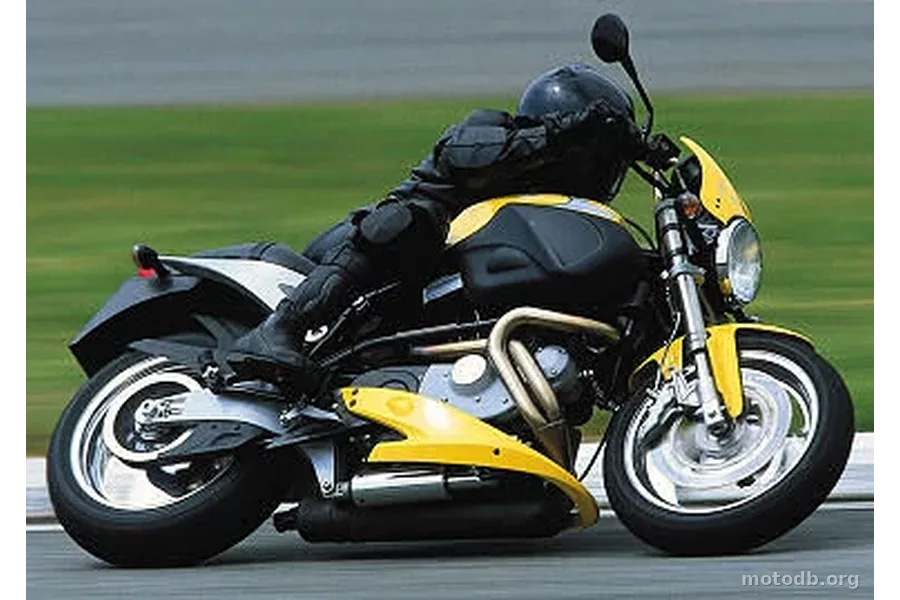
What drives a manufacturer to take the Harley-Davidson overhead valve V-twin engine, a motor designed for miles of straight asphalt, and graft it onto a sporty chassis built to bite into corners? That’s exactly the question Erik Buell has been asking himself for years, and the 2000 X1 Lightning is the most direct answer. A 1199 cc V-twin producing 95 horsepower at 6200 rpm, 107.9 Nm of torque at 6500 rpm, housed in a compact steel tubular frame weighing 200 kg dry. On paper, it resembles a mechanical oxymoron. On the road, it’s another story.
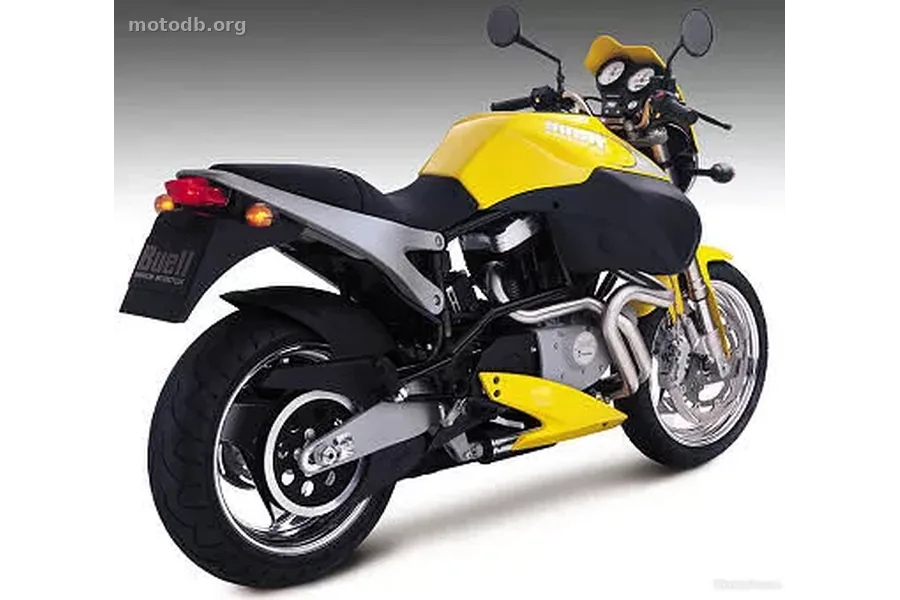
The engine is the soul of this machine, and it doesn’t seek to be discreet. Where a Yamaha XJR 1300 distills its power with the civility of a well-bred four-cylinder, the Buell twin imposes its conditions from the mid-range. The surge is frank, physical, almost brutal in its way of sending the 221 kg towards 216 km/h. It’s not an engine to be tamed, it’s an engine with which one negotiates. Lovers of linear progression and smooth operation will look elsewhere, towards Japanese or German roadsters.
The drawback comes from an unexpected place: the final gearing, limited by homologation requirements, caps what the engine would be capable of expressing fully. It’s frustrating precisely because the rest of the package keeps its promises on smooth pavement. Road handling is crisp, the steering precise, and the belt transmission on the five-speed gearbox functions without a hitch. But as soon as the asphalt degrades, the suspensions show their limits. The 41 mm telescopic fork and the single rear shock absorber, with modest travel of 120 and 117 mm respectively, struggle on chaotic surfaces. Under heavy braking, the fork can also be overwhelmed by events, despite the actual power of the front disc.
The design is worth stopping for. Buell hid everything under the machine: the short exhaust pipe under the engine, the shock absorber follows the same logic, and the resulting compact silhouette resembles nothing else on the market in 2000. The passenger seat is more of a symbol than actual functionality. This stylistic choice, consistent with the mechanical personality of the machine, at odds with bourgeois comfort, clearly states who the Lightning is for: not the tourist, not the commuter, but the rider who accepts paying 10,365 euros for a no-compromise riding experience.
The Buell X1 Lightning is not a motorcycle for everyone, and that’s precisely what makes it interesting. It requires a confirmed riding level, a certain tolerance for discomfort, and a real appetite for atypical mechanical characters. Those seeking a versatile and docile sportbike will pass by without regrets. The others, those for whom the motorcycle must provide something indescribable on each outing, will find in this iconoclastic American a machine that keeps its promises in a very particular way.
Practical info
- La moto est accessible aux permis : A
Reviews & comments
No reviews yet. Be the first to share your opinion!