Key performance
Technical specifications
Engine
- Displacement
- 1199 cc
- Power
- 95.0 ch @ 6200 tr/min (69.9 kW)
- Torque
- 107.9 Nm @ 6500 tr/min
- Engine type
- Bicylindre en V, 4 temps
- Cooling
- par air
- Compression ratio
- 10:1
- Bore × stroke
- 88.8 x 96.8 mm
- Valves/cylinder
- 2
- Fuel system
- Injection
Chassis
- Frame
- structure en tubes d\'acier
- Gearbox
- boîte à 5 rapports
- Final drive
- Courroie
- Front suspension
- Fourche téléhydraulique Ø 41mm, déb : 120 mm
- Rear suspension
- Mono-amortisseur, déb : 117 mm
Brakes
- Front brakes
- Freinage
- Rear brakes
- Freinage 1 disque
- Front tyre
- 120/70-17
- Front tyre pressure
- 2.20 bar
- Rear tyre
- 170/60-16
- Rear tyre pressure
- 2.48 bar
Dimensions
- Fuel capacity
- 16.30 L
- Weight
- 221.00 kg
- Dry weight
- 200.00 kg
- New price
- 10 365 €
Overview
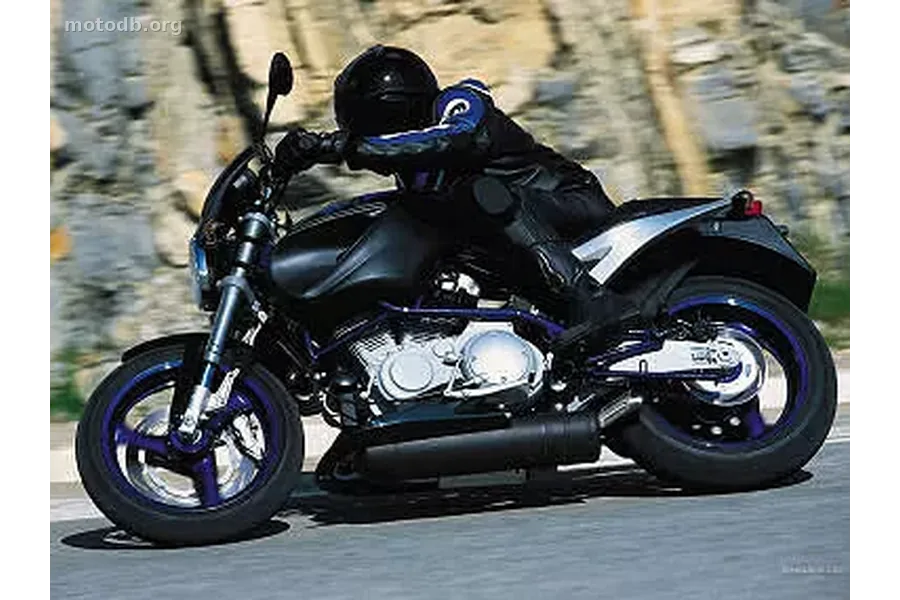
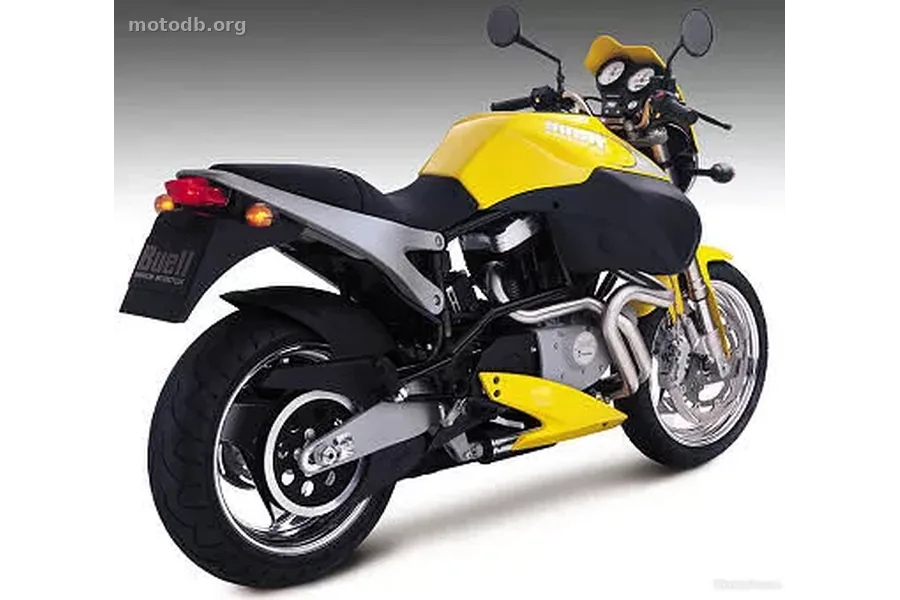
When Erik Buell decided to take Milwaukee’s pushrod V-twin and turn it into a sportbike, many scoffed. The result: the 2001 X1 Lightning, a machine that weighs 221 kilograms fully fueled and looks you straight in the eye, questioning whether you’re really sure you want to go.
The engine is the heart of the matter. A 1199 cc V-twin, bore 88.8 mm, stroke 96.8 mm, compression ratio 10:1, developing 95 horsepower at 6200 rpm and a torque of 107.9 Nm at 6500 rpm. On paper, these figures seem reasonable. On the road, in the mid-range, it’s a different conversation. The twin pulls with a frankness that surprises, a rough and straightforward character that the five-speed belt transmission conveys without superfluous filtering. No silky purr like the Yamaha XJR 1300, no progressive and polished build-up of Japanese four-cylinders. Here, the engine speaks loudly and doesn’t wait for you to ask questions.
The main drawback comes from the transmission ratios, constrained by homologation standards, which restrict part of the engine's natural potential. This is the recurring frustration of Lightning riders: feeling this potential at hand and not being able to fully exploit it due to a gearing too long. The announced top speed of 216 km/h doesn’t tell the whole story of what this motorcycle could have been with more regulatory freedom.
The chassis behavior deserves a clear distinction between two situations. On clean, well-paved roads, the steel tubular frame, the 41 mm telescopic fork and the single rear shock offer healthy, precise, engaging dynamics. Braking with this single large front disc bites with conviction, perhaps even too much in the wet or into a fast corner. On degraded surfaces, the suspension with its 120 mm travel at the front and 117 mm at the rear show their limits, and the fork can be overwhelmed during hard braking combined with road irregularities. This is not a trail bike, let’s not forget.
Visually, the X1 doesn’s seek to please everyone, and that’s precisely its strength. Compact silhouette, exhaust and shock housed under the engine according to the Buell patent, passenger space reduced to its simplest expression. For 10,365 euros in 2001, you bought a machine making no concessions to comfort or versatility. The 16.3-liter tank offers correct, but not generous, range. The target audience is clearly the passionate rider, urban or weekend road rider, who prefers personality to practicality. A beginner would be uncomfortable with this sharp character. A touring rider seeking long-distance comfort would pass by. But for those who want a raw and memorable riding experience, it’s hard to find anything as Americanly direct in this niche.
Practical info
- La moto est accessible aux permis : A
Reviews & comments
No reviews yet. Be the first to share your opinion!