Key performance
Technical specifications
Engine
- Displacement
- 1649 cc
- Power
- 160.5 ch @ 6750 tr/min (118.0 kW)
- Torque
- 180.0 Nm @ 5250 tr/min
- Cooling
- liquide
- Compression ratio
- 12.2 : 1
- Bore × stroke
- 72 x 67.5 mm
- Valves/cylinder
- 4
- Camshafts
- 2 ACT
- Fuel system
- Injection
- Starter
- électrique
- Euro standard
- Euro 5+
Chassis
- Frame
- cadre périmétrique en aluminium
- Gearbox
- boîte à 6 rapports
- Final drive
- Cardan
- Rear suspension
- Mono-amortisseur et monobras Paralever, déb : 135 mm
Brakes
- Front brakes
- Freinage 2 disques Ø 320 mm, étrier 4 pistons
- Rear brakes
- Freinage 1 disque Ø 320 mm, étrier 2 pistons
- Front tyre
- 120/70-17
- Rear tyre
- 190/55-17
Dimensions
- Seat height
- 810.00 mm
- Seat type
- Selle biplaces
- Fuel capacity
- 26.00 L
- Weight
- 343.00 kg
- New price
- 28 900 €
Overview
In 2022, BMW significantly evolved its flagship range, the K 1600, to prolong the pleasure of the 6-cylinder engine before emission standards force us to ride smaller engines with a reduced number of cylinders. The objective for German engineers? To ensure the large machine passes Euro 5 without losing power.
To achieve this, German science has put its best technicians on the heart of the 6-cylinder engine. Let's recall that Euro 5 requires motorcycles to reduce their emissions by one-third compared to Euro 4. Thus, while the architecture and moving mechanical parts remain identical, BMW has changed the entire engine control section. This begins with an engine control unit called BMS-O. While we have limited details on this component, we do know that it has allowed the same power of 118 kW (160 hp) to be maintained despite the demanding castration standard. This new engine management even allows the peak power to be delivered 1,000 rpm earlier at 6,750 rpm (compared to 7,750 rpm for the previous model).
Engine torque (traction force) sees a slight improvement, peaking at 180 Nm at 5,250 rpm compared to 175 Nm previously. The long-distance traveler can therefore load the cases even more, the BM will pull without panting in the high alpine passes. When slowing down, the rider can focus more easily on their trajectories thanks to the electronic MSR (Motor Slip Regulation) engine braking control assistance, which is also optimized. In difficult conditions, the assistance will now monitor things to avoid any sudden lockup with the torque feedback phenomenon or on the free wheel, optimizing engine braking.
The K 1600 receives two additional lambda probes, bringing the total to four on the engine. Lambda probes (before and after the catalytic converter) are very important for analyzing the exhaust gases from the engine (regulation probe) and after the catalytic converter for pollution control (diagnostic probe). The lambda probe is often called the oxygen sensor. The engine control electronic control center (and therefore the air / fuel mixture) can thus perfectly adjust the injectors for optimized operation and consequently reduce pollution emissions. The mixture entering the combustion chamber will neither be too rich nor too lean. The goal is to inject a stoichiometric mixture, the ideal operating value of an engine.
Still with the aim of optimizing its 1,649 cc 6-cylinder engine, BMW now uses two knock sensors. These detect engine noises in the form of frequencies to send the analyses to the engine control unit. The latter can then control the engine ignition timing to favor perfect combustion. One could develop an entire mechanical article on the notion of ignition in the engine and the very important role of knocking. To simplify, let's say that this equipment not only reduces pollution for combustion but that the adjustment at each cycle of the engine (depending on its temperature, its speed of rotation) also allows the combustion chamber and the piston head to remain "clean". A clean engine internally is also an engine that is in good condition and that pollutes less.
The engine's power transmission to the wheel is still entrusted to the 6-speed gearbox and the driveshaft duo. Note that those who have a slightly sporty inclination, despite the weight of over 330 kg with full tanks, can count on an option to be ordered from the factory with the Shifter Pro inherited from the S 1000 RR. The latter will allow you to change gears on the fly (up or down) without touching the clutch.
From a chassis perspective, nothing changes. BMW still trusts its perimeter aluminum frame coupled with the traditional Duolever and Paralever suspensions. The rear suspension offers 135 mm of travel when the front has a 115 mm stroke. These suspensions are still under the control of electronic Dynamic ESA (Electronic Suspension Adjustment), branded by the Bavarian manufacturer. BMW specifies that on this new generation, fully automatic load compensation is standard. Thus, you will no longer worry about whether you are riding solo, duo with cases and/or the mother-in-law, the leveling correction and suspension adjustment will always be perfect. The suspension also reads the road to adapt to the quality of the ground passing under the wheels in order to strengthen the feeling of comfort or conversely, to adapt the motorcycle's dynamism to your driving in winding roads.
Assisted Riding, Always More
The K 1600 GT is designed to be the most dynamic in the range. The riding position, more "alert" than on the GTL, is in this direction. Armed with technology, it can count on a host of driving aids to make the experience as comfortable as possible, and also as easy for those who are not yet fully able to ride a heavy "char", weighing over 330 kg with full tanks. Three riding modes are available: Rain, Road or Dynamic. Even without mastering the language of Shakespeare, you will easily understand the usefulness of each mode: wet, road or dynamic. The fury of the 6-cylinder is also controlled by the DTC (Dynamic Traction Control), also called anti-wheelspin acceleration traction control. If low-speed maneuvers scare you, BMW has also provided a virtual push with a hill start assist or a reverse assist: just add wheels!
The upper part of the motorcycle, the cockpit, evolves radically front/back.
Thus, the K 1600 GT receives a new LED light and its daytime visual signature is reinforced. The main light is directional allowing to increase visibility in turns. It is also capable of adjusting its position by +/- 2° in order not to lose length during braking or acceleration phases.
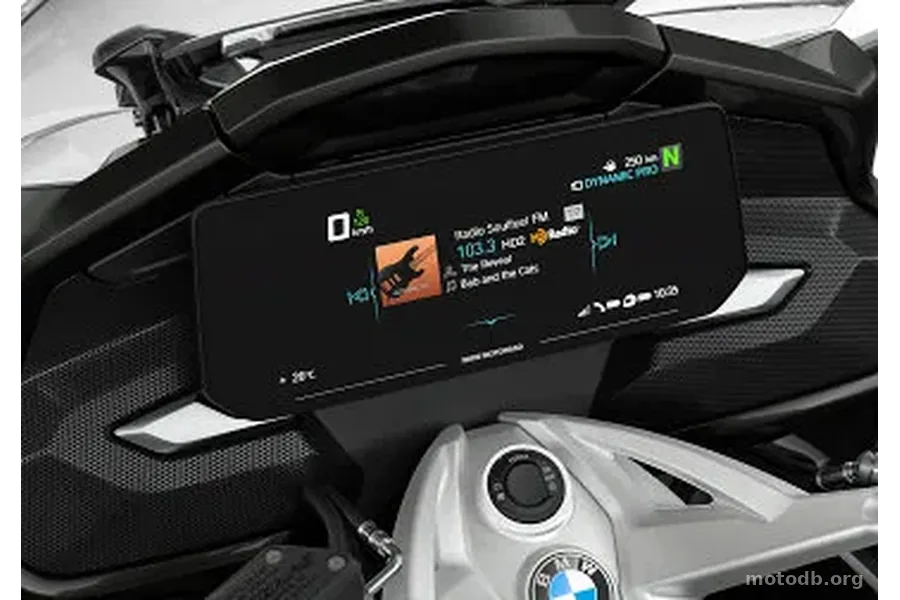
For the rider, the Bavarian 2022 ship receives the TFT screen from its two-cylinder sister, the R 1250 RT. The K 1600 GT, GTL, B and Grand America are now equipped as standard with this 10.25-inch color TFT screen. In addition to the traditional information, this screen can now offer integrated navigation. We can now do without an additional screen for GPS. If the sound of the 6-cylinder with its mechanical howl does not satisfy you, music lovers can count on a new 2.0 audio system (optional).
The cockpit is complemented by a USB-C charging compartment (waterproof and ventilated), an E-Call emergency call button, 4 configurable shortcut buttons to avoid getting lost in the menus of all possibilities, or a keyless start (since 2023). Those who are more chilly will be delighted to learn that the K 1600 can receive heated grips and seat among countless refinements. BMW has deemed it appropriate to specify that the K 1600 GT still benefits from cases for the least observant among you. This brings it 64 liters of luggage space and a more "lightweight" look than the 16 GTL and Grand America senatorials.
Finally, long-distance travelers will always be pleased to learn that BMW has managed to preserve the mechanical richness of its flagship intact. More than ever an invitation to travel, the K 1600 adapts to your desires with all its formulas.
Vincent Beaucousin - Photos manufacturer
Standard equipment
- Assistance au freinage : BMW Motorrad ABS
- Nombre de mode de conduite : 3
- Volume de rangement : 64 litres
- Taille de l'écran TFT couleur : 26,04 cm / 10.25 pouces
- ABS Cornering
- Jantes aluminium
- Béquille centrale
- Indicateur de vitesse engagée
- Régulateur de vitesse
- Radio
- GPS
- Prise USB
- Aide au démarrage en côte (Hill Hold Control)
- Marche arrière
- Démarrage sans clé
- Contrôle de traction
- Poignées chauffantes
- Pare brise réglable électriquement
- Suspensions réglables électroniquement
- Valises
- Selle réglable
- Selle chauffante
- Phares adaptatifs en virage
- Contrôle du frein moteur
- Surveillance de la pression des pneus
Practical info
- La moto est accessible aux permis : A
Indicators & positioning
Similar bikes
Heritage Softail Classic 110th Anniversary
FLHTC Electra Glide Classic
Electra Glide Ultra Limited 110th Anniversary
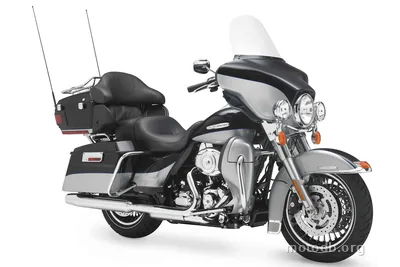
FLHTK Electra Glide Ultra Limited
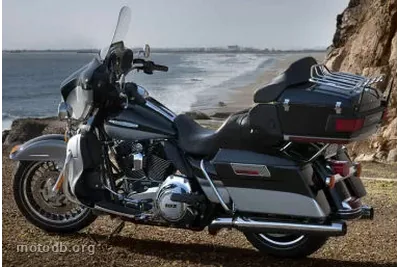
1690 ELECTRA GLIDE ULTRA LIMITED 110ème Anniversaire FLHTK
Reviews & comments
No reviews yet. Be the first to share your opinion!