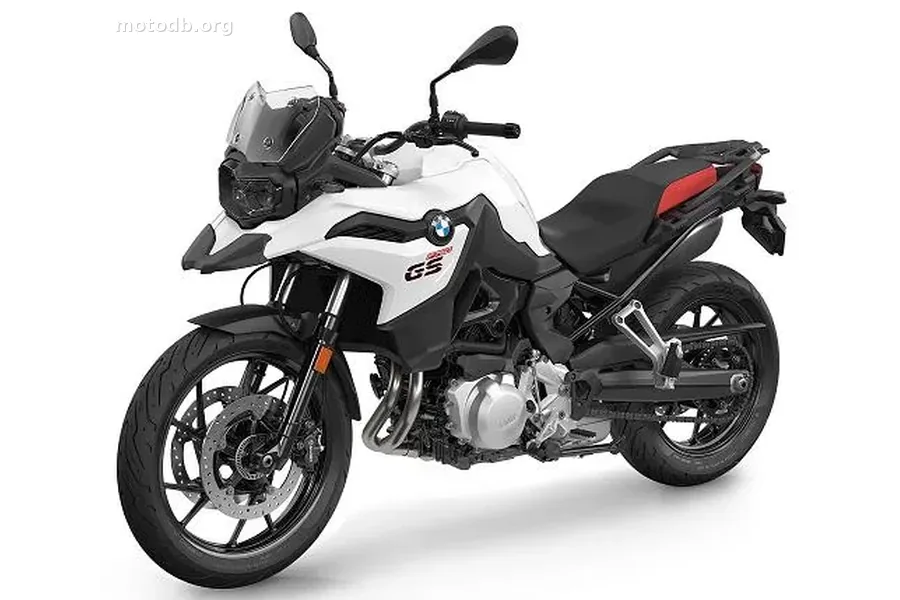
Key performance
Technical specifications
Engine
- Displacement
- 853 cc
- Power
- 77.0 ch @ 7500 tr/min (56.2 kW)
- Torque
- 83.0 Nm @ 6000 tr/min
- Engine type
- Twin, four-stroke
- Cooling
- Liquid
- Compression ratio
- 12.7:1
- Bore × stroke
- 84.0 x 77.0 mm (3.3 x 3.0 inches)
- Valves/cylinder
- 4
- Camshafts
- 2 ACT
- Fuel system
- Injection. Electroinc intake pipe injection, digital engine management (BMS-K+)
- Valve timing
- Double Overhead Cams/Twin Cam (DOHC)
- Lubrication
- Dry sump
- Starter
- Electric
Chassis
- Frame
- Bridge-type frame, steel shell construction
- Gearbox
- 6-speed
- Final drive
- Chain (final drive)
- Clutch
- Multiple-disc clutch in oil bath, mechanically operated
- Front suspension
- Telescopic fork, 41 mm
- Rear suspension
- Cast aluminium dual swing arm, central spring strut, spring pre-load hydraulically adjustable (continuously variable) at handwheel, rebound damping adjustable
- Front wheel travel
- 151 mm (5.9 inches)
- Rear wheel travel
- 177 mm (7.0 inches)
Brakes
- Front brakes
- Double disc. ABS. Floating discs. Two-piston calipers.
- Rear brakes
- Single disc. ABS. Floating disc. Single-piston caliper.
- Front tyre
- 110/80-19
- Front tyre pressure
- 2.20 bar
- Rear tyre
- 150/70-17
- Rear tyre pressure
- 2.50 bar
Dimensions
- Seat height
- 815.00 mm
- Wheelbase
- 1559.00 mm
- Length
- 2255.00 mm
- Width
- 922.00 mm
- Height
- 1225.00 mm
- Fuel capacity
- 15.00 L
- Weight
- 224.00 kg
- New price
- 10 200 €
Overview
Born into a family of champions, it’s both a chance and a burden. The BMW F 750 GS has carried this dual heritage since its beginnings: too tame for adventurers who prefer the F 850 GS, too expensive for those eyeing a KTM 790 Adventure or a Kawasaki Versys 650, it has long searched for its place. But since the 2018 redesign, the little Bavarian has found its target, and that target is quite precise: the A2 license holder who wants to ride a GS without putting 15,000 euros on the table, or the urban commuter who has no intention of riding in the mud on a Sunday morning.
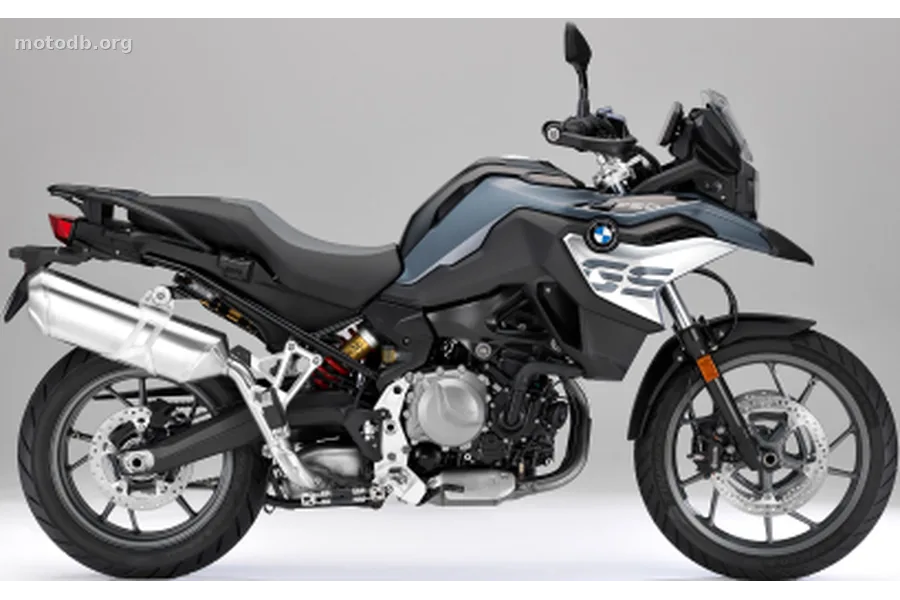
The heart of the matter is this 853 cm3 parallel-twin, a technical decision that profoundly changes the character of the machine. Forget the droning and linear two-cylinder of the previous generation: with this offset ignition, the engine breathes differently, it pulses, it lives. The 77 horsepower peaks at 7,500 rpm and the 83 Nm of torque is expressed from 6,000 rpm, which places the BMW F 750 GS 2020 in an honest position against the competition. Two balance shafts manage residual vibrations, and on the highway, the wrists thank you. The announced consumption of 4.1 liters per 100 km is not a fantasy: with 15 liters on board, you easily exceed 300 kilometers of range without stress. For a versatile trail bike designed for long distances, this is a solid argument.
The architecture has also evolved in the right direction. The steel double-tube frame replaces the old tubular trellis and provides welcome rigidity. The 41 mm telescopic fork is not inverted, subtly recalling that this motorcycle is not designed for forest trails. The reduced stroke of 151 mm confirms the assumed road vocation. This is where BMW F 750 GS reviews often diverge on forums: those who hoped for a real versatile trail bike turn to the F 850 GS with its inverted fork, its 21-inch front wheel and its 190 mm of stroke. Here, the front tire wears a 110/80-19, not a trail-enduro carcass. The message is clear. At 224 kg fully fueled, it’s not exactly a feather to handle on rough trails either.
The standard on-board electronics are reasonable without being stingy: two riding modes, ASC traction control, ABS, and since 2019 the dynamic brake light. BMW then declined a long list of options, from the 6.5-inch TFT dashboard to the Dynamic ESA electronic suspension, through active cornering ABS Pro or the quickshifter. The BMW F 750 GS accessories catalog is extensive, vario top case, hand guards, tall screen, and it is easy to inflate the bill well beyond the base price of 10,200 euros. That’s the BMW game: the base machine is well-equipped, but complete enjoyment costs money.
For an A2 license holder or a motorcyclist returning to riding after a few years of absence, the used BMW F 750 GS today constitutes a serious opportunity, and announcements are plentiful. The seat height of 815 mm remains accessible for an average build, the riding position is natural, and the machine inspires confidence from the first few kilometers. It doesn’t have the firepower of an R 1250 GS, nor the off-road pretensions of an F 850 GS, but it assumes the role of an effective mid-size trail bike, comfortable on long roads, economical at the pump and well-equipped enough to seduce without frustrating. It’s not the most spectacular of the family, but it’s perhaps the most sensible.
Standard equipment
- Assistance au freinage : ABS
Practical info
- La moto est accessible aux permis : A
Reviews & comments
No reviews yet. Be the first to share your opinion!