Key performance
Technical specifications
Engine
- Displacement
- 853 cc
- Power
- 77.0 ch @ 7500 tr/min (56.6 kW)
- Torque
- 83.0 Nm @ 6000 tr/min
- Engine type
- Bicylindre en ligne, 4 temps
- Cooling
- Liquid
- Compression ratio
- 12.7:1
- Bore × stroke
- 84.0 x 77.0 mm (3.3 x 3.0 inches)
- Valves/cylinder
- 4
- Camshafts
- 2 ACT
- Fuel system
- Injection. Electronic fuel injection
- Valve timing
- Double Overhead Cams/Twin Cam (DOHC)
- Lubrication
- Dry sump
- Starter
- Electric
Chassis
- Frame
- Tubular steel space frame, load bearing engine
- Gearbox
- 6-speed
- Final drive
- Chain (final drive)
- Clutch
- Multiple-disc wet clutch (anti hopping), mechanically operated
- Front suspension
- Telescopic fork, 41 mm
- Rear suspension
- Cast aluminum 2-sided swing arm, central spring strut, spring pre-load hydraulically adjustable (continuously variable) at handwheel, rebound damping adjustable
- Front wheel travel
- 170 mm (6.7 inches)
- Rear wheel travel
- 170 mm (6.7 inches)
Brakes
- Front brakes
- Double disc. ABS. Floating discs. Two-piston calipers.
- Rear brakes
- Single disc. ABS. Floating disc. Single-piston caliper.
- Front tyre
- 110/80-R19
- Front tyre pressure
- 2.20 bar
- Rear tyre
- 150/70-R17
- Rear tyre pressure
- 2.50 bar
Dimensions
- Seat height
- 815.00 mm
- Wheelbase
- 1559.00 mm
- Length
- 2255.00 mm
- Width
- 922.00 mm
- Height
- 1225.00 mm
- Fuel capacity
- 15.00 L
- Weight
- 224.00 kg
- New price
- 10 990 €
Overview
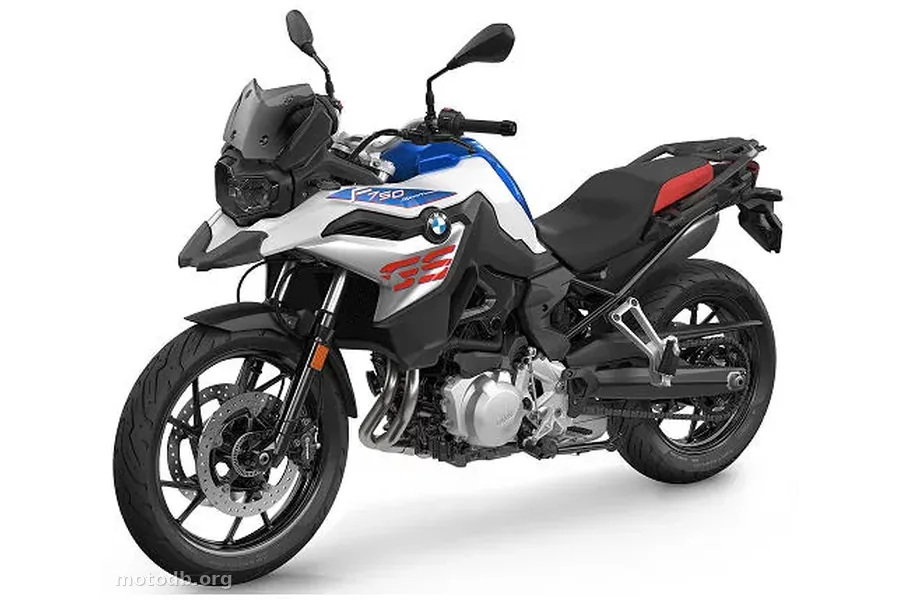
The time has come for the F 750 GS to gain some technology. Its engine is being updated for Euro 5; it’s as good an opportunity as any to enrich the equipment and to rally further. ABS now comes in Pro mode, traction control DTC replaces ASC, indicator lights are all LEDs, and a USB socket is located near the dashboard. As for options, the ‘Dynamic’ riding mode is more responsive, engine braking control is added to the Pro riding modes, a low seat facilitates easier access, and pre-selection buttons for the riding modes can be mounted on the handlebar (with the TFT screen only).
When you’re part of the GS family, you know you’re going to have to compose in the shadow of the great superstar sister, the unbeatable R 1200 GS. And when, in addition to that, you’re saddled with a twin sister F 800 GS that does everything the same, but better, you’d better not rest on your laurels.
That’s the story of the F 700 GS, which, despite a difficult positioning, perseveres and becomes the F 750 GS in 2018. (Alongside it, the F 800 GS also accelerates and is renamed F 850 GS). And although they have both struggled to establish themselves on the market, the little Germans are right to hold firm because the extension of the A2 license to all new motorcyclists could well finally reward them: They are indeed eligible for the A2 category.
The entry-level trail from BMW has therefore undergone a serious overhaul in 2018, starting with an increase in displacement of 55cm3 to now measure 853cm3. Yes, it’s indeed an 850. Despite a less flattering commercial name, the little GS carries the same engine as its sister, as was already the case with the F700 and F800. Visually almost identical, it is on the power and torque values that the two will distinguish themselves. And on their general abilities. One being more suited to off-road than the other. The other is therefore her: The F 750 GS.
The first change for the F 750 GS comes with the design. More harmonious (more ‘masculine,’ to use BMW’s idea), the mid-size trail has a less divisive face than when it arrived in 2012. The fairing flanks gain sharp angles and no longer have that monolithic look of the 700. They are also more enveloping towards the bottom. The line of the motorcycle also changes on the side of the tank, which takes up a more classic position. Previously, it was located at the rear of the motorcycle with its characteristic fuel filler cap positioned on the rear fairing. Abandoning this peculiarity in a desire for better mass centralization, the F750GS will carry its hump in a more conventional position. Although 1 liter of fuel has evaporated during the migration (15 liters), there is no need to worry, as range should still be around 300km for a Lilliputian consumption of 4.1L/100km. This new ‘true’ tank contrasts with the fluidity of the previous line, which linked the seat and tank in the same gentle curve. This seat, which rose high at the thigh on the F700GS, is now cheerfully trimmed, while the tank almost rises vertically from the engine. While the visual rendering is certainly more striking, we question the loss of comfort between the two generations. In return, the seat is lowered by 5 mm for greater accessibility. Whatever the case, this reversal, in addition to improving the center of gravity, allows the rear to be lightened, which in return carries a very useful standard luggage rack. And since it’s time for the big move, the engineers also decided to reverse the position of the exhaust and chain. The pot turns to the right and the secondary transmission moves to the left. A pot to the right of the machine avoids burning yourself when maneuvering it on the left side; the side you use the most.
Revitalized by its new look, the F 750 GS can finally show off its new heart. Faithful to the parallel twin that has powered it since 2012, the machine gains power. Calibrated at 270° versus 360° previously, the new two-cylinder is based on the previous 798cm, the bore and stroke of which have been increased to 84 x 77mm. Although slightly more powerful and more torquey at usual revs, it should be more lively. Thus, we must now count on 77 hp at 7500 rpm and 8.4 Nm of torque at 6000 rpm to move the F750GS, which is 2 hp and 0.5 Nm more than the F700. The calibration of the engine at 270° (which is also found on the MT-07) should also transform the vocalizations of the machine for a more powerful and valorizing rendering. And as the engineers have taken criticism into account, they have also smoothed out the engine’s unwanted vibrations thanks to the two central balance shafts. Big rollers will appreciate.
In addition to this new engine, the little FGS abandons its tubular trellis frame for a more rigid double steel beam. The swingarm is also redesigned for more rigidity. On the suspension side, the new non-inverted telescopic fork recalls that the F750GS is now even more oriented towards urban trails. The travel, previously 170 mm, is reduced to 151 mm! The F 750 GS clearly leaves its off-road desires to the F 850 GS. Rear damping remains entrusted to the central spring/damper combination.
The F 750 GS is loaded up with electronics, as standard and (especially) as options. Let’s start with the original equipment, which includes two riding modes (Rain and Road), traction control, Pro ABS, the Dynamic brake light since 2019, and a revamped dashboard.
But BMW obliges, you will need to go through different accessory packs to fully enjoy your machine. It will already be possible to swap this classic cockpit for a high-tech 6.5-inch color TFT screen, which is much more modern and allows you to manage music, the phone and the machine’s vital parameters.
But other treats may soon tempt you. It will be possible to equip the F 750 GS with the Dynamic ESA electronic adjustable suspension, a quickshifter, the Pro riding modes that integrate ‘Dynamic and Enduro (Enduro Pro being reserved for the F850GS), the dynamic tail light, the emergency call system, a full LED headlight with daytime running lights, the Keyless Ride keyless start system, tire pressure monitoring and the 6.5-inch color TFT dashboard.
With this evolution, the new BMW F750GS significantly raises its level compared to the previous generation; and only the 12 extra kilos (224kg full) tarnish the picture. Terrain enthusiasts will naturally turn to the F 850 GS, which offers more appropriate peripherals (inverted fork, long travel, narrow front tire on 21-inch spoke rims). But for those who want to ride a GS without too much impact on either their crampons or their wallet, the F 750 GS still has serious advantages.
M.B - Photo constructeur.
Standard equipment
- Assistance au freinage : ABS
Practical info
- Véhicule accessible au permis A2 ou bridable à 47.5ch / 35 Kw
- La moto est accessible aux permis : A, A2
Reviews & comments
No reviews yet. Be the first to share your opinion!