Key performance
Technical specifications
Engine
- Displacement
- 449 cc
- Power
- 58.0 ch @ 9000 tr/min (42.7 kW)
- Torque
- 50.0 Nm @ 7000 tr/min
- Engine type
- Monocylindre, 4 temps
- Cooling
- liquide
- Compression ratio
- 12.5: 1
- Bore × stroke
- 95 x 63.4 mm
- Valves/cylinder
- 5
- Camshafts
- 2 ACT
Chassis
- Frame
- simple berceau en acier, boucle arrière démontable en alu
- Gearbox
- boîte à 5 rapports
- Final drive
- Chaîne
- Front suspension
- Fourche téléhydraulique inversée Öhlins Ø 46 mm, déb : 300 mm
- Rear suspension
- Mono-amortisseur Öhlins, déb : 315 mm
Brakes
- Front brakes
- Freinage 1 disque Ø 250 mm, étrier 2 pistons
- Rear brakes
- Freinage 1 disque Ø 245 mm, étrier simple piston
- Front tyre
- 90/90-21
- Rear tyre
- 130/90-18
Dimensions
- Seat height
- 997.00 mm
- Fuel capacity
- 10.00 L
- Dry weight
- 126.00 kg
- New price
- 12 195 €
Overview
Imagine a motorcycle pulling on both wheels like a wild horse pulling on its reins. This isn’t a new concept in engineers’ design studios, but in 2004, Yamaha, in partnership with Öhlins, dared to do it. They chose as their test subject a beast already formidable, the WR-F 450, to make it the first production motorcycle with all-wheel drive. The goal was clear: to tame the untamable, whether in quicksand or the treacherous roots of a woodland. An ambition that finds its absolute meaning in the hell of African rallies.
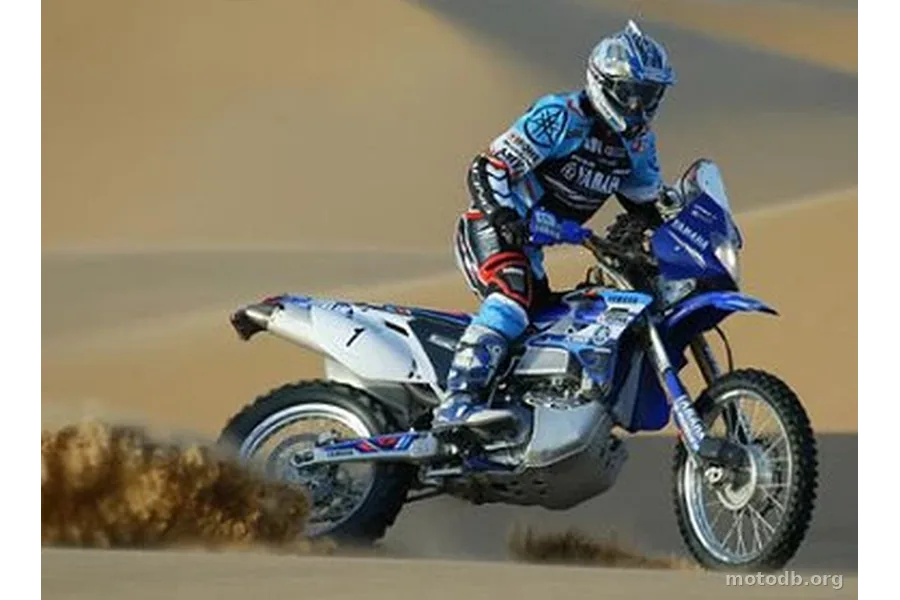
Externally, the transformation is subtle, almost furtive. A more robust front hub, two hoses, and a box near the output sprocket. That’s all. But beneath this apparent simplicity lies precision mechanics. The principle? An oil pump, operated by the gearbox, sends fluid under pressure to a small hydraulic motor housed in the front hub. Result: up to 30% of the power of the 58 horsepower single-cylinder engine can be transmitted to the front wheel. The trick is that the 2-TRAC system only intervenes when needed, when the rear wheel begins to lose traction. It then acts as an invisible guide.
On the handlebars, the difference with a standard WR-F is palpable. On slippery climbs or broken turns, the motorcycle pulls itself with a disconcerting authority. It seems to carry you, reducing the struggle for directional control. Controlled sliding becomes child's play, offering a feeling of unprecedented safety on this type of machine. Of course, not everything is perfect. When the front wheel pulls, you feel a slight stiffness added to the 46 mm Öhlins fork, as if the system added a mechanical constraint. But it’s a small price to pay for such an advancement in traction.
With its 126 kg dry weight and 10-liter tank, it’s not a relaxed trail bike. It’s a pure performance tool, designed for the demanding rider seeking absolute efficiency in technical off-road conditions. Its price, around 12,200 euros at the time, placed it in a very high-end niche. Facing competitors like a KTM EXC of the time, lighter and more agile, the Yamaha didn’t play in the same league. It offered a radically different philosophy: mastery through technology rather than aggression alone.
The WR-F 450 2-TRAC remains a mechanical museum piece, a bold experiment that proved the viability of all-wheel drive on a lightweight motorcycle. It did not revolutionize the market, but it opened a path that others are exploring today. It’s the motorcycle of the rider who wants to be right even when the terrain is wrong. A production prototype that, despite its age, continues to fascinate with its engineering and unique character.
Practical info
- La moto est accessible aux permis : A
Indicators & positioning
Similar bikes
TF 450-C
TF 450-RC
Desmo450 MX Factory
Reviews & comments
No reviews yet. Be the first to share your opinion!